On this page
India's food-grade standard for steviol glycosides measures nine compounds in one HPLC run but weighs out only two reference standards. The other seven are calculated with a correction factor, f, that the standard simply lists. You can rebuild every one of those factors with Class 12 biomolecules: count the sugars, subtract a water for each link, and divide. Along the way you meet glycosidic links, an ester of a sugar and a pair of isomers that the HPLC column tells apart.
What does IS 16527 say steviol glycosides are?
IS 16527:2018, Steviol Glycosides, Food Grade says they come from the leaves of Stevia rebaudiana. The leaves are extracted with hot water, and the extract is passed through an adsorption resin that traps the glycosides. The foreword describes them as "about 200 - 300 times sweeter than sucrose". It gives stevioside as C₃₈H₆₀O₁₈ (804.88) and rebaudioside A as C₄₄H₇₀O₂₃ (967.03).
The product must contain at least 95.0% of nine named glycosides in total: stevioside, rebaudiosides A, B, C, D and F, dulcoside A, rubusoside and steviolbioside. All share one core. In the standard's words, "Steviol (R1 = R2 = H) is the aglycone", the non-sugar part. Steviol is C₂₀H₃₀O₃, with a carboxylic acid (R1 position) and a tertiary OH at C-13 (R2 position).
Is the sugar joined as an ester or as a glycoside?
Both, and the standard's chemical name for stevioside shows it: "13-[(2-O-β-D-glucopyranosyl-β-D-glucopyranosyl)oxy]kaur-16-en-18-oic acid, β-D-glucopyranosyl ester".
Read it in two parts:
"13-[...oxy]": at C-13, a glucose is bonded through its anomeric carbon (C-1) to steviol's oxygen. That is a glycosidic link, the same kind that joins the two glucoses in maltose. A second glucose hangs on the first one's C-2, so the chain is glucose(β1→2)glucose.
"...oic acid, β-D-glucopyranosyl ester": the carboxylic acid has also been condensed with glucose's anomeric OH. The result is an ester, with a C=O next to the sugar oxygen.
In both cases the glucose uses its C-1 in the β form. If β and anomeric carbons are hazy, revise glucose's cyclic forms and anomers and how glycosidic links are read in sucrose, maltose, starch and cellulose.
Why care? Class 12 chemistry predicts the two links behave differently. An ester is hydrolysed by base (saponification). A glycosidic link is an acetal, stable to base but hydrolysed by acid. So the ester glucose should be the one that base removes. Treat that as a prediction from general chemistry: we have not checked it against a stevia-specific source.
Which sugars does each of the nine glycosides carry?
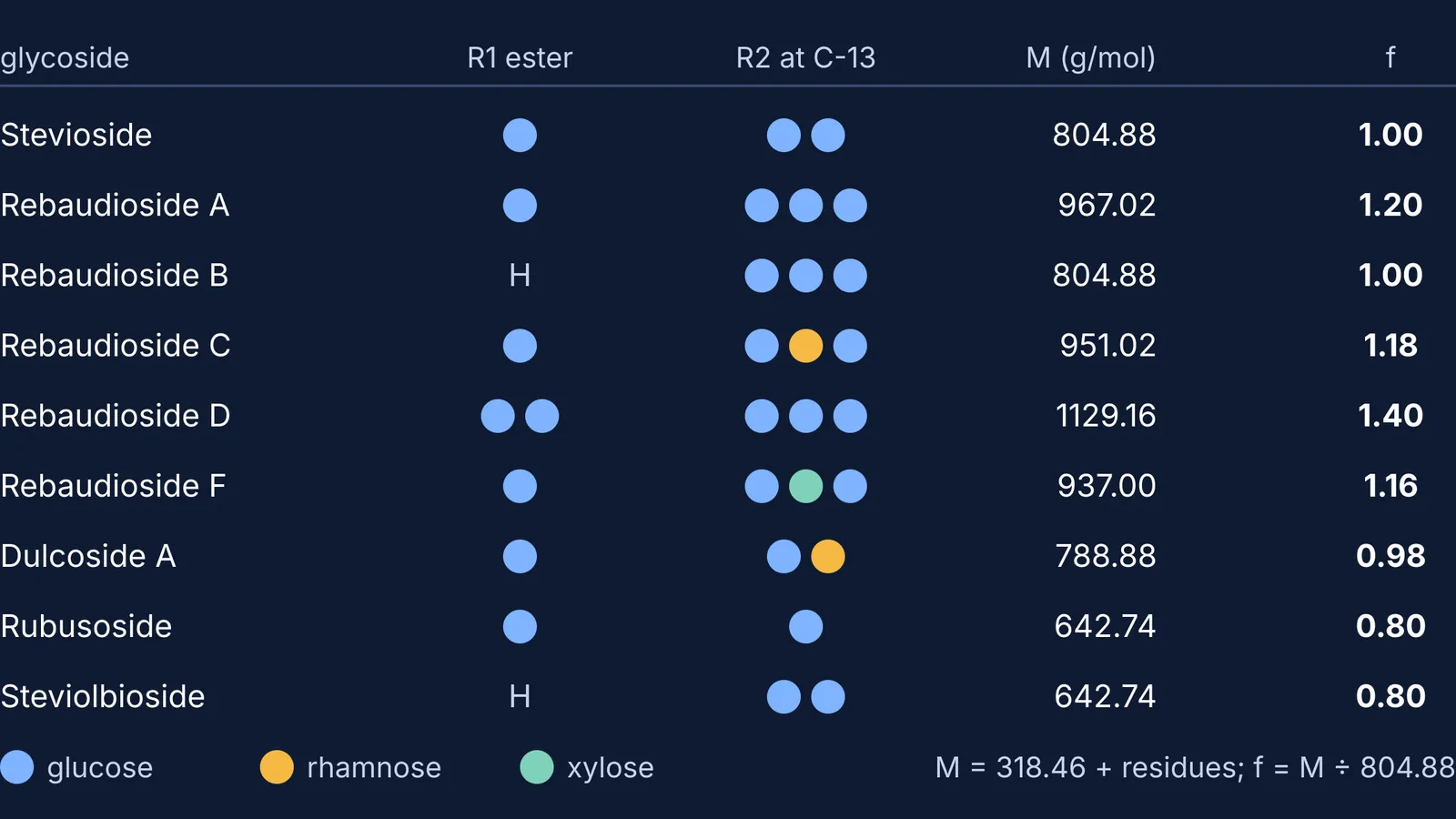
The standard's table of R1 and R2 groups names three sugars: "Glc, Rha and Xyl represent, respectively, glucose, rhamnose and xylose". Counting them:
Stevioside: R1 glucose; R2 two glucoses. Total 3 glucose.
Rebaudioside A: R1 glucose; R2 three glucoses (β1→2 and β1→3 on the first). Total 4 glucose.
Rebaudioside B: R1 is H, a free COOH; R2 as in Reb A. Total 3 glucose.
Rebaudioside C: R1 glucose; R2 two glucoses and one α-rhamnose. 3 glucose + 1 rhamnose.
Rebaudioside D: R1 two glucoses; R2 as in Reb A. Total 5 glucose.
Rebaudioside F: R1 glucose; R2 two glucoses and one xylose. 3 glucose + 1 xylose.
Dulcoside A: R1 glucose; R2 glucose and α-rhamnose. 2 glucose + 1 rhamnose.
Rubusoside: R1 glucose; R2 glucose. Total 2 glucose.
Steviolbioside: R1 is H; R2 two glucoses. Total 2 glucose.
How do you get each molar mass by counting sugars?
Every link, ester or glycosidic, is a condensation that releases one H₂O. So each sugar adds its own mass minus 18.02 g/mol. Using C = 12.011, H = 1.008 and O = 15.999:
Steviol, C₂₀H₃₀O₃: 318.46
Glucose, C₆H₁₂O₆: 180.16 − 18.02 = 162.14 per residue
Rhamnose, C₆H₁₂O₅: 164.16 − 18.02 = 146.14 per residue
Xylose, C₅H₁₀O₅: 150.13 − 18.02 = 132.12 per residue
Worked example: stevioside and Reb A.
Stevioside = 318.46 + 3 × 162.14 = 804.88. The formula is C₂₀H₃₀O₃ + 3 C₆H₁₂O₆ − 3 H₂O = C₃₈H₆₀O₁₈. Both match the standard.
Reb A = 318.46 + 4 × 162.14 = 967.02, formula C₄₄H₇₀O₂₃. The standard prints 967.03; the last digit depends on the atomic masses used.
f for Reb A = 967.02 ÷ 804.88 = 1.201, so 1.20.
The same sum for the others gives Reb C 951.02 (f = 1.18), Reb D 1129.16 (1.40), Reb F 937.00 (1.16), dulcoside A 788.88 (0.98), rubusoside and steviolbioside 642.74 each (0.80), and Reb B 804.88 (1.00). All nine of the standard's f values reproduce to two decimals.
Why does the HPLC method multiply peak area by f?
For each glycoside except Reb A, Annex A uses:
%X = (Ws ÷ W) × (fX × AX ÷ As) × 100
Here Ws is the mass of stevioside standard, W the mass of sample (both mg, dried basis), AX the sample's peak area for X and As the stevioside standard's peak area. Reb A is calculated the same way against its own weighed standard, with no f.
The detector is UV at 210 nm. The standard gives the factor but not the reason, so here is our reading. Sugars absorb very little at 210 nm, so the signal comes mainly from the steviol core, which every glycoside shares. Equal moles then give roughly equal areas, and the area ratio measures moles. To turn moles of X into mass, you multiply by the molar-mass ratio, which is exactly f.
Exercise. Stevioside standard 50.0 mg, sample 80.0 mg, standard peak area 1000, Reb C peak area 60.
Without f: 50.0 ÷ 80.0 × 60 ÷ 1000 × 100 = 3.75%.
With f = 1.18: 3.75 × 1.18 = 4.43%.
Leaving out f underestimates Reb C, because each mole of it weighs 18% more than a mole of stevioside.
To practise molar-mass and condensation sums step by step, try the Fermi Problem Library, whose solver explains the reasoning. For glycosidic links, anomers and esters as connected ideas, the Concept Library gives each concept its own lesson. Our post on saccharin, aspartame and sucralose covers three sweeteners with very different structures.
Where does this show up in JEE and NEET?
Class 12 Biomolecules: glycosidic linkage, α and β anomers, D-glucopyranose, condensation with loss of water.
Class 12 Aldehydes, Ketones and Carboxylic Acids: esters and their hydrolysis; acetals.
Class 11: molar mass from a formula, and isomers with the same formula.
Quick checklist
Can you split the BIS name of stevioside into its glycoside part and its ester part?
Can you write a glucose residue as 180.16 − 18.02 = 162.14?
Can you rebuild f for Reb D (1.40) and dulcoside A (0.98)?
Can you explain why a peak-area ratio needs a molar-mass factor?
Can you say why Reb B and stevioside are isomers, not one compound?