On this page
How are JEE Main numerical value questions marked?
NTA's Information Bulletin for JEE (Main) 2027 says each Paper 1 subject has a multiple-choice Section A and a numerical-value Section B. Mathematics has 5 Section B questions: +4 if correct, −1 if incorrect, 0 if unanswered. You type an integer on an on-screen keypad, rounded off to the nearest integer, so round only at the end.
All eight questions use methods from Unit 9, Differential Equations, of NTA's Syllabus for JEE (Main) 2027. For theory and a plan, read how to prepare differential equations for JEE Main in two weeks.
Easy: can you get these right first time?
Q1 (easy). The equation (1 + (dy/dx)²)^(3/2) = 5 d²y/dx² has order m and degree n. Find m + n.
Answer: 4. Squaring gives (1 + (dy/dx)²)³ = 25(d²y/dx²)², a polynomial in the derivatives. The highest derivative is the second, so m = 2, and its power is 2, so n = 2.
Slip: 5, from taking the exponent 3 on the first-derivative bracket as the degree.
Q2 (easy). dy/dx = (1 + y²)/(1 + x²) and y(0) = 1. Find y(1/2).
Answer: 3. Separate: tan⁻¹y = tan⁻¹x + C, and y(0) = 1 gives C = π/4. So y = (1 + x)/(1 − x) and y(1/2) = 1.5/0.5 = 3.
Slip: 9, from writing C = 1 instead of tan⁻¹1 = π/4.
Q3 (easy). dy/dx + y/x = 3x for x > 0, and y(1) = 3. Find y(2).
Answer: 5. The integrating factor is x, so (xy)′ = 3x², xy = x³ + C and C = 2. So y(2) = (8 + 2)/2 = 5.
Slip: 4, from multiplying only the left side by x, which gives 3.75.
Medium: where do the steps pile up?
Q4 (medium). dy/dx = y/x + x/y for x > 0, and y(1) = 2. Find y(e)²/e².
Answer: 6. Put y = vx: x dv/dx = 1/v, so v dv = dx/x and v²/2 = ln x + C. At x = 1, v = 2, so C = 2 and v² = 2 ln x + 4. At x = e, y²/x² = v² = 6.
Slip: 5, from writing v² instead of v²/2 after integrating.
Q5 (medium). dy/dx + y tan x = sec x, with y(0) = 1. Find 10 y(π/4).
Answer: 14. The integrating factor is e^(∫tan x dx) = sec x, so (y sec x)′ = sec²x and y sec x = tan x + C. y(0) = 1 gives C = 1, so y = sin x + cos x and 10 y(π/4) = 10√2 ≈ 14.14, which rounds to 14.
Slip: 25, from taking cos x as the integrating factor.
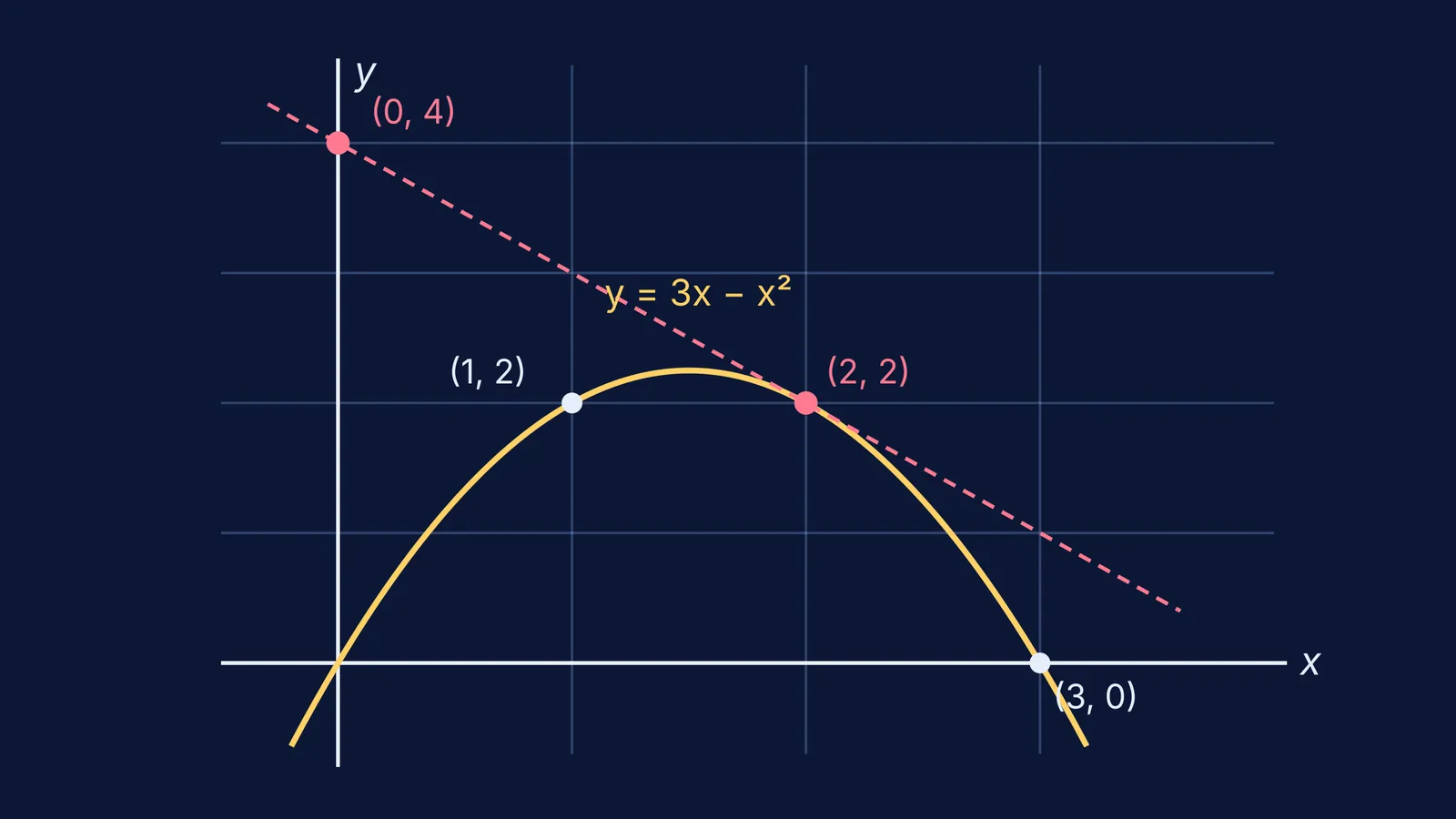
Q6 (medium). A curve in x > 0 passes through (1, 2), and its tangent at every point (x, y) cuts the y-axis at height x². It meets the positive x-axis at (a, 0). Find a.
Answer: 3. The tangent cuts the y-axis at y − xy′, so y − xy′ = x², or y′ − y/x = −x. With integrating factor 1/x, (y/x)′ = −1, so y/x = −x + C, and C = 3. So y = 3x − x², which is zero at x = 3.
Check: at (2, 2) the tangent is y = 4 − x, which cuts the y-axis at 4 = 2². Slip: 2, from using x as the integrating factor, giving a = ∛7 ≈ 1.91.
Hard: can you spot the trick?
Q7 (hard). dy/dx = (x + y)², with y(0) = 0. Find 100 y(π/4).
Answer: 21. Put v = x + y, so dv/dx = 1 + v², tan⁻¹v = x + C and C = 0. So y = tan x − x, and 100(1 − π/4) ≈ 21.46 rounds to 21.
Check: y′ = sec²x − 1 = tan²x = (x + y)². Slip: 100, from forgetting to subtract x.
Q8 (hard). f is differentiable, f(0) = 1 and f′(x) = f(x) + ∫₀¹ f(t) dt for all x. Find ∫₀¹ f(t) dt.
Answer: 6. The integral is a constant k, so f′ − f = k and f(x) = (1 + k)eˣ − k. Integrating from 0 to 1, k = (1 + k)(e − 1) − k, so k = (e − 1)/(3 − e) ≈ 6.10, giving 6.
Slip: 2, from solving f′ = f alone, which gives k = e − 1 ≈ 1.72.
How do you avoid wrong numbers in differential equations?
Name the type first: separable, homogeneous, linear or a substitution.
Add the constant as you integrate, then use the initial condition.
Substitute your answer back into the equation.
Keep √2, e and π exact, then round once.
A wrong entry costs a mark: read when to guess with negative marking.
For multiple-choice practice, try our differential equations JEE Main practice questions with solutions.
Answer won't match? The Fermi Problem Library has a step-by-step solver that explains the reasoning. For the rest of your JEE preparation, start at Fermi Test Prep.