On this page
In differential equations, marks often go to a dropped sign or a forgotten constant, not a missing method. These eight original JEE Main-style questions get harder as you go; try each before reading its solution.
What does the JEE Main syllabus include for differential equations?
Unit 9 of the official JEE Main 2027 syllabus published by NTA lists order and degree, separation of variables, homogeneous equations, and linear equations of the type dy/dx + p(x)y = q(x). For the method behind each, see our guide to preparing differential equations for JEE Main in two weeks.
How do you find the order and degree of a differential equation?
Question 1
Find the order and degree of [1 + (dy/dx)²]^(3/2) = 5 d²y/dx². (A) 2, 1 (B) 2, 2 (C) 2, 3/2 (D) 1, 3
Solution: square both sides: (1 + y′²)³ = 25(y″)². The highest derivative, y″, now appears squared: order 2, degree 2. Answer: (B).
Trap: (A) reads the degree before clearing the 3/2 power. Check: a degree is a positive integer, which rules out (C).
Question 2
For which equation is the degree not defined? (A) y‴ + (y′)² = x (B) y″ = y′ sin x (C) y″ + e^(y′) = 0 (D) (y″)² = xy′
Solution: e^(y′) is not a polynomial in y′. Answer: (C).
Trap: (B), but sin x is only a function of x; its degree is 1. Check: is every derivative inside a polynomial?
How do you solve separable and homogeneous differential equations?
Question 3
If dy/dx = e^(x+y) and y(0) = 0, find y(ln(3/2)). (A) ln 2 (B) −ln(3/2) (C) ln(3/2) (D) ln 3
Solution: e^(−y) dy = e^x dx, so −e^(−y) = e^x + C, and y(0) = 0 gives e^(−y) = 2 − e^x. At x = ln(3/2), e^(−y) = 1/2, so y = ln 2. Answer: (A).
Trap: (B) integrates e^(−y) as e^(−y), giving y = −x. Check: y = −ln(2 − e^x) gives y′ = e^x/(2 − e^x) = e^x · e^y.
Question 4 (numerical value)
A culture grows at a rate proportional to its size and doubles in 3 hours. After how many hours is it eight times as large?
Solution: dN/dt = kN gives N = N₀e^(kt). Since e^(3k) = 2 and 8 = 2³, t = 3 × 3 = 9. Answer: 9.
Trap: 24, from 3 × 8; a factor of 8 is three doublings, not eight. Check: it doubles at 3, 6 and 9 hours.
Question 5
The curve through (1, 0) satisfying 2xy dy/dx = x² + y² has y² at x = 2 equal to (A) 2 (B) −4 (C) 6 (D) 4
Solution: put y = vx: x dv/dx = (1 − v²)/(2v), so 2v dv/(1 − v²) = dx/x and −ln|1 − v²| = ln|x| + c. So x² − y² = Cx. At (1, 0), C = 1, so y² = x² − x = 2. Answer: (A).
Trap: dropping the minus sign gives x² − y² = Cx³ and y² = −4, impossible for a square. Check: y² = x² − x gives 2xyy′ = 2x² − x = x² + y².
How do you solve a linear differential equation in JEE Main?
Write it as dy/dx + p(x)y = q(x), multiply by the integrating factor e^(∫p dx), and integrate. Shaky on derivatives? Revise limits, continuity and differentiability for JEE Main first.
Question 6
If dy/dx + y tan x = sec x and y(0) = 1, then y(π/4) is (A) √2 (B) √2(1 + π/4) (C) 1 (D) 2√2
Solution: the integrating factor is sec x, so (y sec x)′ = sec²x and y = sin x + C cos x. y(0) = 1 gives C = 1, so y(π/4) = √2. Answer: (A).
Trap: (B) uses cos x as the integrating factor, a sign slip in ∫tan x dx = ln|sec x|. Check: for y = sin x + cos x, y′ + y tan x = cos x + sin²x/cos x = sec x.
Question 7
The curve y dx − (x + 2y²) dy = 0 passes through (1, 1). Find x when y = 2. (A) 6 (B) 17/6 (C) 4 (D) 10
Solution: it is linear in x, not y: dx/dy − x/y = 2y. With integrating factor 1/y, (x/y)′ = 2 and x = 2y² + Cy. At (1, 1), C = −1, so x = 2y² − y = 6. Answer: (A).
Trap: (B) uses y instead of 1/y as the integrating factor. Check: dx/dy = 4y − 1, and x/y + 2y = 4y − 1.
Question 8 (numerical value)
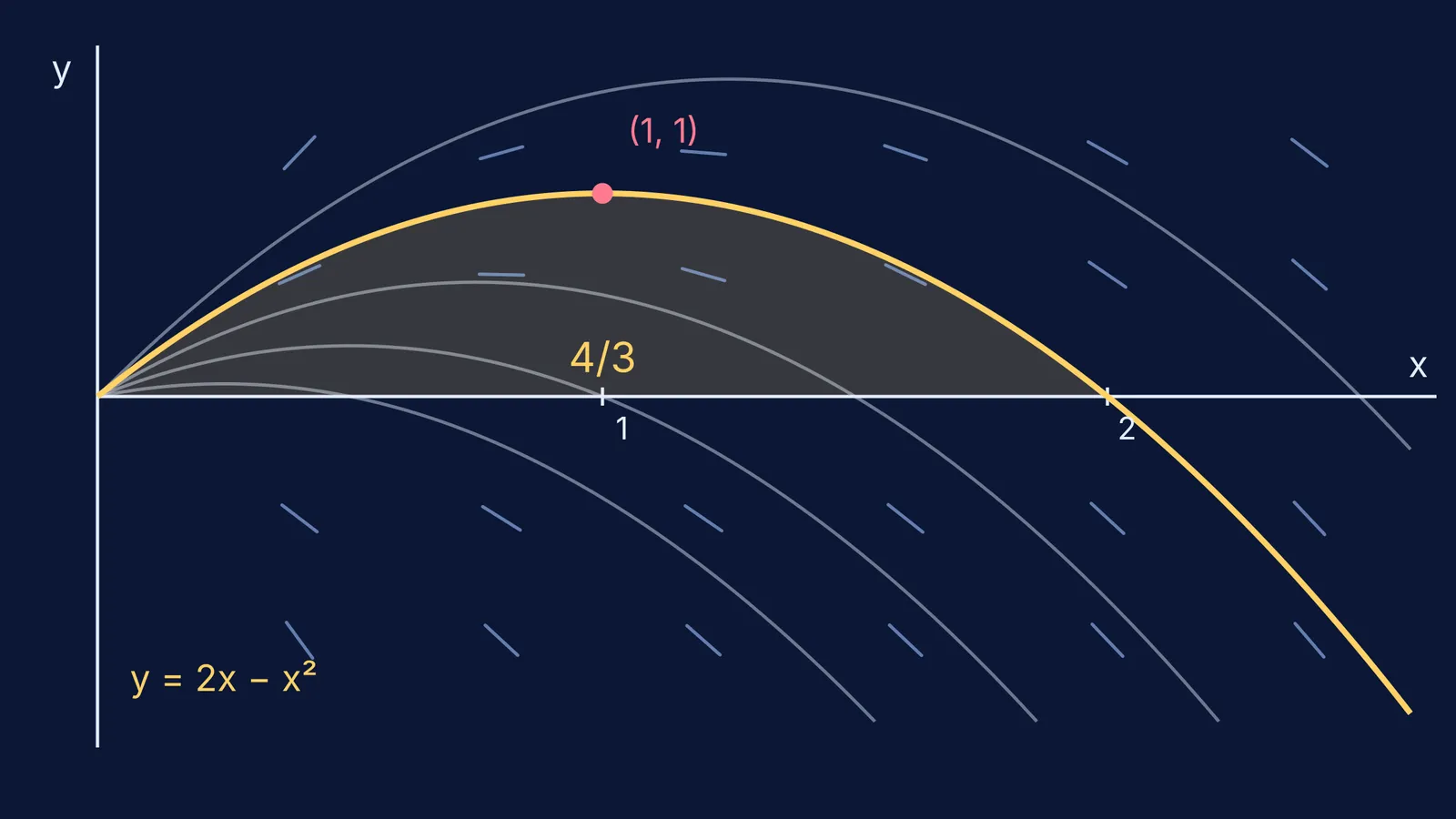
The tangent at any point P(x, y), x > 0, of a curve meets the y-axis at height x². The curve passes through (1, 1). If A is the area between the curve and the x-axis, find 3A.
Solution: the tangent's y-intercept is y − xy′, so y′ − y/x = −x. With integrating factor 1/x, (y/x)′ = −1 and y = Cx − x². Through (1, 1), y = 2x − x², which meets the x-axis at 0 and 2. A = ∫₀² (2x − x²) dx = 4/3. Answer: 4.
Trap: taking the intercept as y + xy′ gives a curve that never meets the x-axis, so no area exists. Check: at (1, 1) the tangent is y = 1, meeting the y-axis at 1 = 1².
How should you use this set in revision?
Attempt all eight cold, timed, without notes.
Label each miss: wrong method, algebra slip, or wrong setup.
For a wrong method, relearn that type and redo the question next day.
Keep a list of your own slips (∫tan x, the sign in Question 5) and read it before each mock.
A week later, change the initial conditions and solve again.
If one step keeps going wrong, the Fermi Problem Library has worked problems with a step-by-step solver that explains the reasoning rather than printing an answer. For wider preparation, see Fermi Test Prep for JEE Main and Advanced.