On this page
Burn charcoal and you get CO₂ with some CO. Which forms first? In 1899 most textbooks said carbon burns straight to CO₂, and CO appears only when hot carbon reduces that CO₂. Harold Baily Dixon, at the Owens College in Manchester, tested the experiments behind that claim. His key trick was to dilute the oxygen with CO₂ so the coke could not heat up. CO still came out.
The paper is H. B. Dixon, "On the Mode of Burning of Carbon", J. Chem. Soc. Trans. 75 (1899) 630–640 (DOI 10.1039/CT8997500630; scan on the Internet Archive). Numbers and quotes are from that scan, checked against the page images. In 1899 "carbonic acid" or "carbonic anhydride" meant CO₂, and "carbonic oxide" meant CO. We use the modern formulas.
What did chemists believe in 1899 about how carbon burns?
The usual evidence was a diamond burning to CO₂ without flame, and the blue CO flame on a red-hot coke fire. Dixon quotes Mendeleev's Principles of Chemistry (English edition, 1891): "the first product of combustion of charcoal is always carbonic anhydride, and not carbonic oxide." That statement rested mainly on experiments by Julius Lang (Zeitschrift für physikalische Chemie, 1888). The same year, Brereton Baker concluded that CO is probably formed first. Dixon's comment: "When two investigators of admitted skill draw opposite conclusions from their experiments, it may be assumed that all the facts are not before us."
What was Lang's argument, and what did Dixon find?
Lang passed oxygen over purified gas-carbon at 500 °C. A fast stream gave some CO, which fell to zero as the stream slowed. His explanation: a fast stream heats patches of carbon, which reduce CO₂ to CO; a slow stream lets the carbon lose that heat.
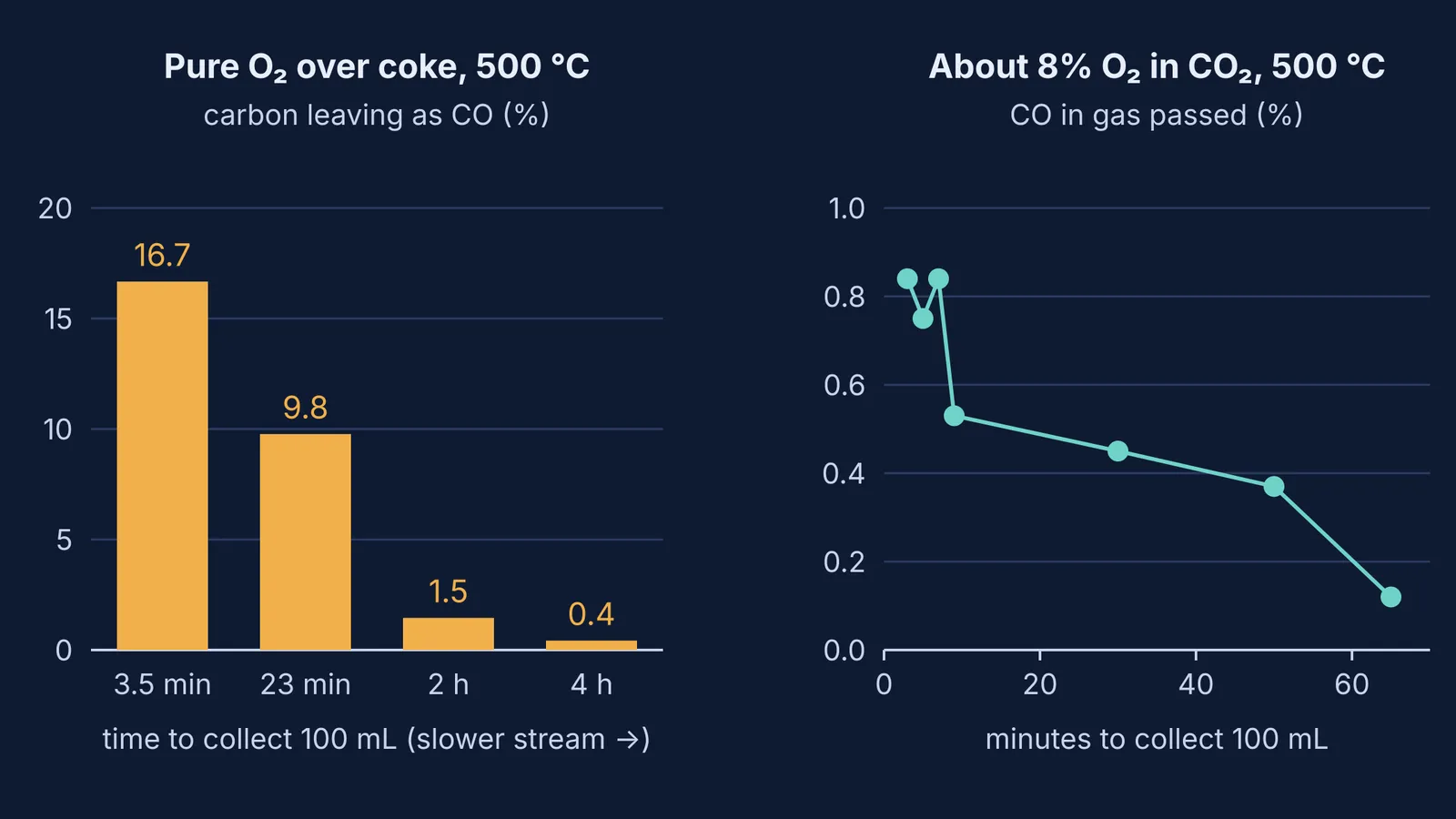
Dixon repeated this "some dozens" of times over coke at 500 °C, which he set using the melting point of lead chloride. The CO fell as the stream slowed but, in his words, "never entirely disappears." His Table I used oxygen containing 2.5% nitrogen.
Worked example: how much of the carbon left as CO?
Each burned carbon atom leaves as one CO₂ or one CO molecule, so the share of carbon leaving as CO is CO ÷ (CO + CO₂).
100 mL collected in 3.5 minutes: 80.83% CO₂, 16.17% CO. Share = 16.17 ÷ 97.00 = 16.7%.
23 minutes: 87.52% CO₂, 9.48% CO. Share = 9.8%.
2 hours: 96.38% CO₂, 1.42% CO. Share = 1.5%.
4 hours: 96.52% CO₂, 0.41% CO. Share = 0.4%.
The slowest stream is 240 ÷ 3.5 ≈ 69 times slower than the fastest, yet CO is still there.
The trend matches Lang's; the end point does not. And Dixon notes that even a slow stream must heat the front 2 cm of coke, where most of the reaction happens, so this alone cannot decide the question.
How did diluting the oxygen with CO₂ test the idea?
Dixon needed CO to appear where CO₂ could not be reduced. He diluted the oxygen with CO₂, chosen "on account of its high specific heat" and because potash absorbs it, leaving a small residue to analyse. He calculated that less than 7% oxygen should cool the carbon. In practice, a mixture with 8.5% oxygen "was found to have a slight cooling effect" on an air thermometer buried in the coke.
His Table II used about 8% O₂, 90% CO₂ and 2% N₂. CO was found in every run. It fell from 0.84% of the gas passed (100 mL in 3 minutes) to 0.12% (65 minutes). One CO carries half an O₂, so in the fastest run 0.84 ÷ 2 ÷ 7.7 ≈ 5.5% of the oxygen ended up in CO. In the slowest run it was about 0.7%.
His gas analysis is a classic absorption chain:
Potash (KOH solution) absorbs CO₂.
Phosphorus, or alkaline pyrogallol, absorbs O₂.
Cuprous chloride solution absorbs CO.
His conclusion: if Lang's own argument is accepted, "it is difficult to account for the carbonic oxide found except as the result of the direct union of the oxygen and carbon."
Why can't Hess's law tell you which forms first?
Use modern standard enthalpies of formation (textbook data, not from the paper): CO −110.5 kJ/mol, CO₂ −393.5 kJ/mol.
C + ½O₂ → CO, ΔH = −110.5 kJ.
CO + ½O₂ → CO₂, ΔH = −393.5 − (−110.5) = −283.0 kJ.
Add them: C + O₂ → CO₂, ΔH = −110.5 + (−283.0) = −393.5 kJ.
That is Hess's law, explained in building Hess's law cycles that work. The total heat is the same whichever route the carbon takes, so no heat measurement can reveal the route. It needed a rate experiment.
The heat does explain why hot spots mattered. Per mole of O₂, burning to CO₂ releases 393.5 kJ, while 2C + O₂ → 2CO releases only 221.0 kJ. The reaction that would hide the evidence, CO₂ + C → 2CO, has ΔH = 2(−110.5) − (−393.5) = +172.5 kJ. It is endothermic and needs hot carbon. Dixon's CO₂ diluent took that heat away. The same reaction is the blast-furnace equilibrium worked out in CO and CO₂ over hot coke.
How does this connect to the Ellingham diagram?
The Ellingham diagram plots ΔG° against T per mole of O₂. With approximate 298 K entropies:
C + O₂ → CO₂: ΔS° ≈ +2.9 J K⁻¹, so the line is almost flat.
2C + O₂ → 2CO: ΔS° ≈ +178.8 J K⁻¹, so ΔG° falls steeply as T rises.
The lines cross where 172.5 kJ = T × 0.1759 kJ K⁻¹, at T ≈ 981 K (about 710 °C). This is an estimate from 298 K data.
Dixon worked at 500 °C (773 K), below that crossing, where CO₂ is the more stable product. CO found there reflects rates, not equilibrium, which is why it says something about the path. The story of the diagram itself is in how Harold Ellingham created the Ellingham diagram.
Did Dixon prove that carbon burns to CO first?
No, and he said so. He repeated Lang's other experiments, oxygen plus CO over coke, more than 100 times and got results "entirely at variance" with Lang's. He cited Brereton Baker: carefully dried carbon and oxygen barely glow, and CO is the main product. Dixon found that purified charcoal does not reduce well-dried CO₂ at about 630 °C, and Baker wrote to him that dried CO₂ over charcoal at bright redness gave no CO.
His last line is a model of careful reporting: "whilst the arguments adduced on the other side have been shown to be invalid, it must be admitted that a decisive proof is still required." He gave evidence for CO first, not proof.
To see how enthalpy, entropy and ΔG° connect, the Concept Library covers thermodynamics one concept at a time.
Quick checklist
Dixon, oxygen over coke at 500 °C: carbon leaving as CO fell from 16.7% to 0.4%, never zero.
Oxygen diluted to about 8% in CO₂ cooled the coke, and CO still formed.
Hess's law: both routes give −393.5 kJ, so heat cannot reveal the path. CO₂ + C → 2CO is +172.5 kJ.
Ellingham: the 2CO line crosses the CO₂ line near 980 K.
Dixon's verdict: evidence for CO first, but "a decisive proof is still required."