

On this page
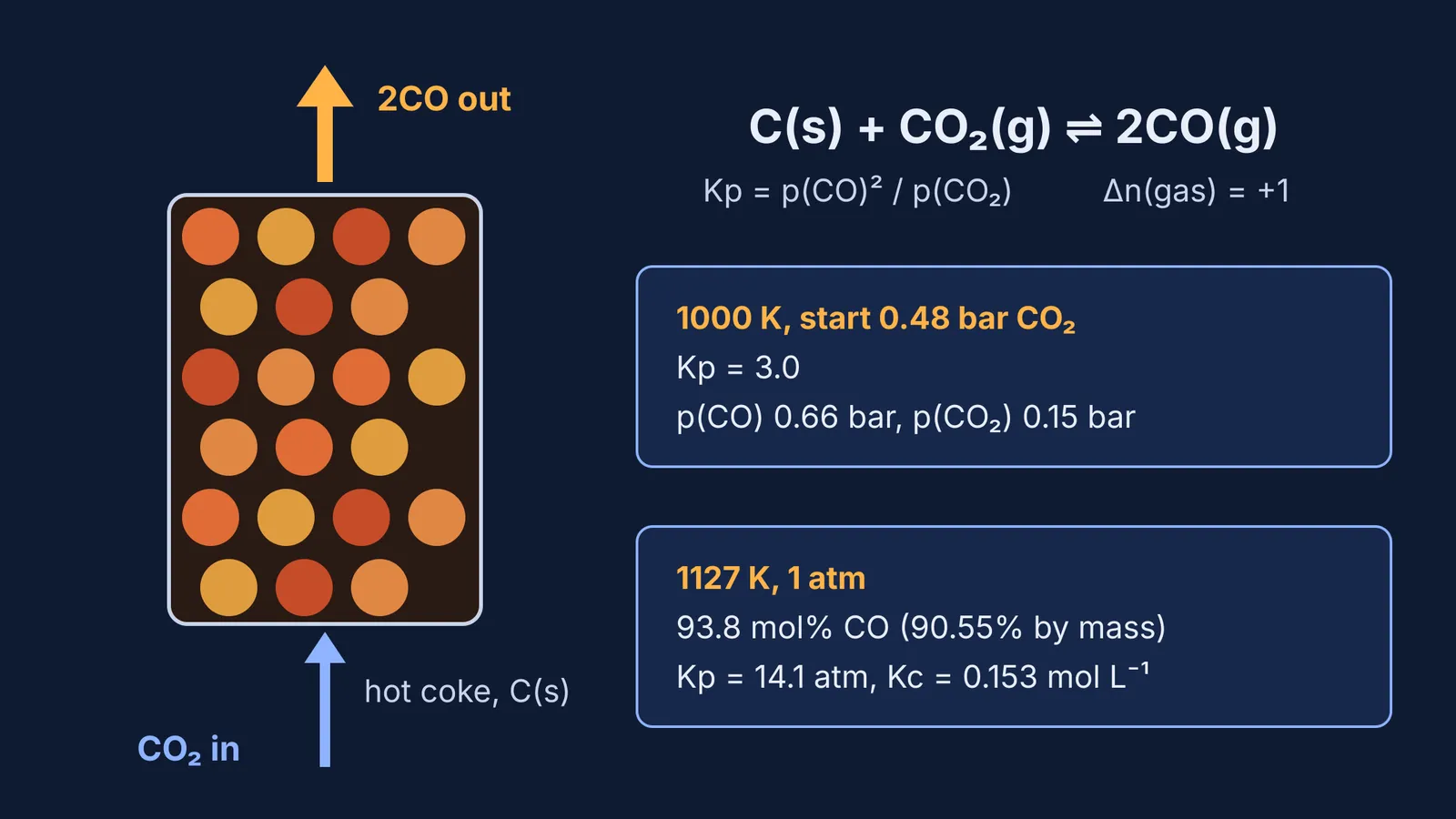
Blow carbon dioxide over red-hot coke and most of it comes out as carbon monoxide. The reaction is C(s) + CO₂(g) ⇌ 2CO(g), and it is an equilibrium, not a one-way change. NCERT's Equilibrium chapter uses it in a worked problem and again in an exercise. Both are good practice, because they combine three things students often slip on: a solid that drops out of K, a Δn that is not zero, and a gas composition given by mass. The same equilibrium also explains why a blast furnace runs on CO rather than CO₂.
How do you write Kp and Kc for C(s) + CO₂(g) ⇌ 2CO(g)?
Carbon is a pure solid, so it does not appear in the expression. That rule, and why it works, is explained in heterogeneous equilibria: why solids and pure liquids drop out of K. What is left is:
Kp = p(CO)² / p(CO₂)
Kc = [CO]² / [CO₂]
Count gas moles only: Δn = 2 − 1 = +1. So Kp = Kc(RT)¹, which means Kc = Kp / RT. The general derivation is in the relation between Kp and Kc.
Two units rules keep the answer right. If Kp is in bar, use R = 0.0831 L bar K⁻¹ mol⁻¹. If Kp is in atm, use R = 0.0821 L atm K⁻¹ mol⁻¹. Do not mix them.
Worked example 1: what are the equilibrium pressures at 1000 K?
This is NCERT's worked problem. CO₂ at 0.48 bar is put in a container with excess hot graphite at 1000 K. Kp = 3.0. Find the partial pressures at equilibrium.
Step 1: set up the change. Let x bar of CO₂ react. Each CO₂ gives two CO.
p(CO₂) = 0.48 − x
p(CO) = 2x
Step 2: write Kp. (2x)² / (0.48 − x) = 3.0
Step 3: make it a quadratic. 4x² = 1.44 − 3.0x, so 4x² + 3.0x − 1.44 = 0.
Step 4: solve. x = [−3.0 + √(9.0 + 23.04)] / 8 = (−3.0 + 5.66) / 8 = 0.33 bar. The other root is negative and has no meaning.
Step 5: the answer.
p(CO) = 2 × 0.33 = 0.66 bar
p(CO₂) = 0.48 − 0.33 = 0.15 bar
Step 6: check. 0.66² / 0.15 = 2.9, which is 3.0 within rounding. About 69% of the CO₂ has reacted, and the total pressure has risen from 0.48 to 0.81 bar because one gas molecule became two.
If a question also asks for Kc, use bar units: Kc = 3.0 / (0.0831 × 1000) = 0.036 mol L⁻¹.
Worked example 2: how do you find Kp from a percentage by mass?
This is the NCERT exercise. At 1127 K and 1 atm total pressure, the gas in equilibrium with solid carbon is 90.55% CO by mass. Find Kc.
Step 1: change mass to moles. Take 100 g of gas. It contains 90.55 g CO and 9.45 g CO₂.
n(CO) = 90.55 / 28 = 3.234 mol
n(CO₂) = 9.45 / 44 = 0.2148 mol
Step 2: mole fractions. Total = 3.449 mol.
x(CO) = 3.234 / 3.449 = 0.938
x(CO₂) = 0.2148 / 3.449 = 0.0623
Step 3: partial pressures. At 1 atm total, p = x × 1 atm, so p(CO) = 0.938 atm and p(CO₂) = 0.0623 atm.
Step 4: Kp. Kp = 0.938² / 0.0623 = 14.1 atm.
Step 5: Kc. Kp is in atm, so use R = 0.0821. Kc = 14.1 / (0.0821 × 1127) = 14.1 / 92.5 = 0.153 mol L⁻¹.
That matches NCERT's answer of about 0.153. Note that a gas which is 90.55% CO by mass is 93.8% CO by moles, because CO molecules are lighter than CO₂ molecules.
Why does K get larger as the temperature rises?
The forward reaction is strongly endothermic. From standard enthalpies of formation (CO −110.5, CO₂ −393.5 kJ mol⁻¹):
ΔH° = 2(−110.5) − (−393.5) = +172.5 kJ mol⁻¹
For an endothermic reaction, K increases with temperature. NCERT's two values show the trend: Kp is 3.0 bar at 1000 K and 14.1 atm (about 14.3 bar) at 1127 K. Treat these as textbook values; different data tables give somewhat different K at a given temperature.
The entropy change helps explain where the switch happens. One mole of gas becomes two, so ΔS° is large and positive. With standard entropies (C 5.7, CO 197.7, CO₂ 213.8 J K⁻¹ mol⁻¹), ΔS° = 2(197.7) − 213.8 − 5.7 = +175.9 J K⁻¹ mol⁻¹. Then ΔG° = ΔH° − TΔS° becomes zero near T = 172 500 / 175.9 ≈ 980 K, about 710 °C. This uses 298 K values for ΔH° and ΔS°, so it is an estimate. Below roughly that temperature CO₂ is favoured; above it, CO is favoured, and K keeps climbing.
The same crossover appears on an Ellingham diagram, where the line for 2C + O₂ → 2CO slopes downward and crosses the C + O₂ → CO₂ line near this temperature. See how to read an Ellingham diagram if you want the picture.
Pressure matters too. Since Δn = +1, lowering the total pressure shifts the equilibrium towards CO, and raising it shifts it towards CO₂. K itself does not change with pressure; only the composition does.
Why is CO, not CO₂, the reducing gas in a blast furnace?
Near the air inlets of a blast furnace, coke burns to CO₂. That CO₂ immediately rises through more coke at well over 1000 K, where this equilibrium lies far to the right. Example 2 shows that at 1127 K and 1 atm, the gas is about 94 mol% CO. So the gas moving up the furnace is mostly CO.
That CO reduces the iron oxides, for example FeO + CO → Fe + CO₂. Any CO₂ made in the hot zone meets more coke and is turned back into CO. The endothermic step also absorbs heat, which is one reason the temperature falls as the gas rises. The zone-by-zone reactions are listed in reactions in a blast furnace: iron extraction zone by zone.
If you want more Kp and Kc problems with solids and changing Δn, the Fermi Problem Library has a step-by-step solver that explains the reasoning at each stage.
What slips cost marks on this equilibrium?
Writing C(s) in Kp or Kc.
Taking Δn = 0 by counting carbon as a reactant.
Forgetting the 2 in p(CO) = 2x, or forgetting to square it.
Using mass percentages as if they were mole fractions.
Using R = 0.0831 with atm or 0.0821 with bar.
Saying higher pressure increases K. It changes the composition, not K.
Quick checklist
Kp = p(CO)² / p(CO₂); carbon drops out.
Δn = +1, so Kc = Kp / RT.
At 1000 K, Kp = 3.0, start 0.48 bar CO₂: p(CO) = 0.66 bar, p(CO₂) = 0.15 bar.
At 1127 K, 90.55% CO by mass is 93.8 mol% CO: Kp = 14.1 atm, Kc = 0.153 mol L⁻¹.
ΔH° ≈ +172.5 kJ mol⁻¹, so K rises with temperature; ΔG° changes sign near 980 K.
In a blast furnace, hot coke keeps converting CO₂ back to CO, the reducing gas.


