On this page
TBHQ (tert-butylhydroquinone) is an antioxidant added to edible oils and fats. The Indian Standard for it, IS 11913:2023, checks its purity with a redox titration that NCERT already prepares you for: the hydroquinone ring is oxidised to a quinone by ceric sulphate. The interesting part is the correction step. BIS subtracts two impurities using the factors 1.51 and 0.75. Those numbers are not arbitrary. They are ratios of molar masses, and once you see why, you can derive them yourself.
What does IS 11913 say about TBHQ?
The foreword describes TBHQ as a white crystalline solid with a characteristic odour, "used as an antioxidant in edible oils and fats and whole milk powder". It gives the synonyms tert-butylquinol and 2-tert-butyl-1,4-dihydroxybenzene, the formula C₁₀H₁₄O₂ and the molecular weight 166.22. The 2023 edition is the first revision of a 1986 standard that drew on the US Food Chemicals Codex.
Table 1 sets these limits:
Purity as C₁₀H₁₄O₂: at least 99%.
t-butyl-p-benzoquinone: at most 0.2%.
2,5-di-t-butylhydroquinone (DTBHQ): at most 0.2%.
Hydroquinone (HQ): at most 0.1%.
Arsenic 3 mg/kg, lead 2 mg/kg, toluene 25 mg/kg, and an ultraviolet test for polynuclear hydrocarbons.
The melting range is 126.5 to 128.5 °C. For identity, TBHQ in methanol gives a red to pink colour with dimethylamine.
How does the ceric sulphate titration work?
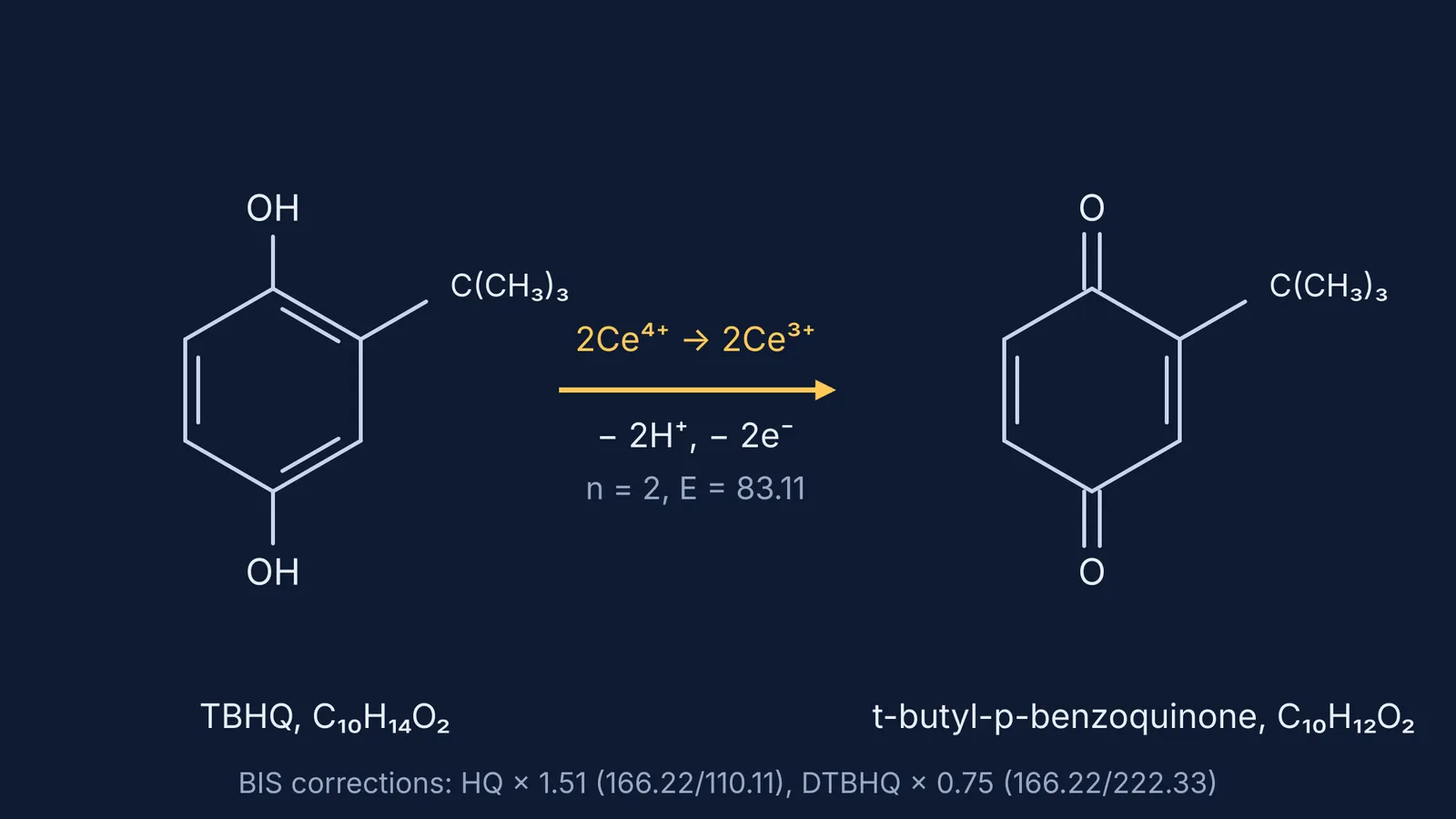
TBHQ is a hydroquinone: a benzene ring with OH groups at positions 1 and 4. Like hydroquinone itself, it is oxidised to a p-benzoquinone by losing two electrons and two protons. Ce⁴⁺ is the oxidant, and each Ce⁴⁺ takes one electron to become Ce³⁺.
C₁₀H₁₄O₂ + 2Ce⁴⁺ → C₁₀H₁₂O₂ + 2Ce³⁺ + 2H⁺
Check it. Carbon: 10 = 10. Hydrogen: 14 = 12 + 2. Oxygen: 2 = 2. Charge: +8 on the left; +6 + 2 = +8 on the right. The product, C₁₀H₁₂O₂ (166.22 − 2.02 = 164.20 g/mol), is t-butyl-p-benzoquinone, the same compound Table 1 limits as an impurity.
So the n-factor of TBHQ is 2, and its equivalent mass is 166.22 / 2 = 83.11. If n-factors are still shaky, revise n-factor and the equivalent concept in redox titrations.
The procedure (Annex A-1) dissolves about 170 mg in methanol, adds water and a little sulphuric acid, and titrates with 0.1 N ceric sulphate. The indicator is sodium p-diphenylaminesulphonate. It changes from yellow to red-violet when the first excess Ce⁴⁺ oxidises it. The same titrant is used for a pharmacopoeia assay in paracetamol assay by ceric sulphate. There, the amide is hydrolysed first. Here, the reducing ring is already there.
Where does BIS's 8.311 come from?
BIS writes purity as:
Purity (A), % = 8.311 × N × (V − 0.1) / M
Here V is the titre in mL, N is the normality and M is the sample mass in grams. Build it from the equivalent mass.
Milliequivalents of Ce⁴⁺ used = N × V.
Mass of TBHQ = N × V × 83.11 mg.
Convert to grams and a percentage: N × V × 83.11 / 1000 / M × 100 = 8.311 × N × V / M.
The 0.1 mL is subtracted because, as BIS's note says, it "represents the volume of ceric sulphate solution consumed by the primary oxidation products of tert-butylhydroquinone ordinarily present in the sample". BIS does not name those products. Note that the quinone in Table 1 cannot be what uses this Ce⁴⁺: it is already oxidised. That is why BIS measures it separately, by infrared absorbance at 1659 cm⁻¹ (the C=O region) in carbon tetrachloride.
Why are the impurity factors 1.51 and 0.75?
Hydroquinone and DTBHQ are also hydroquinones. Each loses two electrons to Ce⁴⁺ exactly as TBHQ does:
C₆H₆O₂ + 2Ce⁴⁺ → C₆H₄O₂ + 2Ce³⁺ + 2H⁺ (HQ, 110.11 g/mol)
C₁₄H₂₂O₂ + 2Ce⁴⁺ → C₁₄H₂₀O₂ + 2Ce³⁺ + 2H⁺ (DTBHQ, 222.33 g/mol)
The titration cannot tell them apart. It counts every one as TBHQ. So ask: 1 g of impurity uses the same Ce⁴⁺ as how many grams of TBHQ?
1 g HQ = 2/110.11 equivalents. The same equivalents of TBHQ weigh (2/110.11) × 83.11 = 166.22/110.11 = 1.510 g.
1 g DTBHQ: (2/222.33) × 83.11 = 166.22/222.33 = 0.748 g.
These are BIS's factors to two decimals: 1.51 and 0.75. Hydroquinone is lighter per electron, so 1% of it looks like 1.51% TBHQ. DTBHQ is heavier, so 1% looks like only 0.75%. BIS therefore writes:
Corrected purity = A − (% HQ × 1.51) − (% DTBHQ × 0.75)
The % HQ and % DTBHQ come from a separate gas chromatography test in the standard.
Worked example: corrected purity
You weigh 0.1702 g of TBHQ and titrate with 0.1000 N ceric sulphate. The titre is 20.55 mL. Chromatography gives 0.08% HQ and 0.15% DTBHQ.
Subtract the fixed 0.1 mL: 20.55 − 0.10 = 20.45 mL.
A = 8.311 × 0.1000 × 20.45 / 0.1702 = 99.86%.
HQ correction: 0.08 × 1.51 = 0.12.
DTBHQ correction: 0.15 × 0.75 = 0.11.
Corrected purity = 99.86 − 0.12 − 0.11 = 99.63%. The minimum is 99%, so it passes. Both impurities are also within their limits (0.1% and 0.2%).
Two checks are worth doing. For 170 mg of pure TBHQ, the expected titre is 170 / 83.11 / 0.1 = 20.45 mL, so this titre is reasonable. And the 0.1 mL blank is worth 8.311 × 0.1 × 0.1 / 0.170 ≈ 0.49% purity, which is enough to move a borderline sample across the 99% line.
Why are hydroquinone and 2,5-di-t-butylhydroquinone the impurities?
The standard does not describe how TBHQ is made. PubChem's manufacturing entry for TBHQ states that hydroquinone is tert-butylated with isobutylene or tert-butyl alcohol in the presence of a Friedel–Crafts catalyst. The electrophile is the tert-butyl cation, (CH₃)₃C⁺. Read the impurity list against that route:
Hydroquinone is starting material that did not react.
DTBHQ is a second alkylation. The two OH groups strongly activate the ring, and an alkyl group adds a little more activation, so TBHQ can react again. This is polyalkylation, one of the Friedel–Crafts limitations NCERT lists. For the others, see why Friedel–Crafts fails with nitrobenzene and aniline.
t-butyl-p-benzoquinone is TBHQ that has been oxidised, the same reaction as the titration.
Why 2,5 and not 2,3 or 2,6? In TBHQ the free positions are 3, 5 and 6. Each is ortho to one OH. Position 3 is squeezed between the bulky t-butyl group and an OH. Positions 5 and 6 are both open, but position 5 is also para to the t-butyl group, which is an ortho/para director. That reasoning is ours; the observed fact is BIS's name for the impurity, 2,5-di-t-butylhydroquinone.
Do not call the OH groups deactivating. They activate the ring. What keeps a third t-butyl group off is steric crowding, not deactivation.
For more redox titration sums worked step by step, with the reasoning shown, use the Fermi Problem Library.
Quick checklist
TBHQ → t-butyl-p-benzoquinone + 2H⁺ + 2e⁻, so n = 2 and E = 83.11.
8.311 = 83.11 with mL, mg and % folded in.
The 0.1 mL blank is BIS's fixed allowance for oxidation products; the quinone itself is measured by IR.
HQ and DTBHQ also take 2 e⁻, so they inflate the titre.
Correction factors: 166.22/110.11 = 1.51 and 166.22/222.33 = 0.75.
DTBHQ shows polyalkylation; the second t-butyl goes para to the first.