

On this page
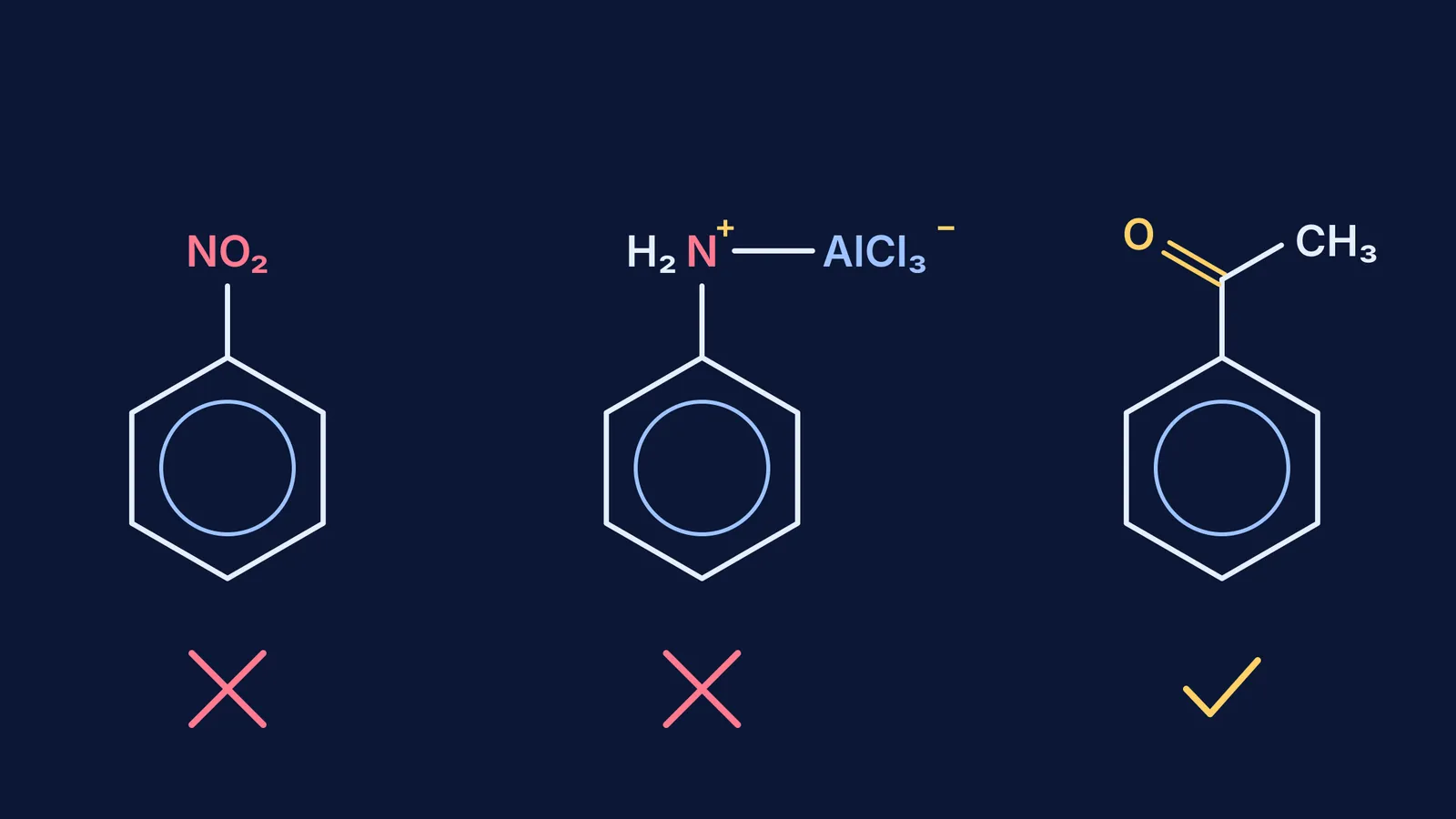
If you have lost marks for writing AlCl₃ over an arrow next to nitrobenzene or aniline, one idea explains both mistakes. Friedel-Crafts needs two things: a ring with enough electrons to attack the electrophile, and a catalyst that stays free to make that electrophile. Nitrobenzene fails the first test and aniline fails the second. If directing groups still feel shaky, start with our guide to electrophilic substitution in benzene and directing groups.
Why does Friedel-Crafts fail with nitrobenzene?
The nitro group pulls electron density out of the ring, so the ring is too poor a nucleophile to attack a carbocation or an acylium ion. Chemistry LibreTexts says it plainly: “Since the nitro group is a powerful deactivating substituent, Friedel-Crafts acylation of nitrobenzene does not take place under any conditions” (LibreTexts, substitution reactions of benzenes/Arenes/Reactivity_of_Arenes/Benzene/Characteristics_of_Specific_Substitution_Reactions_of_Benzenes)). The same page gives a working rule: acylation is “generally restricted to aromatic systems that are at least as reactive as chlorobenzene”.
The OpenStax organic chemistry text extends the ban to rings carrying a strongly electron-withdrawing carbonyl (C=O) group (OpenStax via LibreTexts, section 16.3/16%3A_Chemistry_of_Benzene_-_Electrophilic_Aromatic_Substitution/16.03%3A_Alkylation_and_Acylation_of_Aromatic_Rings_-_The_Friedel-Crafts_Reaction)). So benzaldehyde, acetophenone and benzoic acid are out too.
Why doesn't aniline undergo Friedel-Crafts reaction?
On paper, aniline looks ideal, because –NH₂ is a powerful activating group. The problem is the catalyst. NCERT's Class 12 textbook states: “Aniline does not undergo Friedel-Crafts reaction (alkylation and acetylation) due to salt formation with aluminium chloride, the Lewis acid, which is used as a catalyst” (NCERT Class 12 Chemistry, Unit 9 Amines, p. 273). NCERT adds that the nitrogen then carries a positive charge and “acts as a strong deactivating group for further reaction”.
The lone pair that was pushing electrons into the ring now forms a bond to aluminium. And the AlCl₃ that should have made the electrophile is used up. OpenStax gives the same exception for any ring with a “basic amino group that can be protonated” (OpenStax via LibreTexts, section 16.3/16%3A_Chemistry_of_Benzene_-_Electrophilic_Aromatic_Substitution/16.03%3A_Alkylation_and_Acylation_of_Aromatic_Rings_-_The_Friedel-Crafts_Reaction)). The same lone-pair problem explains why aniline is acetylated before nitration.
What goes wrong in Friedel-Crafts alkylation?
OpenStax section 16.3 lists the classic faults of alkylation, and they apply even to benzene itself (OpenStax via LibreTexts/16%3A_Chemistry_of_Benzene_-_Electrophilic_Aromatic_Substitution/16.03%3A_Alkylation_and_Acylation_of_Aromatic_Rings_-_The_Friedel-Crafts_Reaction)).
Rearrangement. The carbocation can shift to a more stable one before it attacks. Benzene with 1-chlorobutane gives rearranged sec-butylbenzene and unrearranged butylbenzene in roughly a 2:1 ratio. Our explainer on hydride and methyl shifts in carbocations shows why.
Polyalkylation. The alkyl group you add activates the ring, so the product is more reactive than benzene. With 2-chloro-2-methylpropane, the major product is p-di-tert-butylbenzene, with only small amounts of tert-butylbenzene.
Only alkyl halides work. Aryl and vinylic halides don't react, because those carbocations are too high in energy to form.
How does Friedel-Crafts acylation get round these problems?
Acylation swaps the carbocation for an acylium ion, R–C≡O⁺. The acylium ion is stabilised by resonance, so it does not rearrange (LibreTexts, Friedel-Crafts acylation/Arenes/Reactivity_of_Arenes/Friedel-Crafts_Acylation)). The ketone it makes deactivates the ring, which is why acylations “never occur more than once on a ring” (OpenStax via LibreTexts, section 16.3/16%3A_Chemistry_of_Benzene_-_Electrophilic_Aromatic_Substitution/16.03%3A_Alkylation_and_Acylation_of_Aromatic_Rings_-_The_Friedel-Crafts_Reaction)).
Acylation does not rescue nitrobenzene or aniline: “Friedel-Crafts Acylation fails with strong deactivating rings” (LibreTexts, limitations of Friedel-Crafts alkylations/15%3A_Benzene_and_Aromaticity%3A_Electrophilic_Aromatic_Substitution/15.12%3A_Limitations_of_Friedel-Crafts_Alkylations)).
To put on a straight alkyl chain, acylate first and then remove the C=O. OpenStax reduces propiophenone to propylbenzene by hydrogenation over palladium, and notes that this two-step route makes it possible “to circumvent the carbocation rearrangement problems” (OpenStax via LibreTexts, section 16.9/16%3A_Chemistry_of_Benzene_-_Electrophilic_Aromatic_Substitution/16.09%3A_Reduction_of_Aromatic_Compounds)). In NCERT you would use Clemmensen reduction (Zn-Hg, HCl) or Wolff-Kishner reduction (hydrazine, then KOH in ethylene glycol) to turn C=O into CH₂ (NCERT Class 12 Chemistry, Unit 8, p. 239).
Worked example: making n-propylbenzene
The tempting route is benzene + 1-chloropropane + AlCl₃. A three-carbon chain rearranges to the iso form (LibreTexts, limitations of Friedel-Crafts alkylations/15%3A_Benzene_and_Aromaticity%3A_Electrophilic_Aromatic_Substitution/15.12%3A_Limitations_of_Friedel-Crafts_Alkylations)), so the main product is isopropylbenzene.
Instead, acylate: benzene + CH₃CH₂COCl + AlCl₃ gives propiophenone, C₆H₅COCH₂CH₃, with no rearrangement and only one substitution.
Reduce with Zn-Hg and HCl (Clemmensen) to get C₆H₅CH₂CH₂CH₃, n-propylbenzene.
A four-question check before you write AlCl₃
Does the ring carry –NO₂ or a C=O group, or is it less reactive than chlorobenzene? Then no Friedel-Crafts, alkylation or acylation.
Does the ring carry a basic amino group, as in aniline? Then the nitrogen ties up AlCl₃ and the reaction fails.
Is the halide on an aryl or vinylic carbon? Then no carbocation forms.
Do you need a straight chain of three or more carbons, or exactly one group? Then acylate and reduce.
When a question asks why, name the deactivating group or the salt formed with AlCl₃ in one sentence; “no reaction” on its own explains nothing.
If you keep picking the wrong route in conversion problems, the Fermi Problem Library has worked problems with a step-by-step solver that explains the reasoning rather than printing an answer. If the gap is further back, in why groups activate or deactivate a ring, the Fermi Concept Library gives each concept its own lesson and its place in the map.
Try the four questions on benzoic acid, N,N-dimethylaniline and toluene before your next mock.


