On this page
The NMC's NEET (UG) 2026 syllabus covers Biomolecules as "chemical constituents of living cells", part of Unit 3 (Cell Structure and Function) in Biology. Each order below is NCERT's, from Chapter 9 of Class 11 Biology (Reprint 2026-27). All 12 questions are original, not past-paper items or predictions.
Which sequences in Biomolecules does NCERT give in order?
Items 4 and 5 are hierarchies NCERT builds level by level; the rest are steps in time order.
Splitting a tissue into two pools (9.1): tissue → ground in trichloroacetic acid → thick slurry → strained through cheesecloth or cotton → filtrate (acid-soluble pool) and retentate (acid-insoluble fraction).
Identifying one compound (9.1): extract → separation techniques until one compound is isolated and purified → analytical techniques → molecular formula and probable structure.
Finding the inorganic part (9.1): wet weight → drying, water evaporates → dry weight → full burning, carbon compounds removed as CO2 and water vapour → ash holding inorganic elements.
Base to nucleic acid (9.1, 9.6): nitrogen base → nucleoside (base on a sugar) → nucleotide (phosphate esterified to that sugar) → nucleic acid, a polynucleotide.
Levels of protein structure (9.7, Figure 9.3 a to d): primary → secondary → tertiary → quaternary.
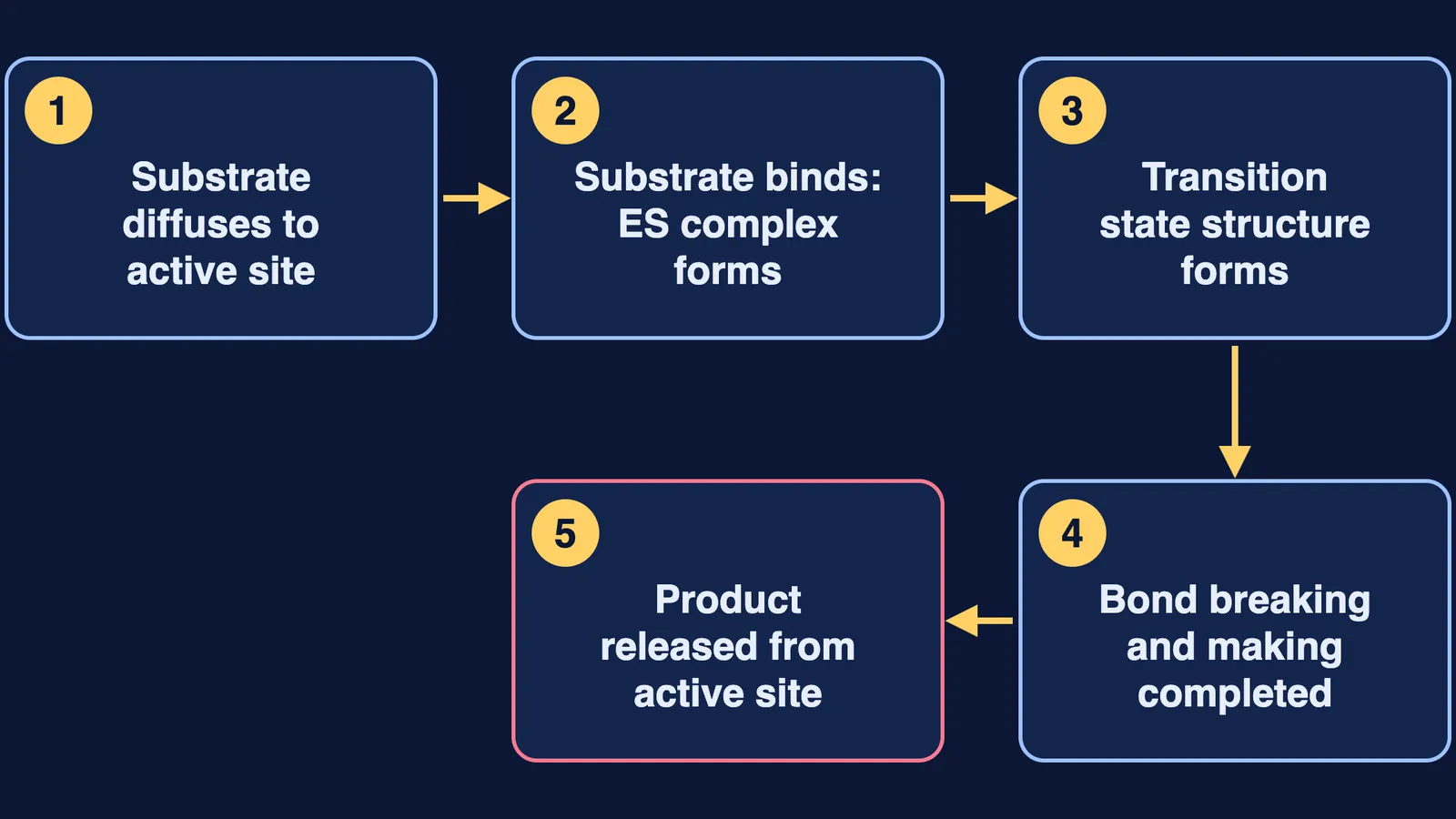
Substrate to product (9.8.2): substrate diffuses to the active site → ES complex → transition state structure → bond breaking and making completed → product released.
Glucose to lactic acid (9.8.1): glucose → ten enzyme-catalysed reactions → pyruvic acid → one or two more reactions → lactic acid (anaerobic skeletal muscle).
The hero card shows sequence 6; no question below tests it, as our statement and match-the-list set already orders the catalytic cycle.
How do you attack sequence questions?
Fix the first and last steps and strike out options that break either. Survivors usually differ by one neighbouring pair: ask which step needs the other to exist already.
Arrange-in-order questions (Q1 to Q6)
Q1. Separating the two pools: A. Strain through cheesecloth; B. Grind in trichloroacetic acid; C. Filtrate and retentate obtained; D. Take a piece of liver; E. A thick slurry forms
(1) D, E, B, A, C (2) D, B, E, A, C (3) B, D, E, A, C (4) D, B, A, E, C
Answer: (2). Tissue, grinding, slurry, straining, two fractions (9.1).
Q2. Identifying a compound: A. Apply analytical techniques; B. Extract the compounds; C. Molecular formula and probable structure; D. Separate until one compound is pure
(1) B, A, D, C (2) D, B, A, C (3) B, D, A, C (4) B, D, C, A
Answer: (3). Analysis is applied to the purified compound and gives formula and structure (9.1).
Q3. Finding the inorganic part: A. Burn the dried tissue fully; B. Weigh the fresh tissue; C. Dry the tissue; D. Ash remains; E. Record the dry weight
(1) B, C, E, A, D (2) C, B, E, A, D (3) B, E, C, A, D (4) B, C, A, E, D
Answer: (1). Wet weight, drying, dry weight, burning, ash (9.1).
Q4. From smallest unit to polymer: A. Nucleotide; B. Nitrogen base; C. Nucleic acid; D. Nucleoside
(1) B, A, D, C (2) D, B, A, C (3) B, D, C, A (4) B, D, A, C
Answer: (4). Sugar joins the base, phosphate then joins the sugar, and nucleic acids are polynucleotides (9.1, 9.6).
Q5. Protein structure, first level to fourth: A. Chain folded on itself, giving a 3-D view; B. Positional information: which amino acid is first, second and so on; C. Architecture of a protein built from several polypeptides; D. Some portions of the thread coiled as right-handed helices
(1) B, A, D, C (2) B, D, A, C (3) D, B, A, C (4) B, D, C, A
Answer: (2). Primary, secondary, tertiary, quaternary (9.7).
Q6. Glucose to lactic acid: A. Lactic acid in skeletal muscle; B. Ten enzyme-catalysed reactions; C. Pyruvic acid; D. Glucose; E. One or two additional reactions
(1) D, B, C, E, A (2) D, C, B, E, A (3) D, B, E, C, A (4) B, D, C, E, A
Answer: (1). The pathway reaches pyruvic acid first; extra reactions give lactic acid (9.8.1).
Which step comes before, after or out of place? (Q7 to Q9)
Q7. In the trichloroacetic acid method, what is obtained immediately after grinding? (1) The filtrate (2) Ash (3) A thick slurry (4) The retentate
Answer: (3). Straining the slurry then gives the two fractions (9.1).
Q8. In NCERT's identification route, which step comes immediately before analytical techniques are applied? (1) Extracting the compounds (2) Isolating and purifying one compound (3) Writing the molecular formula (4) Straining through cotton
Answer: (2). Extraction comes earlier, not immediately before (9.1).
Q9. One step is out of place; moving it alone fixes the order. P. Weigh fresh tissue; Q. Burn the tissue fully; R. Dry the tissue; S. Weigh the dried tissue; T. Ash remains. (1) P (2) Q (3) R (4) S
Answer: (2). Q belongs between S and T (9.1).
Two-statement questions on order (Q10 to Q12)
Options: (1) Both correct (2) Both incorrect (3) Only I correct (4) Only II correct
Q10. I: Analytical techniques give the molecular formula before the compound is purified. II: In skeletal muscle, lactic acid forms before pyruvic acid.
Answer: (2). Purification comes first (9.1); pyruvic acid comes first (9.8.1).
Q11. I: NCERT places the tertiary level before the secondary level. II: The nucleoside level sits between the nitrogen base and the nucleotide.
Answer: (4). Secondary precedes tertiary (9.7); a nucleotide is a nucleoside with phosphate (9.1).
Q12. I: In the ash method, the water evaporates before carbon compounds are oxidised. II: In the trichloroacetic acid method, straining comes after the slurry forms.
Answer: (1). Drying precedes burning, and the slurry is what gets strained (9.1).
How should you use this set?
Cover the answers and do all 12. For each miss, rewrite that sequence from memory. For other formats, try the diagram-based questions on the activation energy graph and the NCERT exceptions and odd-one-out set.
Not sure which chapter to drill next? Fermi's AI tutor works out what you already know and builds a plan for the session.