On this page
Every order below is from Chapter 3 of NCERT Class 11 Biology (Reprint 2026-27), with its section. The NEET (UG) 2026 syllabus puts plant groups under Unit 1 of Biology, Diversity in Living World. All 12 questions are original practice, not past-paper items.
Which sequences does NCERT give in Plant Kingdom?
Classification systems (introduction): artificial, as in Linnaeus'; then natural, as in Bentham and Hooker's; at present, phylogenetic.
Bryophyte life cycle (3.2, 3.2.1): antherozoids swim through water to the archegonium; fusion with the egg; the zygote forms a sporophyte, with no immediate meiosis; meiosis in some sporophyte cells; spores germinate into a gametophyte. In liverworts the spores form in the capsule and grow into free-living gametophytes.
Moss gametophyte (3.2.2): spore; protonema; leafy stage as a lateral bud on the secondary protonema; sex organs at the shoot apex.
Rock colonisation (3.2): mosses and lichens colonise rock; they decompose it; higher plants can then grow.
Pteridophyte life cycle (3.3): meiosis in spore mother cells; spores grow into a prothallus; it bears antheridia and archegonia; water carries antherozoids; a zygote forms and builds the sporophyte.
Heterospory to seed habit (3.3): megaspores and microspores; megaspores give female gametophytes, kept on the parent sporophyte; zygotes become young embryos inside them, a precursor to the seed habit.
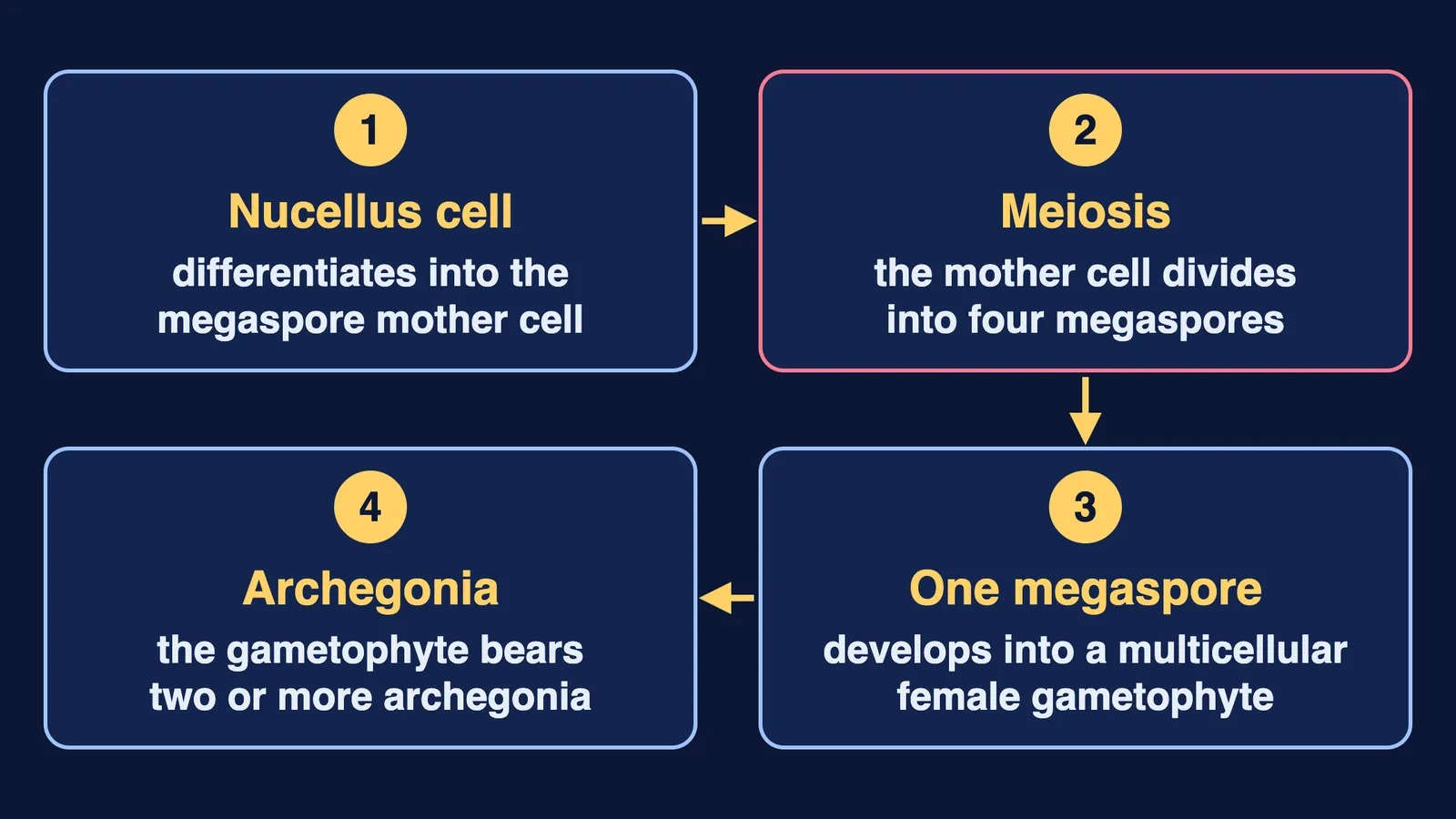
Gymnosperms (3.4): a nucellus cell becomes the megaspore mother cell; meiosis gives four megaspores; one forms a female gametophyte with archegonia. Pollen forms in the microsporangium, is released and carried by air to the ovule; the pollen tube discharges near the archegonia; the zygote becomes an embryo.
How do you solve arrange-in-order questions fast?
Pin the first and last step before reading the codes; usually two survive. Then find the adjacent pair they disagree on. Nothing grows from a spore that has not yet formed.
Can you put these Plant Kingdom steps in NCERT's order?
Q1. Bryophyte fertilisation. A. Antherozoids are released into water B. The antheridium produces biflagellate antherozoids C. An antherozoid fuses with the egg D. Antherozoids come in contact with the archegonium E. The zygote produces a multicellular sporophyte. (1) B-D-A-C-E (2) B-A-C-D-E (3) A-B-D-C-E (4) B-A-D-C-E
Q2. Moss. A. Sex organs appear at the apex of leafy shoots B. A spore develops into the protonema C. Spores form in the capsule after meiosis D. The leafy stage buds from the secondary protonema E. The zygote develops into foot, seta and capsule. (1) B-A-D-E-C (2) B-D-A-E-C (3) B-D-E-A-C (4) B-D-A-C-E
Q3. Pteridophytes. A. Spores germinate into a prothallus B. Water carries antherozoids to the archegonium C. Spore mother cells divide by meiosis D. The zygote produces a sporophyte E. The prothallus bears antheridia and archegonia. (1) C-E-A-B-D (2) A-C-E-B-D (3) C-A-B-E-D (4) C-A-E-B-D
Q4. Gymnosperm pollen. A. Pollen grains are released from the microsporangium B. Microsporangia produce microspores C. Air currents carry the pollen grains D. Microspores develop into pollen grains within the microsporangium E. Pollen grains reach the opening of the ovules. (1) B-D-A-C-E (2) D-B-A-C-E (3) B-A-D-C-E (4) B-D-C-A-E
Q5. Gymnosperm fertilisation. A. The pollen tube discharges its contents near the mouth of the archegonia B. Pollen comes in contact with the opening of the ovule C. The zygote develops into an embryo D. The pollen tube, carrying male gametes, grows towards the archegonia. (1) B-A-D-C (2) D-B-A-C (3) B-D-A-C (4) B-D-C-A
Q6. Selaginella. A. The zygote develops into a young embryo B. A megaspore germinates into a female gametophyte C. The sporophyte produces two kinds of spores D. A male gamete fuses with the egg. (1) B-C-D-A (2) C-B-D-A (3) C-B-A-D (4) C-D-B-A
Answers. 1: (4). Antherozoids travel through water to the archegonium before fusion (3.2). 2: (2). Sex organs form on leafy shoots before any zygote (3.2.2). 3: (4). Sex organs precede antherozoid transfer (3.3). 4: (1). Pollen develops inside the microsporangium, then is released and air-borne (3.4). 5: (3). The tube reaches the archegonia and discharges before a zygote forms (3.4). 6: (2). Zygotes become embryos inside female gametophytes (3.3).
Which before, after and out-of-place items test the same orders?
Q7. Which systems came between the artificial and today's phylogenetic ones? (1) Androecium-based systems (2) Numerical taxonomy (3) Natural systems such as Bentham and Hooker's (4) Habit-based systems
Q8. What happens immediately after mosses and lichens colonise bare rock? (1) They decompose the rock (2) Higher plants grow there (3) Sphagnum peat builds up (4) Algae fix carbon dioxide
Q9. Which step must move to the end of this liverwort order? (A) Sex organs form on thalli (B) Spores germinate into free-living gametophytes (C) The sporophyte forms foot, seta and capsule (D) Meiosis produces spores in the capsule. (1) A (2) C (3) D (4) B
Key for Q10 to Q12: (1) I and II both true (2) Neither is true (3) Only I is true (4) Only II is true.
Q10. I: In gymnosperms, air brings pollen to the ovule before the pollen tube grows towards the archegonia. II: In mosses, spores form in the capsule before the zygote becomes a sporophyte.
Q11. I: In pteridophytes, water carries antherozoids to the mouth of the archegonium before a zygote forms. II: In liverworts, sex organs form on the thalli before the sporophyte develops.
Q12. I: In bryophytes, haploid spores germinate directly into the sporophyte. II: In gymnosperms, pollen grains develop within the microsporangium before they are released.
Answers. 7: (3). Natural systems followed artificial ones (introduction). 8: (1). Decomposition readies the substrate (3.2). 9: (4). Spores germinate after meiosis in the capsule (3.2.1). 10: (3). The capsule belongs to the sporophyte (3.2.2). 11: (1). Both follow 3.3 and 3.2.1. 12: (4). Bryophyte spores give a gametophyte (3.2); pollen is released from the microsporangium (3.4).
Where should you practise next?
Give yourself 12 minutes for the 12 items, then retry only the misses after two days. For other formats, try the Plant Kingdom statement and match-the-list set and the Plant Kingdom diagram-based questions, or revise the groups with our Plant Kingdom Class 11 guide.
Not sure which life cycle to revise first? Fermi's AI tutor works out what you already know and builds a plan for the session.