On this page
Put white CdCl₂·6NH₃ in an evacuated vessel and ammonia gas appears above it. Wait, and the pressure stops at a value that depends only on the temperature, not on how much solid you used. In 1899 W. R. Lang and A. Rigaut in Glasgow measured that pressure from 0 to 69 °C. They also settled a dispute over the formula: six ammonias, not five.
The paper is W. R. Lang and A. Rigaut, "The Composition and Tensions of Dissociation of the Ammoniacal Chlorides of Cadmium", J. Chem. Soc. Trans. 75 (1899) 883–887 (DOI 10.1039/CT8997500883; scan on the Internet Archive). It is signed from the Chemistry Department, University of Glasgow, August 1899, and gives Lang's degree as D.Sc.; it says nothing else about either author. The numbers below were checked against the page images. Cadmium compounds are toxic, so this post gives no preparation.
Why should a solid have a fixed ammonia pressure?
The paper opens with the rule its authors took from Deville, Debray and Isambert: "a definite chemical compound always has a constant tension of dissociation". "Tension of dissociation" is the old name for dissociation pressure.
In modern terms this is a heterogeneous equilibrium. Write it as CdCl₂·6NH₃(s) ⇌ lower ammine(s) + x NH₃(g). The solids drop out, so Kp = p(NH₃)^x. At a fixed temperature Kp is fixed, so p(NH₃) is fixed, as long as both solids are present. The textbook example is CaCO₃(s) ⇌ CaO(s) + CO₂(g), with Kp = p(CO₂).
Why solids drop out is covered in heterogeneous equilibria: why solids and pure liquids drop out of K. The same idea with water instead of ammonia is in when blue vitriol loses water, Kp = p(H₂O)². This post adds two things that one lacks: the temperature dependence, and using the pressure as a test of composition.
Was it CdCl₂·5NH₃ or CdCl₂·6NH₃?
Croft had made the compound from dry ammonia gas and called it CdCl₂·6NH₃. André, working with ammonia solution at 0 °C, gave the formula CdCl₂·5NH₃ "as the result of one experiment". Lang and Rigaut followed his method and found the product "identical with that obtained by Croft".
They made the compound from dry gaseous NH₃ and analysed it. Then they heated it at 100 °C until no more ammonia came off and analysed the residue.
Worked example 1: decide n from percentage composition
Use CdCl₂ = 183.32 and NH₃ = 17.031 g/mol.
CdCl₂·6NH₃: M = 183.32 + 6 × 17.031 = 285.51. CdCl₂ = 183.32 ÷ 285.51 = 64.21%, NH₃ = 35.79%.
CdCl₂·5NH₃: M = 268.48. CdCl₂ = 68.28%, NH₃ = 31.72%.
Lang and Rigaut found 64.02% CdCl₂ and 36.00% NH₃. The 6NH₃ formula misses by 0.2 points; the 5NH₃ formula misses by more than 4.
Solve for n directly: (36.00 ÷ 17.031) ÷ (64.02 ÷ 183.32) = 2.114 ÷ 0.3492 = 6.05. So n = 6.
The residue after 100 °C: found 84.49% CdCl₂ and 15.51% NH₃. CdCl₂·2NH₃ needs 84.33% and 15.67%. Solving gives n = 1.98.
The crystals André had made from cold aqueous ammonia were analysed too. The paper concludes their formula "is not CdCl₂,5NH₃" but CdCl₂,6NH₃, though it prints no numbers for that analysis. At 22 °C those wet-made crystals gave 147 mm "instead of 135 mm", which the authors put down to traces of water vapour.
Today the hexammine is written [Cd(NH₃)₆]Cl₂, using the coordination theory Werner published in 1893 (see Alfred Werner and how coordination compounds got their shape). Lang and Rigaut wrote CdCl₂,6NH₃ and made no structural claim.
How does the ammonia pressure change with temperature?
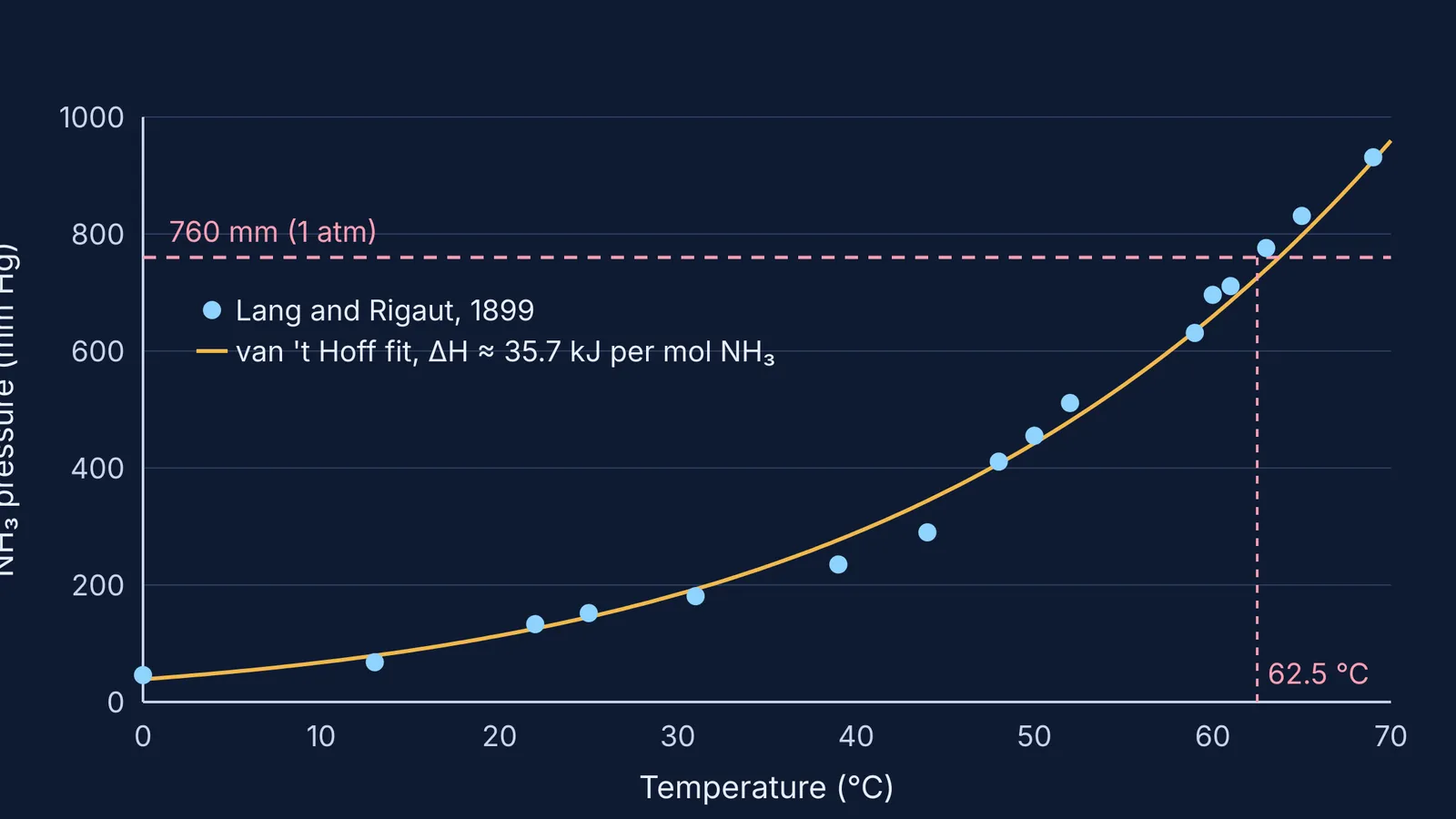
Their table has 16 readings. A selection:
0 °C: 46 mm
25 °C: 152 mm (exactly 0.200 atm)
48 °C: 411 mm
60 °C: 696 mm
63 °C: 776 mm
69 °C: 931 mm
They add: "above 62° the substance CdCl₂,6NH₃ can no longer exist", while CdCl₂,2NH₃ is "very stable" at 100 °C and only begins to decompose at about 210 °C. Intermediate products must form between 62 and 100 °C, but the paper does not say which. So you cannot write CdCl₂·6NH₃ → CdCl₂·2NH₃ + 4NH₃ as the equilibrium they measured.
Our reading of the 62°: the pressure passes 760 mm between 61 °C (711 mm) and 63 °C (776 mm). Interpolating ln p gives 62.5 °C. Above that, the hexammine cannot survive under 1 atm of ammonia. The paper does not give this reason.
How do you get ΔH from a dissociation pressure?
The van 't Hoff equation says ln Kp falls on a straight line against 1/T, with slope −ΔH/R. Here Kp = p^x, so ln Kp = x ln p. A plot of ln p against 1/T then has slope −(ΔH/x)/R. That is the enthalpy per mole of NH₃ released, and you get it without knowing x.
Worked example 2: van 't Hoff from two points
Take 0 °C (273.15 K, 46 mm) and 60 °C (333.15 K, 696 mm).
ln(696 ÷ 46) = 2.717.
1/273.15 − 1/333.15 = 6.593 × 10⁻⁴ K⁻¹.
ΔH per mol NH₃ = 8.314 × 2.717 ÷ (6.593 × 10⁻⁴) = 34.3 kJ mol⁻¹.
A least-squares line through all 16 points gives 35.7 kJ mol⁻¹ (r² = 0.99). Other pairs scatter: 25 and 60 °C give 35.9, but 39 and 65 °C give 42.6. Look at the jump from 290 mm at 44 °C to 411 mm at 48 °C, and note that the paper's table gives 133 mm at 22 °C while its text says 135 mm. So quote "about 35 kJ per mol of NH₃". ΔH is positive, so the pressure rises with temperature, as Le Chatelier predicts for an endothermic loss of gas. The general method is in how K changes with temperature: the van 't Hoff equation.
The Fermi Problem Library has more Kp and van 't Hoff problems, with a step-by-step solver that explains the reasoning.
Where is this in your syllabus?
Class 11 Equilibrium: heterogeneous equilibria, and how K changes with temperature.
Class 12 Coordination Compounds: ammine complexes and Werner formulas.
Class 11 Some Basic Concepts: percentage composition to fix a formula.
If you are preparing for JEE Main and Advanced, Fermi Test Prep pairs practice with an AI tutor.
Quick checklist
A definite compound has a fixed dissociation pressure at each temperature.
Kp = p(NH₃)^x; the solids drop out.
36.00% NH₃ found against 35.79% for 6NH₃ and 31.72% for 5NH₃: the formula is CdCl₂·6NH₃.
p rises from 46 mm at 0 °C to 931 mm at 69 °C; it reaches 760 mm near 62.5 °C.
Slope of ln p against 1/T gives ΔH ≈ 35 kJ per mol NH₃.
The paper does not identify the lower ammine in equilibrium with the hexammine.