On this page
Every Class 12 student writes [Cu(NH₃)₄]²⁺ for the deep blue colour of copper sulphate in excess ammonia. But how did anyone know there were four ammonia molecules on each copper ion in solution, before spectroscopy or X-ray crystallography? In 1900, H. M. Dawson and J. McCrae of the Yorkshire College, Leeds, counted them with a separating funnel, some chloroform and a burette. Their paper, "The nature of metal-ammonia compounds in aqueous solution. Part I", is in the Journal of the Chemical Society, Transactions, volume 77, pages 1239 to 1262 (scan on the Internet Archive).
What was Dawson and McCrae's idea?
The distribution law says that a solute shared between two liquids that do not mix splits in a fixed ratio at a given temperature, as long as it has the same molecular form in both. If you need a refresher, see the Nernst distribution law and the partition coefficient.
Dawson and McCrae turned the law around. In their words: "If we invert this distribution theorem, it follows that deviations from the constant concentration ratio will serve as a measure of any molecular change which the distributing substance undergoes in one or other of the media." They credited the idea to Hantzsch and Sebaldt (1899).
The logic: the chloroform layer is in equilibrium only with free NH₃ in the water, and ammonia held by Cu²⁺ is invisible to it. So the chloroform layer tells you the free NH₃, and total minus free is the fixed NH₃.
How was ammonia shared between water and chloroform?
They shook 50 mL of the aqueous solution with 50 or 100 mL of chloroform in a separating funnel kept in a thermostat. Then they separated the layers and titrated the ammonia in each with 0.1 N acid, using methyl orange.
With pure water at 20 °C, seven runs gave ratios (concentration in water ÷ concentration in chloroform) from 26.0 to 26.9, with a mean of 26.3. The ratio falls as the temperature rises: 24.9 at 25 °C and 23.2 at 30 °C. So every comparison has to be made at the same temperature.
Now add copper sulphate to the water. In 0.4 N CuSO₄ at 20 °C, one run gave a ratio of 135.1, about five times the value for pure water.
How do you get four ammonia molecules from the numbers?
Here is the first 0.4 N CuSO₄ run at 20 °C, worked step by step.
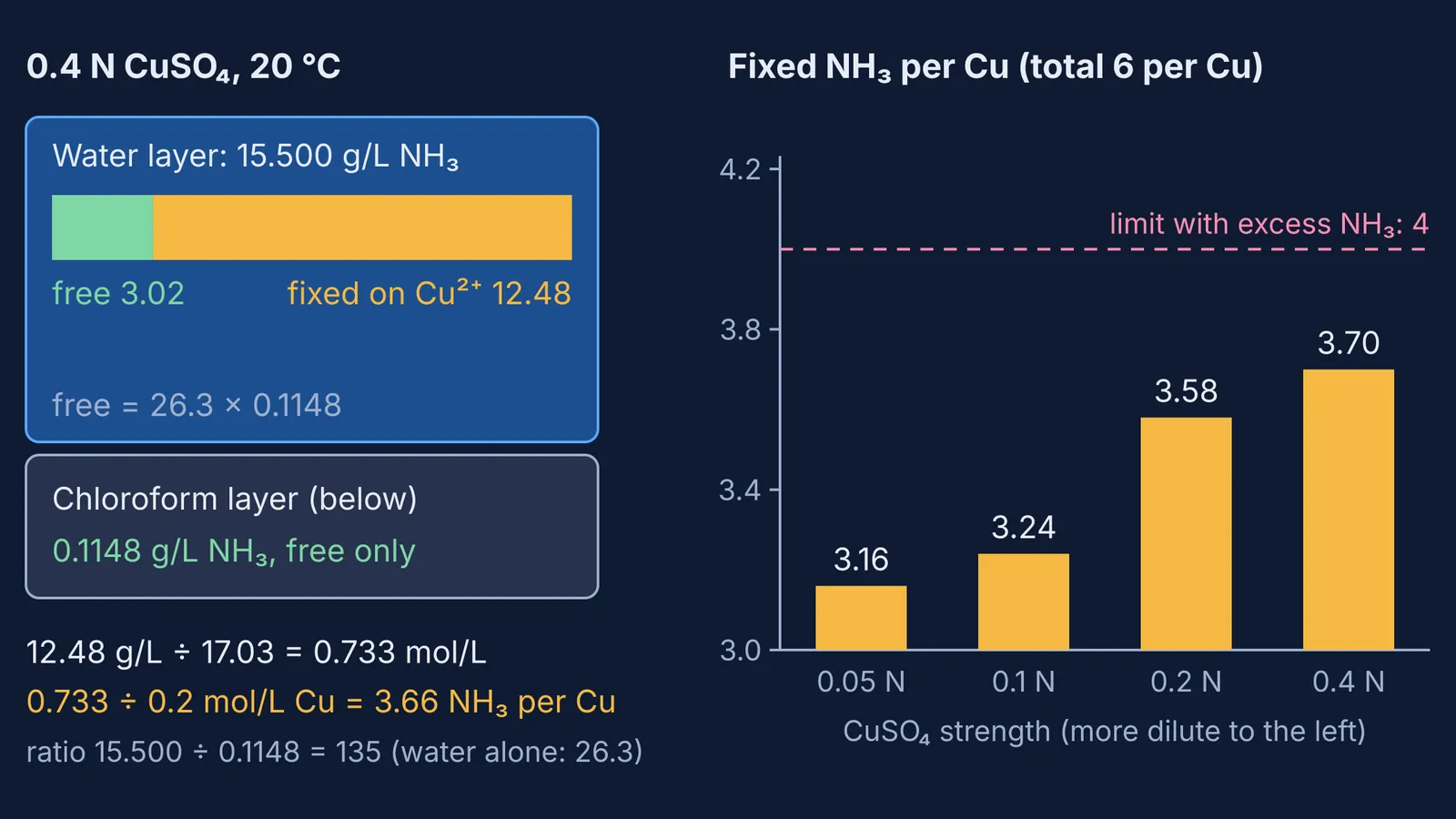
Data. Ammonia in the water layer = 15.500 g/L. Ammonia in the chloroform layer = 0.1148 g/L.
Check the ratio. 15.500 ÷ 0.1148 = 135.0 (printed as 135.1).
Free NH₃ in water. Only free ammonia balances the chloroform layer, so free NH₃ = 26.3 × 0.1148 = 3.019 g/L.
Fixed NH₃. 15.500 − 3.019 = 12.48 g/L. Divide by the molar mass of NH₃ (17.03 g/mol): 12.48 ÷ 17.03 = 0.733 mol/L. The paper prints 0.731, because it used 17.07 for NH₃.
Moles of copper. 0.4 N CuSO₄ is 0.2 mol/L, because one mole of Cu²⁺ is two equivalents. The paper confirms this: a decinormal (0.1 N) solution, it says, holds 0.05 mol of salt per litre.
Ammonia per copper. Fixed NH₃ per Cu = 0.733 ÷ 0.2 = 3.66. The printed ratio is 1 : 3.65.
Compare with the total. Total NH₃ per Cu = (15.500 ÷ 17.03) ÷ 0.2 = 4.55 (printed 1 : 4.54). So of about 4.5 ammonia molecules per copper ion, about 3.7 were bound and fewer than 1 was free.
For more on that conversion, see how to convert normality to molarity using the n-factor.
Why was the number not exactly four?
The other two 0.4 N runs show what happens with more ammonia. As the total rose to 5.98 and then 7.41 NH₃ per Cu, the fixed ammonia stayed close to four: 3.70 and 3.64 per Cu. They reported that, at every concentration they studied, the bound amount rose only slowly as more ammonia was added. Their conclusion was that "in presence of a considerable excess of ammonia, 1 molecule of the salt takes up 4 molecules of ammonia".
Dilution pushed the count down. With the total held at 6 NH₃ per CuSO₄, the fixed ammonia per copper was:
0.05 N CuSO₄: 3.16
0.1 N: 3.24
0.2 N: 3.58
0.4 N: 3.70
That is Le Chatelier's principle in raw data. For Cu²⁺ + 4NH₃ ⇌ [Cu(NH₃)₄]²⁺, diluting the solution favours the side with more dissolved particles, so the complex partly dissociates. Dawson and McCrae wrote that "dilution of the solution is obviously accompanied by an increase in the dissociation of the copper ammonia compound". Today we would add that the complex forms in steps, so a solution with an average of 3.2 bound NH₃ per copper holds a mixture of complexes with different numbers of ammonia molecules.
Did the anion or other salts change the count?
They tested this in three ways.
Other salts. One curve fitted 0.1 N copper sulphate, copper chloride, zinc sulphate and cadmium iodide, so the ammonia is bound to the metal ion, not the anion. Nickel sulphate gave "substantially the same" results.
Extra sulphate. Adding 0.1 N to 0.4 N Na₂SO₄ to 0.1 N CuSO₄ left the fixed ammonia between 0.1772 and 0.1790 mol/L, "the deviation from the mean being but 0.5 per cent".
Calcium. In 0.2 N calcium chloride the ratio was 28.2, against 56 for copper sulphate of the same strength with the same ammonia in the chloroform. Calcium hardly holds ammonia at all.
What did the experiment not prove?
It counted the ammonia; it did not find the shape. The square planar arrangement, and why it is really a stretched octahedron, came later. See why tetraammine copper(II) is square planar.
They were also careful about the solid. Adding alcohol to ammoniacal copper sulphate throws down CuSO₄·4NH₃·H₂O, which fits their count. But they warned that this "does not prove that this compound is present in considerable quantity" in the solution, because alcohol can shift the equilibrium.
Their count agreed with earlier work they cited. Konowaloff's ammonia vapour pressures (1899) gave a constant of about 4 for copper salts, and Reychler's freezing points (1895) pointed the same way.
Where does this show up in JEE and NEET?
Coordination compounds: the coordination number of Cu²⁺ with NH₃, and the tetraamminecopper(II) sulphate you prepare in the practical.
Distribution law: using a partition coefficient to find how much solute is free in one layer.
Normality and molarity: the 0.4 N = 0.2 mol/L step is exactly the kind of conversion examiners like.
Equilibrium: dilution dissociating a complex is Le Chatelier's principle.
If you want to practise numericals that chain the distribution law, mole conversions and equilibrium like this, the Fermi Problem Library has a step-by-step solver that explains the reasoning.
Quick checklist
The chloroform layer measures only free NH₃: free = 26.3 × [NH₃ in CHCl₃] at 20 °C.
Fixed NH₃ = total NH₃ in water − free NH₃.
Convert normality to molarity first: 0.4 N CuSO₄ = 0.2 mol/L.
0.733 ÷ 0.2 = 3.66 fixed NH₃ per Cu in the worked run; with excess ammonia the count approaches 4.
Dilution lowers the count (3.70 down to 3.16): Le Chatelier.
A count is not a shape.