

On this page
If you have watched ammonia turn copper sulphate solution deep blue (we go through the equations in reactions of copper sulphate with KI, KCN and ammonia), the ion behind that colour is [Cu(NH3)4]2+. Exam answers call it square planar and dsp2. That gets the mark but hides the real reason.
What is the electron configuration of Cu2+ in [Cu(NH3)4]2+?
Copper (Z = 29) is [Ar] 3d10 4s1. Removing two electrons (the 4s electron, then one 3d) leaves Cu2+ as 3d9.
Nine d electrons always leave one unpaired electron. The spin-only moment is the square root of 1 × 3, about 1.73 BM. NCERT uses spin-only moments to tell tetrahedral from square planar in Unit 5, Coordination Compounds (Example 5.7), but for copper(II) both shapes give one unpaired electron.
NCERT lists this among the limits of valence bond theory: it "does not make exact predictions regarding the tetrahedral and square planar structures of 4-coordinate complexes" (NCERT Unit 5, section 5.5.3).
Why does dsp2 hybridisation not quite work for copper(II)?
NCERT assigns dsp2 hybridisation to square planar complexes, using [Ni(CN)4]2- as its example (NCERT Unit 5, section 5.5.1). Ni2+ is d8, so its eight electrons pair up in four 3d orbitals and one 3d orbital is left empty for the hybrid.
Try the same with Cu2+. Nine electrons fill four 3d orbitals with one electron to spare. To empty a 3d orbital for dsp2, that ninth electron has to be pushed up into a 4p orbital. A lone electron in a high-energy 4p orbital should be easy to remove, so the model would predict that [Cu(NH3)4]2+ is easily oxidised to copper(III). That is an awkward prediction for an ion that sits as a stable deep blue solution on the bench.
NCERT itself warns, on the same page, that "the hybrid orbitals do not actually exist" and that hybridisation is "a mathematical manipulation". So treat dsp2 as a label for the shape, not the reason for it.
How does the Jahn–Teller effect turn an octahedron into a square?
Crystal field theory gives the reason. In an octahedral field the five d orbitals split into a lower set of three, t2g, and a higher set of two, eg (dx2−y2 and dz2), which point straight at the ligands (NCERT Unit 5, section 5.5.4). For the energies, see how to calculate CFSE for octahedral and tetrahedral complexes.
For d9, t2g holds six electrons and eg holds three: one eg orbital full, the other half-full, with two equally good ways to arrange that. The state is degenerate.
Hermann Jahn and Edward Teller showed in 1937 that a non-linear molecule cannot be both degenerate and stable: "stability and degeneracy are not possible simultaneously unless the molecule is a linear one" (Proceedings of the Royal Society A, vol. 161, pp. 220–235). The complex distorts to remove the degeneracy.
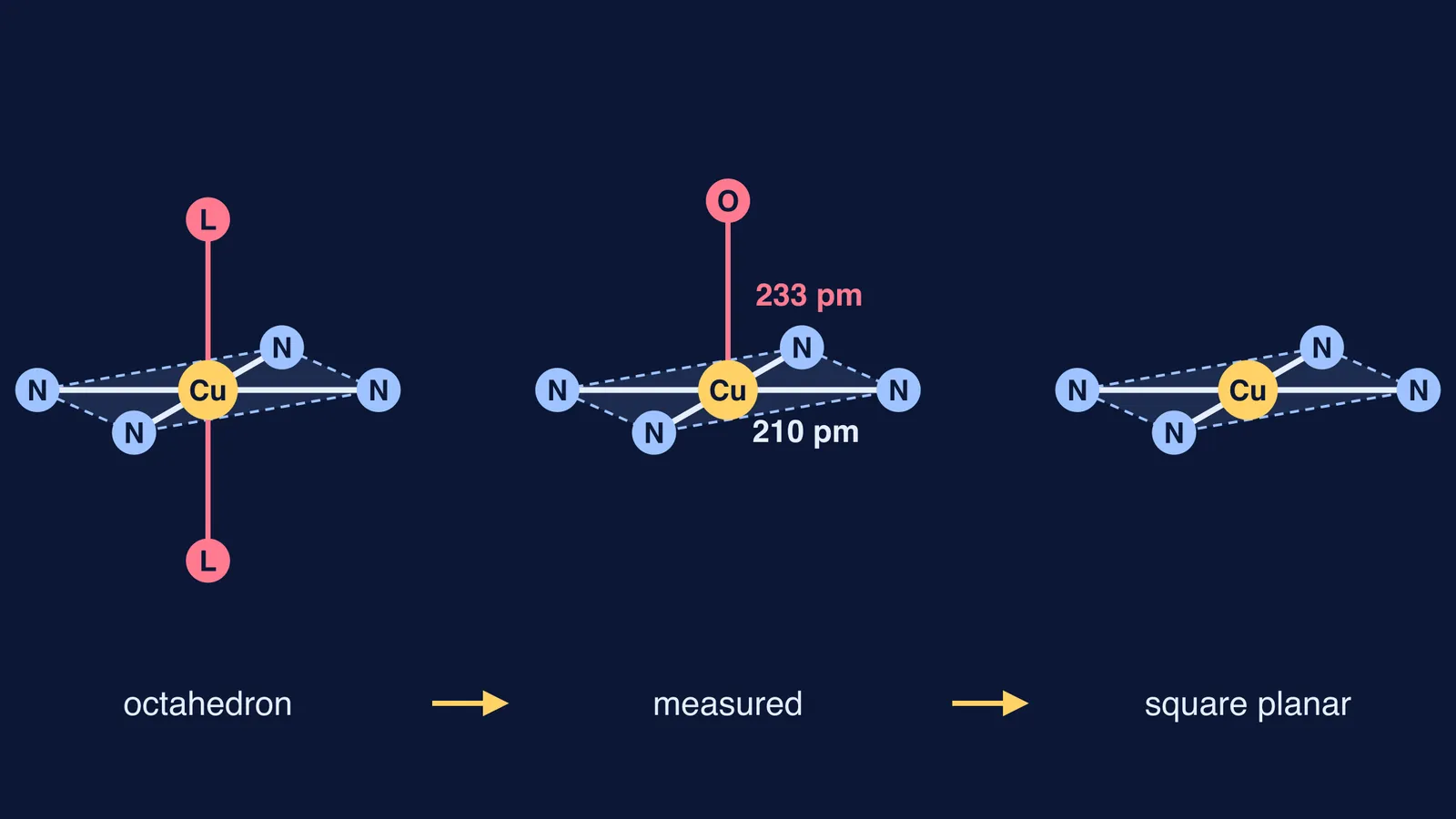
For copper(II) the usual distortion stretches the two bonds along z. The dz2 orbital drops and dx2−y2 rises, so two electrons go down and only one goes up: a net gain in stability (LibreTexts, Jahn–Teller distortion/III:_Reactivity_in_Organic_Biological_and_Inorganic_Chemistry_1/02:_Ligand_Binding_in_Coordination_Complexes_and_Organometallic_Compounds/2.12:_Jahn-Teller_Distortion)). The single unpaired electron ends up in dx2−y2, the orbital aimed at the four ligands in the plane.
Crystal structures show the stretch. In the salt Cu(NH3)4SO4·H2O, X-ray crystallography puts the four Cu–N bonds at about 210 pm and a single Cu–O bond to water at 233 pm, giving a square pyramid (Tetraamminecopper(II) sulfate_sulfate), citing Morosin, Acta Crystallographica B, 1969). Push the axial ligands far enough away and what is left is a square of four nitrogens: the square planar picture in your textbook.
If t2g and eg still feel like labels, the Fermi Concept Library gives each chemistry concept its own lesson and its place in the map, so you can revisit crystal field splitting first.
How should you write this in a CBSE or JEE answer?
Five steps cover the label and the reason:
Configuration: Cu is 3d10 4s1, so Cu2+ is 3d9, with one unpaired electron (spin-only moment about 1.73 BM).
Shape: square planar, four NH3 at the corners of a square around Cu.
Valence bond label: dsp2 (one 3d, one 4s, two 4p). If asked, add the catch: the ninth electron would have to move to 4p.
Real cause: uneven eg filling in d9, so the Jahn–Teller effect elongates the z axis and the axial ligands are weakly held or lost.
Evidence: in crystals of Cu(NH3)4SO4·H2O the axial Cu–O bond (about 233 pm) is longer than the Cu–N bonds (about 210 pm) (X-ray data_sulfate)).
Three traps to avoid:
Calling it tetrahedral sp3 just because the coordination number is 4.
Calling it diamagnetic. Unlike [Ni(CN)4]2-, a d9 ion always has one unpaired electron.
Asking whether it is high spin or low spin. A d9 ion has only one octahedral filling, t2g6 eg3; the choice arises for d4 to d7, as in high spin or low spin: how to decide.
To practise this chain on other ions, the Fermi Problem Library has worked problems with a step-by-step solver that explains the reasoning rather than printing an answer.
Next time a question says "dsp2", write it, then add one line on Jahn–Teller.


