

On this page
Copper(II) sulphate (CuSO₄) is a staple of the chemistry lab. Its bright blue crystals, known as blue vitriol, dissolve in water to give a pale blue solution. But when you mix this solution with potassium iodide (KI), potassium cyanide (KCN), or ammonia (NH₃), the results are anything but ordinary.
These three reactions are favourites in JEE and NEET because they test two core ideas at once: the redox chemistry of transition metals and the formation of coordination complexes. Because they behave differently from standard double displacement reactions, they frequently appear as traps in multiple-choice questions.
Here is exactly what happens in each case, the underlying chemistry, and the balanced equations you need to know.
What is the reaction of copper sulphate with potassium iodide (KI)?
When you add potassium iodide to a solution of copper(II) sulphate, you might expect a simple double displacement to yield copper(II) iodide. Instead, a redox reaction occurs.
The cupric ion (Cu²⁺) is a strong enough oxidising agent to oxidise the iodide ion (I⁻) into molecular iodine (I₂). In the process, copper is reduced from the +2 state to the +1 state, forming copper(I) iodide_iodide). This reaction proceeds spontaneously because the precipitation of copper(I) iodide drives the equilibrium forward.
The overall equation is: 2 CuSO₄ + 4 KI → 2 CuI + I₂ + 2 K₂SO₄
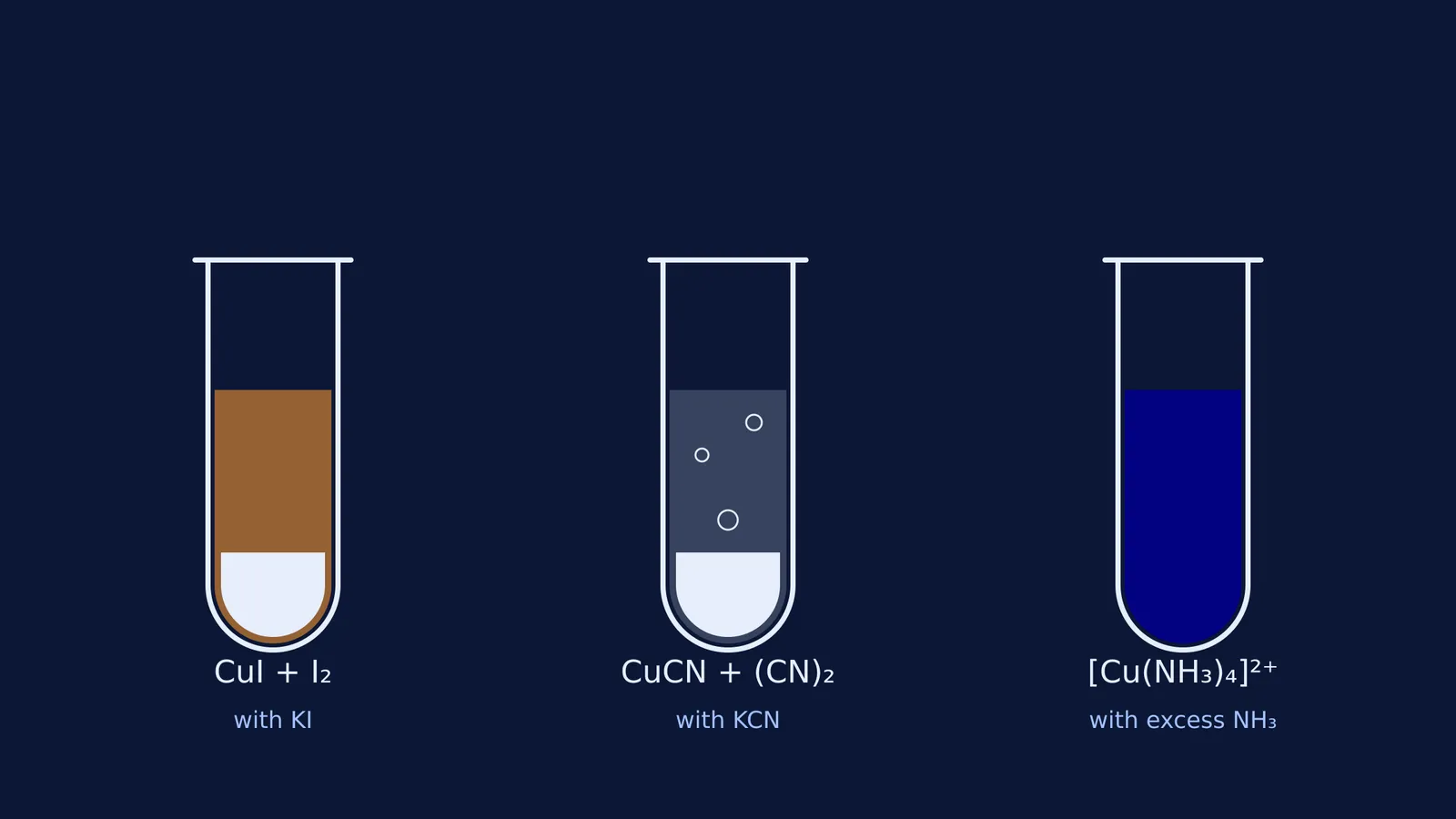
You will see a brown mixture in the test tube. This is because the molecular iodine dissolves in the excess potassium iodide to form the brown triiodide ion (I₃⁻), which masks the precipitate. If you wash away the iodine, you will find that cuprous iodide is actually a stark white solid.
How does copper sulphate react with KCN?
Potassium cyanide reacts with copper sulphate in a way that is chemically identical to potassium iodide. The cyanide ion (CN⁻) is a pseudohalide—a polyatomic ion that behaves very much like a halide ion such as chloride or iodide.
When you add KCN to copper sulphate, the Cu²⁺ ion oxidises the CN⁻ ion into cyanogen gas, (CN)₂. Simultaneously, copper is reduced to form a white precipitate of copper(I) cyanide_cyanide) (CuCN). Because cyanogen is a highly toxic gas, this reaction is rarely performed in high school laboratories, but it remains a heavily tested theoretical concept.
2 CuSO₄ + 4 KCN → 2 CuCN + (CN)₂ + 2 K₂SO₄
If you continue adding excess KCN to the mixture, the white precipitate dissolves. The copper(I) cyanide reacts with the extra cyanide ions to form a highly stable, soluble coordination complex called potassium tetracyanocuprate(I).
CuCN + 3 KCN → K₃[Cu(CN)₄]
If you are struggling to map out how electrons move in these complex redox reactions, the Fermi Problem Library has worked examples of transition metal chemistry with a step-by-step solver that explains the reasoning rather than just printing an answer.
What happens when copper sulphate reacts with ammonia?
The reaction of copper sulphate with ammonia (NH₃) happens in two distinct stages and serves as a classic analytical test for the Cu²⁺ ion.
First, when you add a small amount of dilute aqueous ammonia (often written as ammonium hydroxide, NH₄OH), a pale blue precipitate of copper(II) hydroxide forms.
CuSO₄ + 2 NH₄OH → Cu(OH)₂ + (NH₄)₂SO₄
If you then add excess ammonia, the pale blue precipitate dissolves completely. The ammonia molecules act as strong ligands, displacing water molecules to form a stable coordination complex with the central copper ion. The result is a striking, deep blue solution of tetraamminecopper(II) hydroxide.
Cu(OH)₂ + 4 NH₃ → Cu(NH₃)₄₂
This deep blue solution is also known as Schweizer's reagent. Historically, it found a unique and highly valuable industrial use: it is one of the few solutions capable of dissolving cellulose, and it was widely used in the late 19th and early 20th centuries to manufacture the earliest forms of artificial silk, now known as rayon.
The chemistry of ligands, coordination spheres, and oxidation states can feel abstract when you are just reading chemical formulas. The Fermi Concept Library breaks down every concept in chemistry, including how coordination spheres form, each with its own interactive lesson and its place in the broader syllabus map.
Summary checklist for exams
If you need to recall these quickly for a multiple-choice question, use this checklist:
With KI: Gives a white CuI precipitate and brown I₂ in solution. Copper is reduced from +2 to +1.
With KCN: Gives a white CuCN precipitate and toxic cyanogen (CN)₂ gas. It then dissolves in excess KCN to form the K₃[Cu(CN)₄] complex.
With NH₃: Gives a pale blue Cu(OH)₂ precipitate initially, which rapidly dissolves in excess ammonia to form the deep blue complex Cu(NH₃)₄₂.


