On this page
Pour brown iodine water into a separating funnel, add a little carbon tetrachloride, shake and let it settle. The water goes pale and the lower layer turns violet. The Nernst distribution law explains why. Once you see it as an equilibrium, solvent extraction numericals take two lines of algebra.
What does the Nernst distribution law state?
Walther Nernst published his paper on how one substance is shared between two solvents in 1891, in Zeitschrift für Physikalische Chemie, volume 8, pages 110-139.
In the form textbooks teach, if a solute X is shared between two immiscible solvents A and B at constant temperature, and X has the same molecular form in both, the ratio of its concentrations is constant: C₁/C₂ = K (distribution law notes, RRB DAV College).
The constant K is called the distribution coefficient, the partition coefficient or the distribution ratio; all three names mean the same number (same notes).
Why constant? Molecules cross the boundary both ways, and at equilibrium the two rates match. The concentrations stop changing but are not equal: as with any equilibrium, the constant decides the mix. Because both layers are saturated when you shake excess solute with them, K also equals the ratio of the solute's solubilities, S₁/S₂ (same notes).
What is the partition coefficient of iodine between CCl₄ and water?
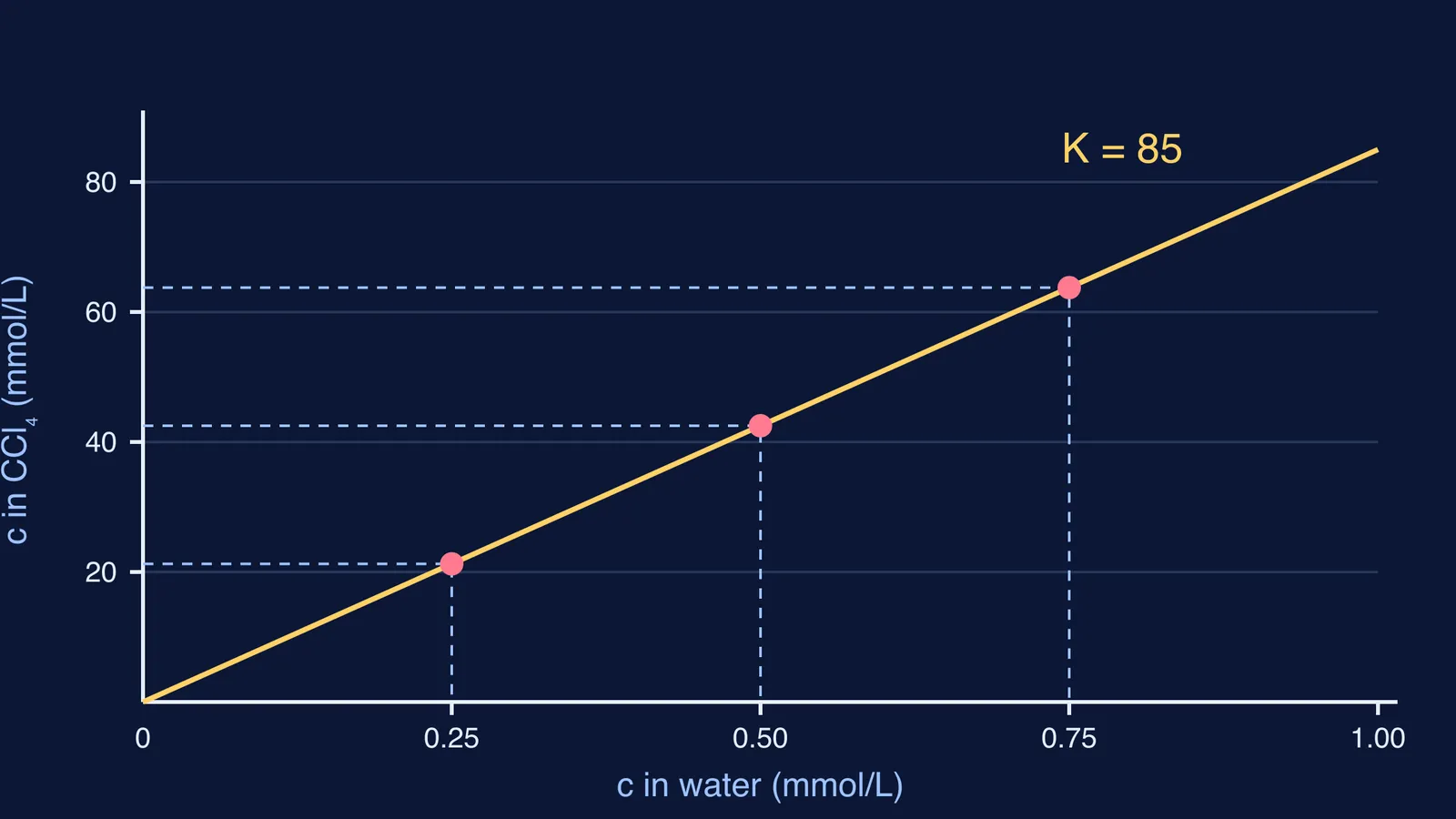
Iodine is about 85 times more soluble in carbon tetrachloride than in water (Chemistry Online). So K is about 85, with CCl₄ on top of the ratio.
Iodine stays as I₂ in both solvents, so its partition coefficient is practically independent of concentration in dilute solutions, which makes it the standard practical for this law (NPTEL, Experiments in Chemistry). You titrate each layer with sodium thiosulfate and check the ratio at several starting amounts.
When does the distribution law not apply?
The RRB DAV notes list the conditions:
the temperature is constant
the solute has the same molecular form in both layers
the solutions are dilute
the two liquids barely dissolve in each other, as with benzene and water
The usual counter-example is benzoic acid. It exists almost entirely as (C₆H₅COOH)₂ dimers in benzene but as single molecules in water. So C₁/C₂ drifts, while C₁/√C₂ stays constant, where C₁ is the concentration in water and C₂ the total in benzene. In general the ratio is C₁ divided by the nth root of C₂, with n = 2 for a dimer. If the solute dissociates in solvent 2 to a degree α instead, the constant is C₁/[C₂(1 − α)] (same notes).
How do you solve a solvent extraction numerical?
Take a mass m of iodine dissolved in 100 mL of water, with K = 85 (CCl₄ over water), the Chemistry Online figure.
One extraction with 10 mL of CCl₄. Let x be the mass left in the water. Then [(m − x)/10] ÷ [x/100] = 85, which gives 10(m − x) = 85x, so x = 10m/95 ≈ 0.105m. About 10.5% stays in the water and 89.5% is extracted.
Two extractions with 5 mL each. Each time, [(m − x)/5] ÷ [x/100] = 85, so x = 20m/105 ≈ 0.190m. After the second portion, 0.190 × 0.190 ≈ 0.036 of the iodine is left. That means 96.4% is extracted with the same 10 mL of solvent.
The general result: after n extractions with v mL of solvent each from V mL of water, the fraction left is [V/(V + Kv)]ⁿ. Plug in V = 100, v = 10, K = 85 and you get 100/950 ≈ 0.105, which matches the first case.
In a LibreTexts worked example/04%3A_Extraction/4.05%3A_Extraction_Theory), one 150 mL ether extraction recovers 0.40 g of 0.50 g of hyoscyamine, while three 50 mL portions recover 0.46 g. More on that in why several small extractions beat one.
A four-step check for any of these problems:
Write K with the right solvent on top.
Let x be the amount left in water, and write each concentration as amount divided by that layer's volume.
Solve for x. For repeated extractions, multiply the fraction left each time.
Sanity-check: a larger K or more solvent must leave less behind.
An answer above 100% usually means a flipped ratio. The Fermi Problem Library has worked problems with a step-by-step solver that explains the reasoning rather than printing an answer.
Where is the distribution law used?
The main use is extraction, in the laboratory and in industry. Organic substances are removed from water with solvents such as ether, chloroform or carbon tetrachloride, because most organic compounds have partition coefficients strongly in favour of the organic solvent (RRB DAV notes). The same notes describe distribution indicators: a drop or two of carbon disulphide picks up enough iodine from a very dilute solution to turn a distinct violet.
The idea of a solute dividing itself between two phases also sits behind partition chromatography, the method Martin and Synge developed.
The distribution law is an equilibrium constant in disguise. If equilibrium feels shaky, the Fermi Concept Library gives each chemistry concept its own lesson, so you can revise it before going back to the funnel.