On this page
Normality and molarity describe the same solution in two currencies. Molarity counts moles of solute per litre; normality counts equivalents per litre. The exchange rate is the n-factor; find it for your reaction and the conversion takes one line.
What is the formula to convert normality to molarity?
Normality is the number of equivalents of solute per litre of solution, and it equals molarity multiplied by the n-factor, or equivalence factor (equivalent concentration).
Molarity to normality: N = M × n-factor
Normality to molarity: M = N ÷ n-factor
Equivalents in a sample: milliequivalents = N × volume in mL
The n-factor is the number of H+ ions one formula unit of an acid gives, the number of H+ a base takes up, or the number of electrons one formula unit gains or loses in a redox reaction. It belongs to the reaction, not just the bottle.
What is the n-factor of H2SO4, Na2CO3 and KMnO4?
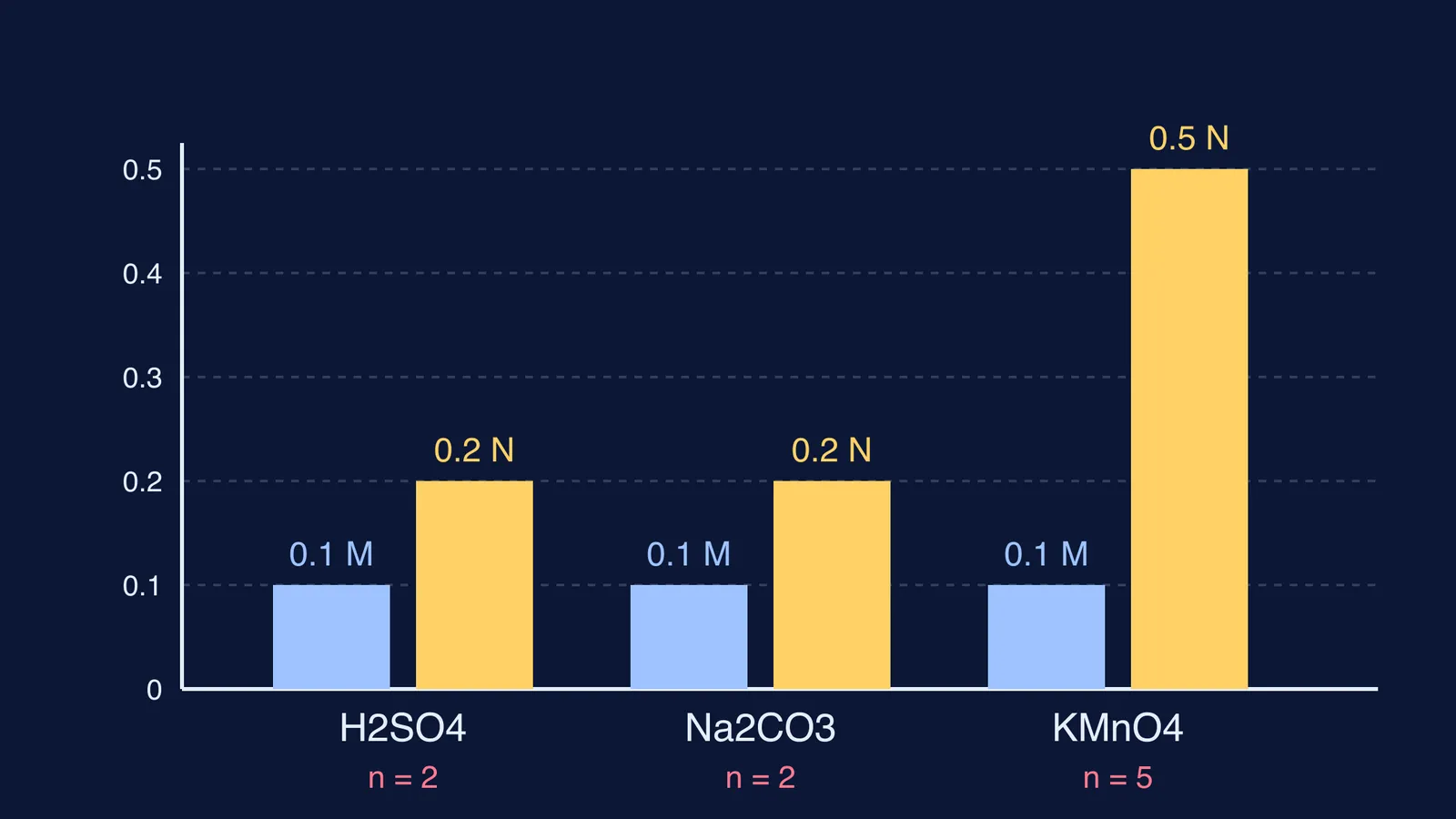
H2SO4 (n = 2). Sulphuric acid is diprotic, so a 1 mol/L solution is 2 N (equivalent concentration). At 98.08 g/mol (PubChem), a 1 N solution is 0.5 M, or 49.04 g per litre.
Na2CO3 (n = 2 when fully neutralised). Carbonate takes up protons in two steps, CO3 2− to HCO3− and then HCO3− to H2CO3, with equivalence points near pH 8.3 and pH 4.0 (LibreTexts soda-ash experiment). Titrated to the second end point, for example with methyl orange, each Na2CO3 takes two H+, so n = 2. Stop at the phenolphthalein end point and only the first step has happened, so n = 1. Its molar mass is 105.99 g/mol (PubChem).
KMnO4 in acid (n = 5). In acidic solution permanganate is reduced by MnO4− + 8H+ + 5e− → Mn2+ + 4H2O, so manganese drops from +7 to +2 and each ion gains five electrons (Purdue general chemistry). A 0.020 M KMnO4 solution used in acid is therefore 0.10 N. With a molar mass of 158.03 g/mol (PubChem), it contains 3.16 g per litre. In neutral or alkaline medium the product and the n-factor change; we cover those in KMnO4 in neutral or alkaline medium: products and n-factors.
How do you solve a titration with normality and with moles?
Problem: 20.0 mL of a sodium carbonate solution needs 16.0 mL of 0.10 N H2SO4 to reach the methyl orange end point. Find the molarity of the carbonate and its strength in g/L.
Method 1, by equivalents:
At the end point, milliequivalents of acid equal milliequivalents of base: N1V1 = N2V2.
0.10 × 16.0 = N × 20.0, so the carbonate is 0.080 N.
Methyl orange means full neutralisation, so n = 2 and M = 0.080 ÷ 2 = 0.040 M.
Strength = 0.040 × 105.99 g/mol (PubChem) = 4.24 g/L.
Method 2, by moles:
Convert the acid first: M of H2SO4 = 0.10 ÷ 2 = 0.050 M.
Moles of acid = 0.050 × 16.0 = 0.80 mmol.
Balanced equation: Na2CO3 + H2SO4 → Na2SO4 + H2O + CO2, a 1 : 1 ratio, so there are 0.80 mmol of Na2CO3.
Molarity = 0.80 ÷ 20.0 = 0.040 M, the same answer.
The methods agree because the n-factors already contain the stoichiometry. Equivalents are quicker for long redox equations; moles are safer when you doubt an n-factor. Solving both ways is a strong self-check. For the mole-ratio approach in more acid-base problems, see how to calculate molarity in titration using basicity; for a redox version, try KMnO4 titration with Mohr's salt.
When does the n-factor change, and why does it matter?
The same bottle can have two normalities. The 0.040 M carbonate above is 0.080 N against methyl orange but 0.040 N against phenolphthalein (n = 1), where it would need just 8.0 mL of the acid.
The US National Institute of Standards and Technology's SI style checklist says the obsolete terms normality, molarity and molal "are not used". Pure and Applied Chemistry, the IUPAC journal, published Recommendations on the usage of the terms 'equivalent' and 'normal' in 1978. You will still meet normality in problem sets, so answer in the unit asked, but think in moles.
Mistakes to check for before you move on:
Using n = 2 for Na2CO3 when the end point is phenolphthalein.
Using n = 5 for KMnO4 in neutral or alkaline solution.
Dividing when you should multiply: at the n-factors above, normality is larger than molarity because n is above 1.
If you keep picking the wrong n-factor for a reaction type, the Fermi Problem Library has worked problems with a step-by-step solver that explains the reasoning rather than printing an answer, so you can see the step where the n-factor comes from. If the idea of an equivalent itself is shaky, start with its lesson in the Fermi Concept Library.
Your next step: take one titration from your last test, solve it both ways, and check that the two answers match.