On this page
Sucralose is sucrose with three OH groups replaced by chlorine. The Indian Standard for food-grade sucralose, IS 15969:2013, names it 1,6-dichloro-1,6-dideoxy-β-D-fructofuranosyl-4-chloro-4-deoxy-α-D-galactopyranoside. Sucrose is a gluco-pyranoside, so one ring has changed its name from gluco to galacto. Compare the R/S labels that PubChem gives the two molecules and four of the nine stereocentres change label. Only one carbon actually changed its arrangement in space. Sorting out which one is a compact drill in Class 12 sugars and stereochemistry.
What does the BIS name of sucralose tell you?
4-chloro-4-deoxy-α-D-galactopyranoside is the six-membered ring. joined through its α C-1. At C-4, OH is replaced by Cl, and the ring has galactose's configuration.
1,6-dichloro-1,6-dideoxy-β-D-fructofuranosyl is the five-membered fructose ring, joined through its β C-2, with Cl at C-1′ and C-6′.
The C-1 to C-2′ link is the same as in sucrose, so both anomeric carbons stay tied up and, like sucrose, it is non-reducing.
IS 15969 gives the formula C₁₂H₁₉Cl₃O₈, formula weight 397.64, and [α] (20 °C, sodium D line) between +84.0° and +87.5° for a 10% w/v solution. How the compound was found is in how Shashikant Phadnis tasted his way to sucralose.
Why is sucralose "galacto" when sucrose is "gluco"?
Glucose and galactose differ at one carbon, C-4. They are C-4 epimers, as covered in the difference between epimers and anomers. In the Haworth projection of a D-pyranose, the C-4 OH of glucose points down and the C-4 OH of galactose points up.
In the structural formula printed in IS 15969, the Cl on the six-membered ring sits up at C-4. So the chlorine is on the opposite face to glucose's OH. That is an inversion at C-4, the result an SN2 displacement (Walden inversion) would give.
Two cautions. The standard does not describe how sucralose is made, so "SN2 at C-4" explains the configuration on paper, not the factory route. And "galacto" describes configuration: sucralose contains no galactose unit, and cutting its glycosidic bond on paper gives 4-chloro-4-deoxygalactose.
The other two chlorines are on C-1′ and C-6′, both CH₂ carbons and so not stereocentres. Nothing can invert there.
Which R/S labels change from sucrose to sucralose?
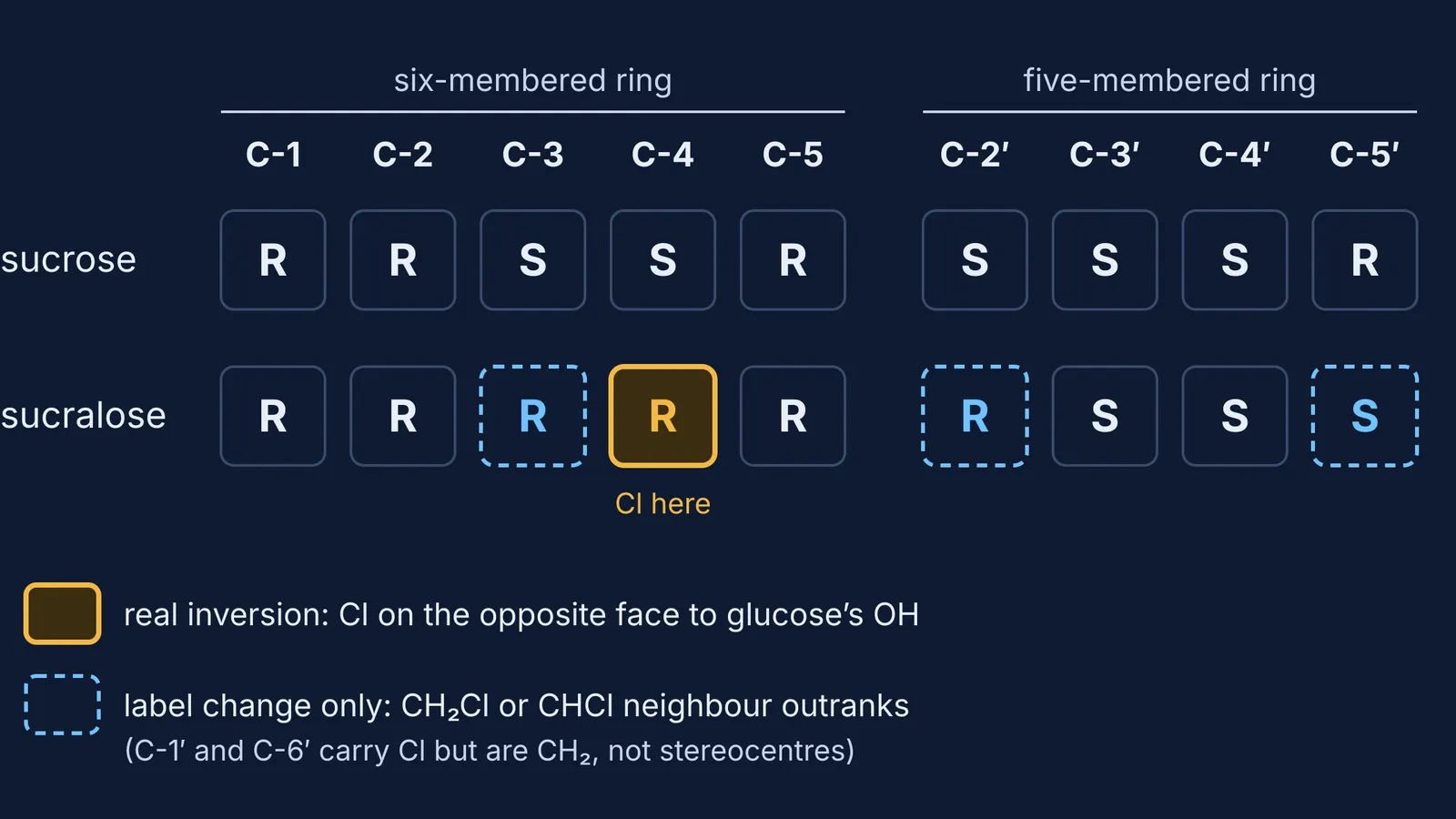
PubChem names both molecules with full R/S labels (CID 5988 for sucrose, CID 71485 for sucralose). PubChem's oxane C-2 is the sugar's C-1; the list uses sugar numbering, and we checked each label with a CIP-labelling program.
C-1 (anomeric carbon): R in sucrose, R in sucralose.
C-2: R, R.
C-3: S becomes R.
C-4: S becomes R.
C-5: R, R.
C-2′: S becomes R.
C-3′: S, S.
C-4′: S, S.
C-5′: R becomes S.
Four labels change. In PubChem's isomeric SMILES (same atom order for both), only C-4 has its chirality tag reversed. Three of the four changes are names, not movements.
Why do three labels flip with no inversion?
If two CIP ranks swap and nothing moves, the label flips, as worked in SN2 inversion that keeps the S label.
C-2′. The two oxygens stay ranks 1 and 2. In sucrose C-1′ is CH₂OH, with attached atoms (O, H, H), and C-3′ is CH(OH)–, with (O, C, H). C-3′ wins at the second atom. In sucralose C-1′ is CH₂Cl, with (Cl, H, H). Cl (atomic number 17) beats O (8) at the first point of difference, so C-1′ now outranks C-3′. Ranks 3 and 4 swap, and S becomes R.
C-5′. Ring O is rank 1 and H is rank 4. In sucrose, C-4′ (O, C, H) beats C-6′ as CH₂OH (O, H, H). In sucralose, C-6′ is CH₂Cl (Cl, H, H) and wins. Ranks 2 and 3 swap, and R becomes S.
C-3. OH is rank 1 and H rank 4. Its neighbours are C-2 and C-4. In sucrose both are (O, C, H), a tie, so you go one sphere further: C-2 leads to C-1 (O, O, H) and C-4 leads to C-5 (O, C, H), so C-2 wins. In sucralose C-4 carries Cl, (Cl, C, H), and wins at once. Ranks 2 and 3 swap, and S becomes R.
Why does C-4 flip for a different reason?
At C-4 in sucrose the ranks are OH, then C-5, then C-3, then H. C-5 beats C-3 because its oxygen is the ring O, which leads on to carbon, while C-3's oxygen leads only to H. In sucralose the ranks are Cl, C-5, C-3, H. Cl simply takes OH's place at the top, and nothing else changes.
With the ranks unchanged, the label flips only because the arrangement flipped. This is the one real inversion, and it turns gluco into galacto.
Worked example: chlorine content and optical rotation
Use the BIS data for sucralose and PubChem's value for sucrose.
Molar mass. 12 × 12.011 + 19 × 1.008 + 3 × 35.45 + 8 × 15.999 = 397.63 g/mol. BIS prints 397.64; the last digit depends on the atomic masses used.
Percentage of chlorine. 3 × 35.45 = 106.35. 106.35 ÷ 397.63 × 100 = 26.75% Cl.
Observed rotation. α = [α] × l × c, with l in dm and c in g/mL. A 10% w/v solution has c = 0.100 g/mL. In a 1 dm tube: 84.0 × 1 × 0.100 = +8.40°, up to 87.5 × 0.100 = +8.75°. In a 2 dm tube the readings double, to +16.8° to +17.5°.
Compare sucrose. PubChem (HSDB) gives sucrose [α] = +66.37° at 20 °C in water, so the same solution in a 1 dm tube reads +6.64°. Per mole (molar rotation = [α] × M ÷ 100), sucralose gives 334 to 348 and sucrose 227. Treat the comparison as approximate: the two values were not measured under identical conditions.
The standard's other checks include an HPLC assay of 98–102%, TLC limits on other chlorinated disaccharides (0.5% reference spot) and chlorinated monosaccharides (0.1%), and triphenylphosphine oxide at most 150 mg/kg, which is 150 ÷ 1,000,000 × 100 = 0.015%. Do not read a manufacturing route into that limit.
What to write in the exam
The topic sits in three chapters: Class 12 Biomolecules (sucrose, glycosidic link, C-4 epimers), Class 12 Haloalkanes and Haloarenes (SN2 with inversion, R/S by CIP rules) and Class 11 Some Basic Concepts of Chemistry (percentage composition).
A model answer: "In sucralose, substitution at C-4 of the glucose unit occurred with inversion, so the unit has the galacto configuration (C-4 epimer of glucose). C-1′ and C-6′ are CH₂ carbons, so substitution there causes no stereochemical change. The R/S labels at C-3, C-2′ and C-5′ change only because Cl changes the CIP priorities."
If CIP ranking still feels shaky, the Concept Library gives each concept its own lesson. For exam-style practice, Fermi Test Prep for JEE Main and Advanced pairs your practice with an AI tutor.
Quick checklist
Sucralose = 4,1′,6′-trichloro: Cl at C-4, C-1′ and C-6′.
C-4 is the only real inversion: gluco becomes galacto.
C-1′ and C-6′ are CH₂, so no stereo change there.
C-3, C-2′ and C-5′ change label from ranking alone: four label changes, one inversion.
Cl = 26.75%; a 10% w/v solution reads +8.40° to +8.75° in a 1 dm tube.
"Galacto" is a configuration, not a galactose unit.