

On this page
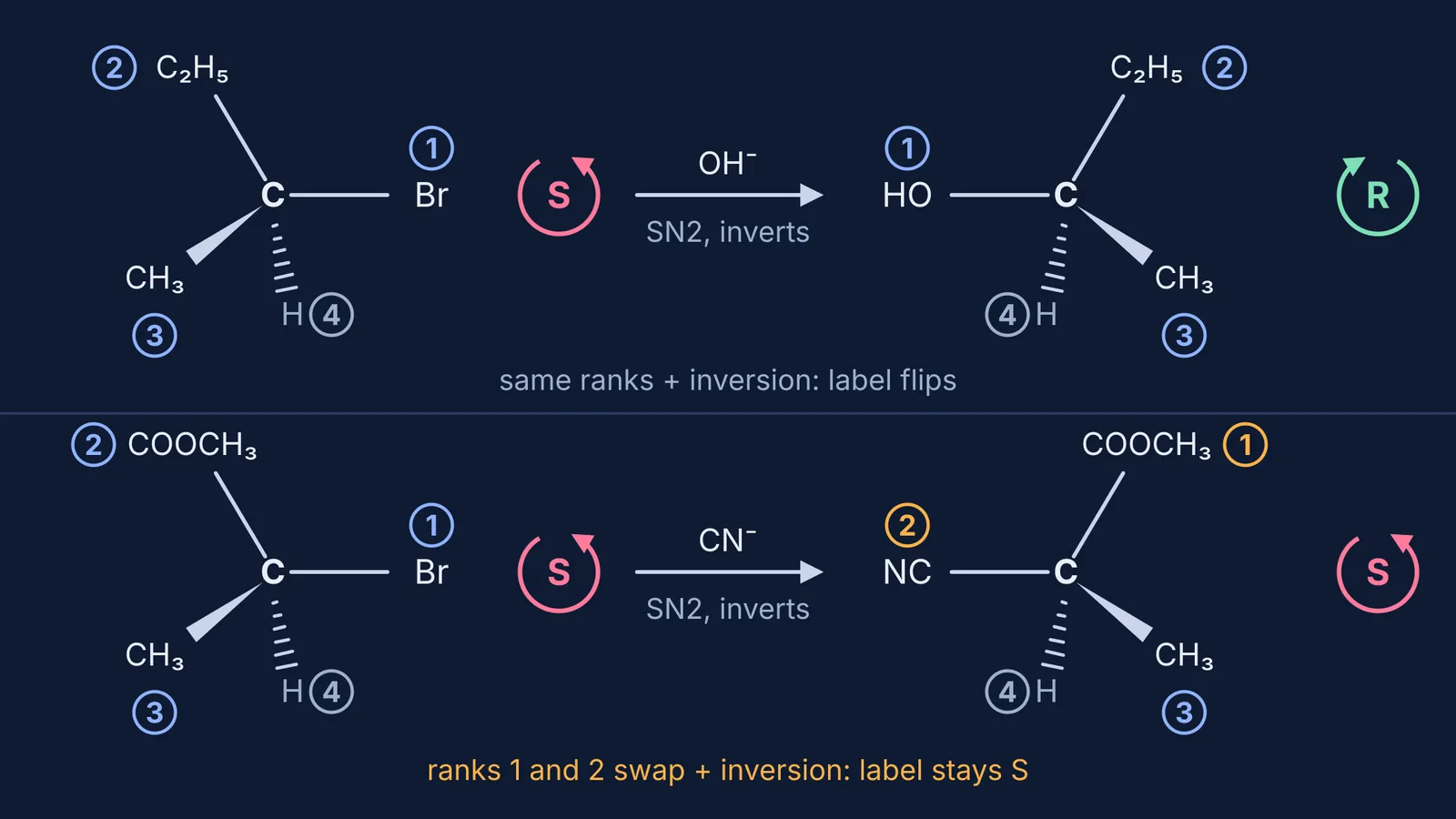
"SN2 gives inversion, so S becomes R." That shortcut gets most exam questions right, but not all of them. Methyl (S)-2-bromopropanoate reacts with cyanide by a clean SN2 reaction, with full inversion, and the product is still named S. Nothing has gone wrong. Inversion describes how the atoms move. R and S are names given by a ranking rule, and the ranking can change when the nucleophile replaces the leaving group.
Does SN2 inversion always turn S into R?
No. In SN2 the nucleophile attacks from the side opposite the leaving group, and the other three groups flip over like an umbrella in the wind (Walden inversion). The SN1 and SN2 stereochemistry post covers this, and it notes in passing that the R/S label flips "assuming the priority of the groups remains the same". This post is about the cases where it does not stay the same.
Here is the logic in two parts.
Inversion mirrors the arrangement. If the nucleophile took exactly the leaving group's rank and the other ranks did not move, the new label would be the opposite of the old one.
Every swap of two ranks flips the label again. If the nucleophile ends up at rank 2 and another group moves up to rank 1, that is one swap. Inversion plus one swap means the label stays the same.
So the label flips with an even number of rank swaps (usually zero) and stays with an odd number (usually one). If you need a refresher on reading R and S from a drawing, see how to assign R or S from a wedge-dash structure.
Worked example 1: when does the label flip?
(S)-2-bromobutane + OH⁻ (SN2) → butan-2-ol. CH₃CH(Br)CH₂CH₃ + OH⁻ → CH₃CH(OH)CH₂CH₃ + Br⁻.
Rank the substrate. The stereocentre is C2. Br has atomic number 35, so it is rank 1. Ethyl and methyl both attach through carbon. Ethyl's carbon carries (C,H,H) and methyl's carries (H,H,H), so ethyl is rank 2 and methyl rank 3. H is rank 4.
Draw the inverted product. OH sits where the attack happened, on the side opposite the old Br, and the other three groups have flipped.
Re-rank the product. O (atomic number 8) beats any carbon, so OH is rank 1. Ethyl stays 2, methyl 3, H 4.
Assign. OH has taken Br's rank and nothing else moved. Zero swaps, so the label flips: the product is (R)-butan-2-ol.
In practice a secondary bromide with OH⁻ also gives some elimination, but the substitution product is (R).
Worked example 2: how can SN2 keep the S label?
Methyl (S)-2-bromopropanoate + CN⁻ (SN2) → methyl 2-cyanopropanoate. CH₃CH(Br)COOCH₃ + CN⁻ → CH₃CH(CN)COOCH₃ + Br⁻.
Rank the substrate. The stereocentre carries Br, COOCH₃, CH₃ and H. Br (35) is rank 1. The ester carbon is attached to (O,O,O): the C=O oxygen counts twice under the CIP duplicate-atom rule, and the OCH₃ oxygen counts once. The methyl carbon is attached to (H,H,H). So COOCH₃ is rank 2, CH₃ rank 3, H rank 4.
Draw the inverted product. CN arrives from the back and the other three groups flip. Cyanide is ambident and can attack through C or N. With NaCN or KCN it attacks mainly through carbon, giving the nitrile, and that is the product here. (AgCN favours N-attack and the isocyanide.)
Re-rank the product. Now two groups attach through carbon, so compare their sets. The nitrile carbon has a triple bond to N, so it counts as (N,N,N). The ester carbon is (O,O,O). Compare the highest atom in each set first: O (8) beats N (7). So COOCH₃ is rank 1 and CN is rank 2. CH₃ stays 3 and H stays 4.
Count the swaps. Before: Br 1, COOCH₃ 2. After: COOCH₃ 1, CN 2. The new group sits in the old rank-1 position, but it is now rank 2, and the ester has moved up to rank 1. That is one swap.
Assign. Inversion flips the label; one swap flips it back. The product is methyl (S)-2-cyanopropanoate.
You can check step 5 directly. Draw the product with H on a dash, then trace COOCH₃ → CN → CH₃. The direction is the same as Br → COOCH₃ → CH₃ in the starting material, so both are S.
The ester also helps the reaction. SN2 at a carbon next to a C=O group is faster than at a plain secondary carbon, so α-bromo esters are good SN2 substrates. One lab caveat: the C–H next to both the ester and the nitrile is fairly acidic, and long exposure to base can racemise the product. Exam questions assume a clean SN2.
Does the nucleophile decide the label?
Yes, and the same substrate shows it. React methyl (S)-2-bromopropanoate with azide (N₃⁻) by SN2 instead of cyanide. Azide attaches through nitrogen. The first atoms are now N (7) for azide and C (6) for the ester, and the first point of difference decides, so N₃ is rank 1. The ester stays rank 2. Zero swaps, so the label flips: methyl (R)-2-azidopropanoate.
Same substrate, same mechanism, same inversion. Cyanide gives S and azide gives R. The difference is entirely in the ranking.
Can retention change the label too?
The same logic works in reverse. A reaction with retention, such as the SNi conversion of an alcohol to a chloride with SOCl₂, keeps the geometry. If the new group takes the old group's rank, the label stays. If ranks swap, the label changes even though nothing inverted. The geometric side of that reaction is in SNi mechanism: why SOCl₂ gives retention and pyridine inversion. For a 2-alkanol turning into a 2-chloroalkane, Cl takes OH's rank 1, so retention keeps the label there.
A three-step routine for any substitution
Draw the product geometry first. SN2: inverted. SNi: retained. SN1: both, so a racemic mixture (often with some excess inversion).
Re-rank all four groups in the product. Do it from scratch with the CIP rules: first atom, then the set of atoms attached to it, with double and triple bonds counted by duplicate atoms.
Assign R or S from your drawing. Use the swap count only as a check.
If you want more practice with problems that combine mechanism and nomenclature, the Fermi Problem Library has a step-by-step solver that explains the reasoning at each stage.
Quick checklist
Inversion is a change in geometry. R/S is a name from a ranking rule.
The label flips on SN2 only if the nucleophile takes the leaving group's rank and no other ranks move.
An odd number of rank swaps cancels the flip.
(S)-2-bromobutane + OH⁻ gives (R)-butan-2-ol.
Methyl (S)-2-bromopropanoate + CN⁻ gives methyl (S)-2-cyanopropanoate, because COOCH₃ (O,O,O) outranks CN (N,N,N).
The same ester with N₃⁻ gives the (R)-azide, because N outranks C.
Draw, re-rank, then assign.


