

On this page
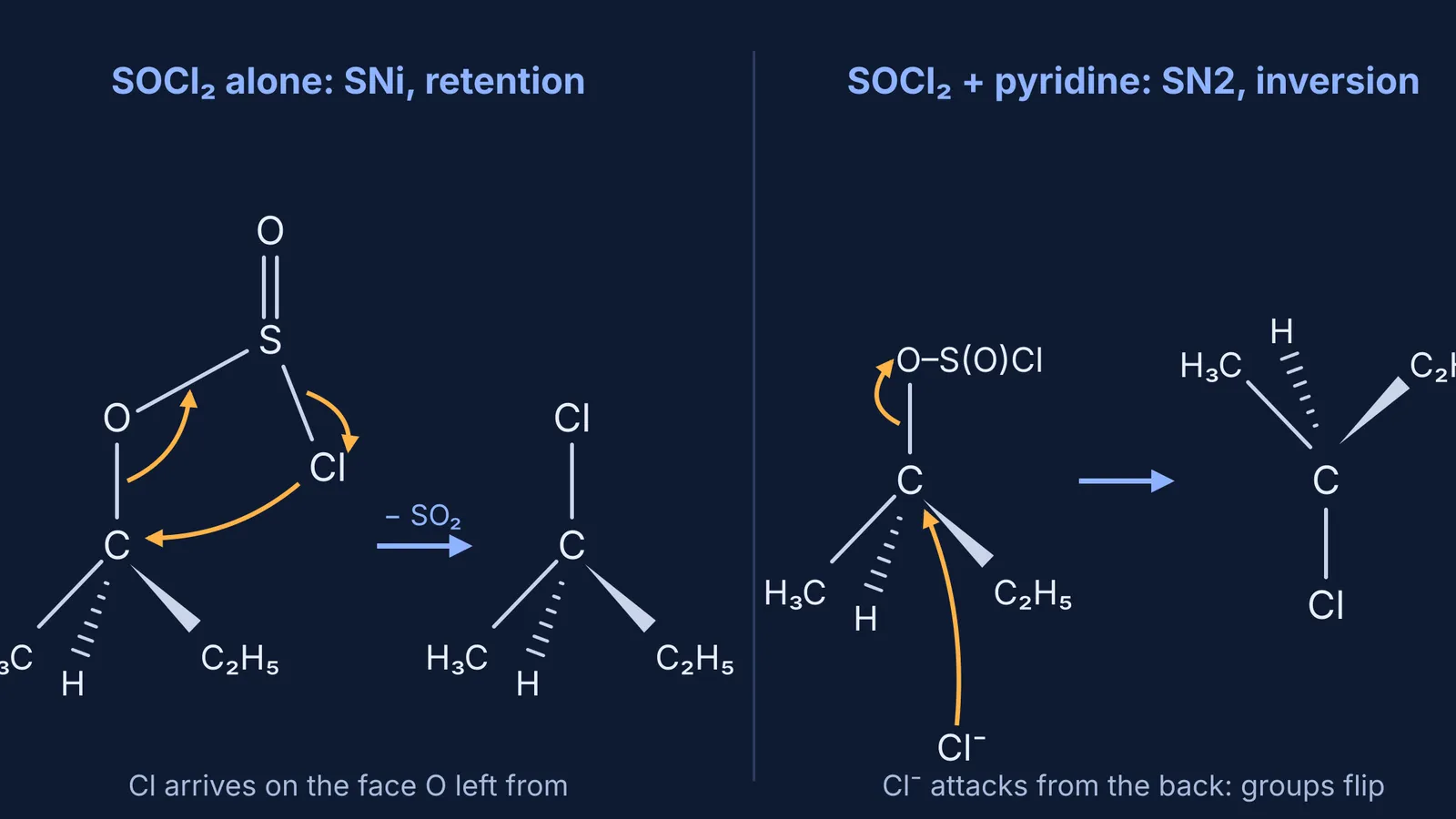
Thionyl chloride, SOCl₂, is the usual reagent for turning an alcohol into an alkyl chloride, partly because its by-products, SO₂ and HCl, escape as gases. That part is covered in why thionyl chloride is preferred for making alkyl chlorides. JEE questions go one step further: they start with a chiral alcohol and ask for the configuration of the chloride. The answer depends on one thing, whether pyridine is in the flask. Without it you get retention by the SNi mechanism. With it you get inversion by SN2.
What is the SNi mechanism?
SNi stands for substitution, nucleophilic, internal. The nucleophile, here chlorine, does not come from the solution. It is delivered from inside the leaving group that is already attached to the same carbon. Because it arrives on the same face that the oxygen leaves from, the new C–Cl bond takes the old C–O position, and the configuration is retained.
Compare this with the two mechanisms you already know:
SN2: the nucleophile attacks from the back, 180° from the leaving group, and the molecule turns inside out like an umbrella in the wind. This is Walden inversion.
SN1: the leaving group leaves first, giving a flat carbocation that can be attacked from either face, so the product is largely racemic.
SNi: chlorine is delivered from the front, the same side the leaving group was on, so the configuration is retained.
For a full comparison of the first two, see SN1 and SN2 stereochemistry: inversion and racemisation explained.
How does SOCl₂ turn an alcohol into a chlorosulphite?
The first step happens at sulphur, not at carbon. The oxygen of the alcohol uses a lone pair to attack the sulphur of SOCl₂, and one chloride is pushed off. The O–H proton is then lost, and it leaves with that chloride as HCl. The product is an alkyl chlorosulphite, R–O–S(=O)–Cl.
Two things matter here:
The C–O bond has not been touched. The stereocentre is exactly as it was in the alcohol.
The poor leaving group, –OH, has become –OS(O)Cl, which leaves easily because it breaks up into stable SO₂ and Cl⁻.
Everything that decides retention or inversion happens in the next step.
Why does SOCl₂ alone give retention?
With no base present, the C–O bond of the chlorosulphite ionises. The carbocation and the ⁻O–S(=O)–Cl anion do not drift apart. They stay together as a tight ion pair, held close in a cage of solvent molecules, with the anion still sitting on the face of the carbon that the oxygen just left.
The anion then falls apart. It loses SO₂, and its chlorine is handed to the carbocation from that same face, before the ion pair has time to separate or turn over. The back face is never attacked, because there is no free chloride in solution to attack it. The result is R–Cl with the chlorine where the oxygen used to be: retention of configuration.
Many textbooks draw this as a four-membered cyclic transition state with three curly arrows: the C–O bond electrons move to form a second S=O bond, the S–Cl bond electrons move onto chlorine, and a chlorine lone pair forms the new C–Cl bond. The ion-pair picture and the cyclic picture give the same answer: chlorine arrives on the front face.
Why does adding pyridine give inversion instead?
Pyridine, C₅H₅N, is a base. It mops up HCl as pyridinium chloride, C₅H₅NH⁺Cl⁻, which means free chloride ions are now in solution. Pyridine can also replace the chlorine on sulphur, giving R–O–S(=O)–N⁺C₅H₅ and releasing another Cl⁻.
Either way, the chlorosulphite (or its pyridinium version) is now surrounded by free Cl⁻, and it carries an excellent leaving group. A chloride ion attacks the carbon from the back, opposite the C–O bond, in a single step. The C–O bond breaks as the C–Cl bond forms. This is an SN2 reaction, so you get inversion of configuration. It is the same Walden inversion you meet in any SN2 reaction; the only difference is that the leaving group was built from SOCl₂.
Worked example: (R)-butan-2-ol with SOCl₂, with and without pyridine
Question: (R)-butan-2-ol is treated (a) with SOCl₂ alone and (b) with SOCl₂ in pyridine. Give the configuration of 2-chlorobutane in each case.
Rank the groups on C2 in the alcohol. OH (oxygen, atomic number 8) > C₂H₅ > CH₃ > H. The ethyl beats methyl because at the first point of difference its carbon carries (C, H, H) against (H, H, H). The alcohol is R.
Rank the groups on C2 in the chloride. Cl > C₂H₅ > CH₃ > H. Chlorine takes the rank 1 that OH had. The other three keep their ranks.
Case (a), SOCl₂ alone: SNi, retention. Chlorine sits exactly where OH was, and the other three groups have not moved. Same positions, same priority order, so the product is (R)-2-chlorobutane.
Case (b), SOCl₂ with pyridine: SN2, inversion. Chloride enters opposite the old C–O bond and the other three groups flip. The product is (S)-2-chlorobutane.
Optical rotation. You cannot predict whether either product is (+) or (−) from R or S. The sign is measured, not deduced from the letter.
If you want to rehearse step 1 on other structures, here is how to assign R or S from a wedge-dash structure.
What should you write for SNi, SN2 and SN1 in the exam?
SOCl₂, no base (SNi): alcohol → chlorosulphite → tight ion pair → Cl delivered to the front face → retention. By-products SO₂ and HCl.
SOCl₂ with pyridine (SN2): chlorosulphite → back-side attack by free Cl⁻ → inversion. HCl is trapped as pyridinium chloride.
Free carbocation (SN1): flat intermediate attacked from both faces → largely racemic product.
In a mechanism answer, show the chlorosulphite first, then mark which face the chlorine arrives on. Examiners look for that face, not just the final formula.
If the umbrella flip is hard to picture, the Concept Library covers substitution mechanisms along with every other concept in chemistry, so you can revisit SN2 before tackling SNi questions.
Quick checklist
SNi = substitution, nucleophilic, internal: the nucleophile comes from the leaving group itself.
SOCl₂ first makes R–O–S(O)Cl; the stereocentre is unchanged at this stage.
No pyridine: tight ion pair, front-side chlorine, retention.
With pyridine: free Cl⁻, back-side attack, inversion.
Re-rank priorities in the product before writing R or S.
(R)-butan-2-ol gives (R)-2-chlorobutane with SOCl₂ alone and (S)-2-chlorobutane with SOCl₂ and pyridine.


