On this page
For about sixty years, chemists described a red or yellow powder as a lower oxide of phosphorus, P₄O. In 1899 David Leonard Chapman and F. Austin Lidbury, at the Owens College, Manchester, showed that it was simply finely divided red phosphorus. Their strongest evidence was arithmetic. Every carefully dried sample contained more phosphorus than the formula P₄O allows, and no compound can do that.
The paper is D. L. Chapman and F. A. Lidbury, "Non-existence of the so-called Suboxide of Phosphorus", J. Chem. Soc. Trans. 75 (1899) 973–978 (DOI 10.1039/CT8997500973; scan on the Internet Archive). Numbers and quotes below were checked against the page images. This Chapman is not Sydney Chapman of the ozone cycle; they are different people.
What was the "suboxide of phosphorus"?
The paper traces the idea back through earlier work:
Le Verrier (1838) made a red substance from white phosphorus covered with phosphorus trichloride and left in air. Its phosphorus content matched P₄O.
Von Schrötter (1852) doubted it. He thought it was impure amorphous phosphorus, a form he had discovered in 1845.
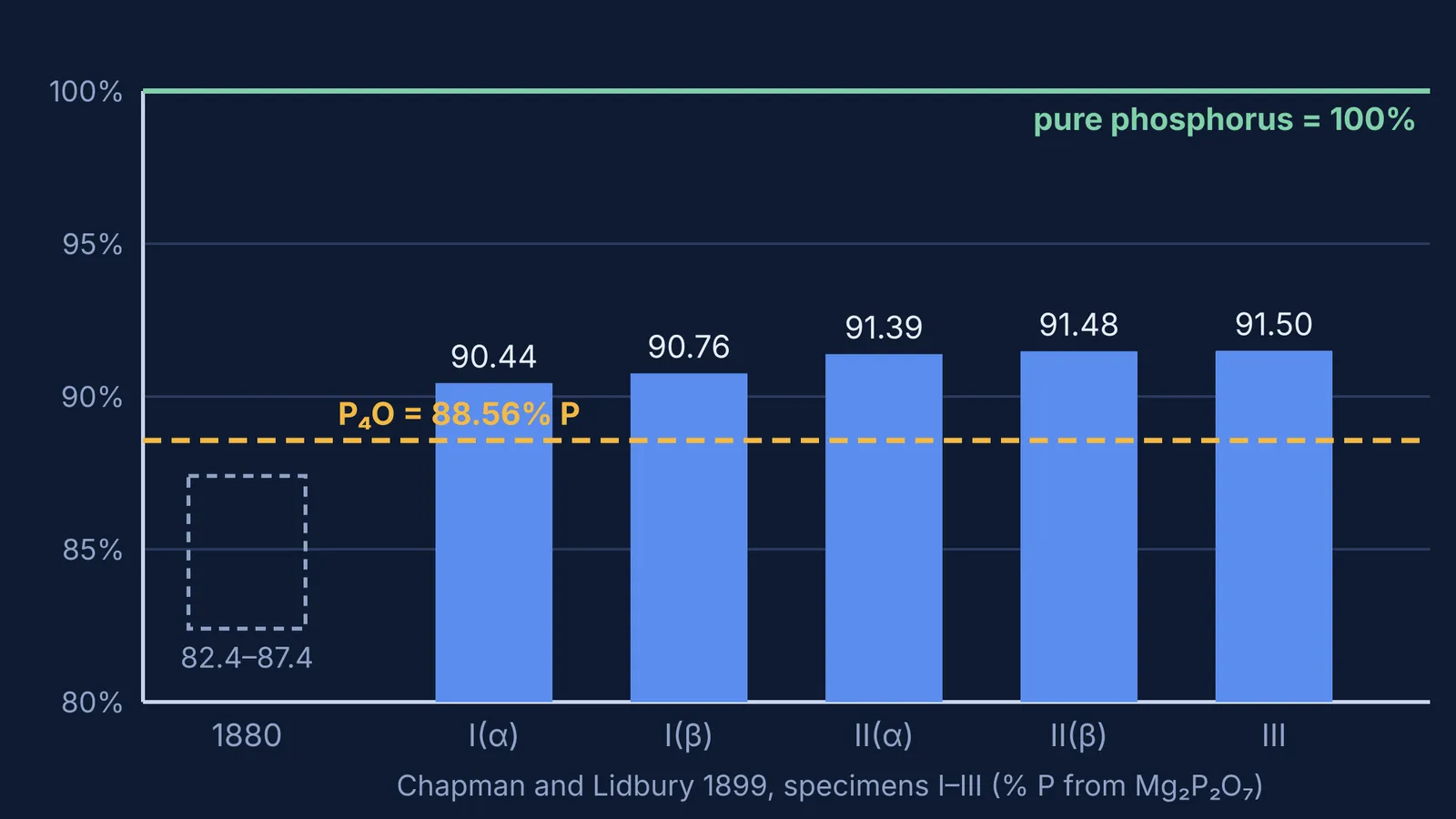
Goldschmidt and Reinitzer (1880) made a similar red substance from phosphorus oxychloride with zinc, magnesium or aluminium. Their work was "generally accepted as affording conclusive proof" of P₄O. Their dried samples gave only 82.4–87.4% phosphorus, below the 88.57% the formula needs. They blamed water. After subtracting the hydrogen as water, they found a P : O atom ratio of 4.01 : 1.
Michaelis and Pitsch (1899) made a yellow form by acidifying the red solution that white phosphorus gives with alcoholic alkali. Some samples had more than 88.57% phosphorus. They blamed free phosphorus thrown down with it.
Notice the pattern (this reading is ours). Low results were blamed on water and high results on free phosphorus. With two adjustable excuses, almost any analysis can be made to fit.
How did Chapman and Lidbury compare it with red phosphorus?
They made the "suboxide" by the published routes. They set it beside very finely divided red phosphorus, made by a sunlight method published by Pedler in 1890. Then they looked for any difference:
Colour. Both ranged from yellow to orange-red depending on how closely the particles packed. "The respective tints are the same in each case."
Microscope. All specimens were "extremely small, translucent particles transmitting yellow light".
Heating in a vacuum. All gave off phosphorus vapour at about 350 °C.
Alkali. Both were "acted on rapidly by caustic alkalis with formation of phosphine".
Water. Both were attacked slowly, giving phosphine, and the filtrates reduced silver nitrate, a sign of the lower phosphorus acids.
Why had red phosphorus seemed inert to alkali before? Commercial red phosphorus has its particles "closely cemented together in large blocks which expose but a small surface". Grind the particles fine and keep them separate, and red phosphorus behaves like the "suboxide".
Why do the analyses rule out P₄O?
Here is a worked example using their gravimetric data. The phosphorus was converted to phosphate and weighed as magnesium pyrophosphate, Mg₂P₂O₇.
Percent P in P₄O. M = 4 × 30.974 + 15.999 = 139.90 g mol⁻¹. P = 123.90 ÷ 139.90 × 100 = 88.56%. The paper's 88.57% matches P = 31 and O = 16.
Phosphorus in the precipitate. Mg₂P₂O₇ has M = 222.55 and contains two P, so the mass fraction of P is 61.95 ÷ 222.55 = 0.2784. This is the familiar NCERT formula, %P = (62 ÷ 222) × (mass of Mg₂P₂O₇ ÷ mass of sample) × 100.
Specimen I(a). 0.1245 g gave 0.4045 g Mg₂P₂O₇. P = 0.4045 × 0.2784 = 0.1126 g, which is 90.44% (paper 90.5).
The other four analyses. Done the same way: 0.26405 g gave 0.86095 g, so 90.76% (paper 90.8); 0.27565 g gave 0.9050 g, so 91.39% (paper 91.41); 0.2279 g gave 0.7490 g, so 91.48% (paper 91.45); 0.1369 g gave 0.4500 g, so 91.50% (paper 91.51).
Compare. All five lie between 90.4% and 91.5%, above 88.56%. Water, acids or oxide as impurities would lower the phosphorus figure, not raise it. So the samples cannot be P₄O plus the usual impurities.
Test the rescue. Suppose the sample were P₄O mixed with a fraction f of free phosphorus. Then 100f + 88.56(1 − f) = x, so f = (x − 88.56) ÷ 11.44. At 90.5%, f = 17%; at 90.8%, f = 20%; at 91.5%, f = 26%.
Judge it. The paper says "19 per cent", which sits nearer our 90.8% figure than the 90.5% one. Either way, every preparation would need a large and different dose of free phosphorus. Chapman and Lidbury found it "more probable" that the product was impure red phosphorus.
A fifth result, specimen IV, is printed as "0·2019 gave 0·7161 Mg₂P₂O₇. P = 94·52 per cent." The scan is clear, but those numbers do not agree with each other: 0.7161 × 0.2784 ÷ 0.2019 gives 98.7%. A sample mass of 0.2109 g would give 94.5%, so a swapped digit is likely. We cannot tell which figure is wrong, so we leave IV out.
The Mg₂P₂O₇ method itself, and how phosphorus is detected first, are covered in detection of phosphorus in organic compounds.
Where did the "oxygen" come from?
Their answer was water and surface chemistry. Even after long drying, the powders released water vapour and phosphine when heated in a vacuum. Water "even at ordinary temperatures, acts on red phosphorus, forming phosphine and the lower acids". Microscopic particles have a huge surface, so a lot of these products can form.
This is disproportionation: phosphorus at 0 goes partly to −3 in PH₃ and partly to +1 or +3 in the lower acids. The paper writes no equations. Two balanced illustrations (ours) are P₄ + 6H₂O → PH₃ + 3H₃PO₂ and P₄ + 6H₂O → 2PH₃ + 2H₃PO₃. The NCERT equation for white phosphorus with alkali is the same idea: P₄ + 3NaOH + 3H₂O → PH₃ + 3NaH₂PO₂.
Their conclusion: "our analyses are entirely inconsistent with the hypothesis that a definite oxide of the formula P₄O exists." That rules out this P₄O only. The oxides P₄O₆ and P₄O₁₀ in your textbook are separate, well-established compounds. For the structures of white and red phosphorus, see white vs red phosphorus. White phosphorus catches fire in air and phosphine is toxic, so nothing here is a procedure.
Where does this show up in JEE and NEET?
Class 12 p-block: allotropes of phosphorus, and phosphine from phosphorus by disproportionation.
Class 11 Some Basic Concepts: percentage composition, and checking a proposed formula against analysis.
Class 11 Organic chemistry: estimating phosphorus as Mg₂P₂O₇.
To see allotropy and disproportionation as linked ideas, the Concept Library gives each chemistry concept its own lesson. For more percentage-composition problems, the Fermi Problem Library has a step-by-step solver that explains the reasoning.
Quick checklist
1838–1899: a red or yellow powder was taken to be P₄O, which needs 88.56% P.
Chapman and Lidbury (1899) found it identical to finely divided red phosphorus.
Their five analyses gave 90.4–91.5% P, too much for P₄O.
%P = (62 ÷ 222) × (mass of Mg₂P₂O₇ ÷ mass of sample) × 100.
The "oxygen" was adsorbed water and surface products such as lower acids.
P₄O₆ and P₄O₁₀ are real; this P₄O was not.