On this page
The bottle says "gold chloride", but the crystals inside are not AuCl₃. The Indian Standard for the electroplating grade, IS 6588:1972, says the material shall "correspond essentially to the formula AuCl₃.HCl.4H₂O". That is chloroauric acid, H[AuCl₄]·4H₂O. Its two main limits, at least 47.8% gold and at most 34.4% chloride, are not arbitrary numbers. They are the percentage composition of that formula, which you can work out yourself with Class 11 mole concept. The test methods behind them are a neat tour of redox, n-factors and gravimetric analysis.
What is gold chloride in the BIS standard?
You can read IS 6588:1972 on the Internet Archive (reaffirmed 2003). Its foreword calls gold chloride "an important starting material for a variety of gold preparations", used in electroplating, decoration of glass and pottery, and electronics. It describes bright golden-yellow crystals, "affected by exposure to sunlight" and "very soluble in water". The standard also warns that it has "a caustic action causing blisters on the skin". This post sticks to the composition and the arithmetic; it gives no handling or plating advice.
Why the name? AuCl₃·HCl is the same set of atoms as HAuCl₄. In the crystal and in water, the gold sits in the complex anion [AuCl₄]⁻, and the H⁺ is its counter-ion. The NCERT-style name is hydrogen tetrachloridoaurate(III). It is the compound gold forms when it dissolves in aqua regia, as our post on why aqua regia dissolves gold explains.
Table 1 of the standard sets five limits:
matter insoluble in ether: max 0.1%
gold (as Au): min 47.8%
chlorides (as Cl): max 34.4%
alkalis and other metals (as sulphates): max 0.2%
nitrates (as NO₃): max 0.05%
Where do 47.8% and 34.4% come from?
Worked example: find % Au and % Cl in H[AuCl₄]·4H₂O.
Molar mass. H 1.008 + Au 196.967 + 4 × Cl 35.453 + 4 × H₂O 18.015 = 411.85 g/mol.
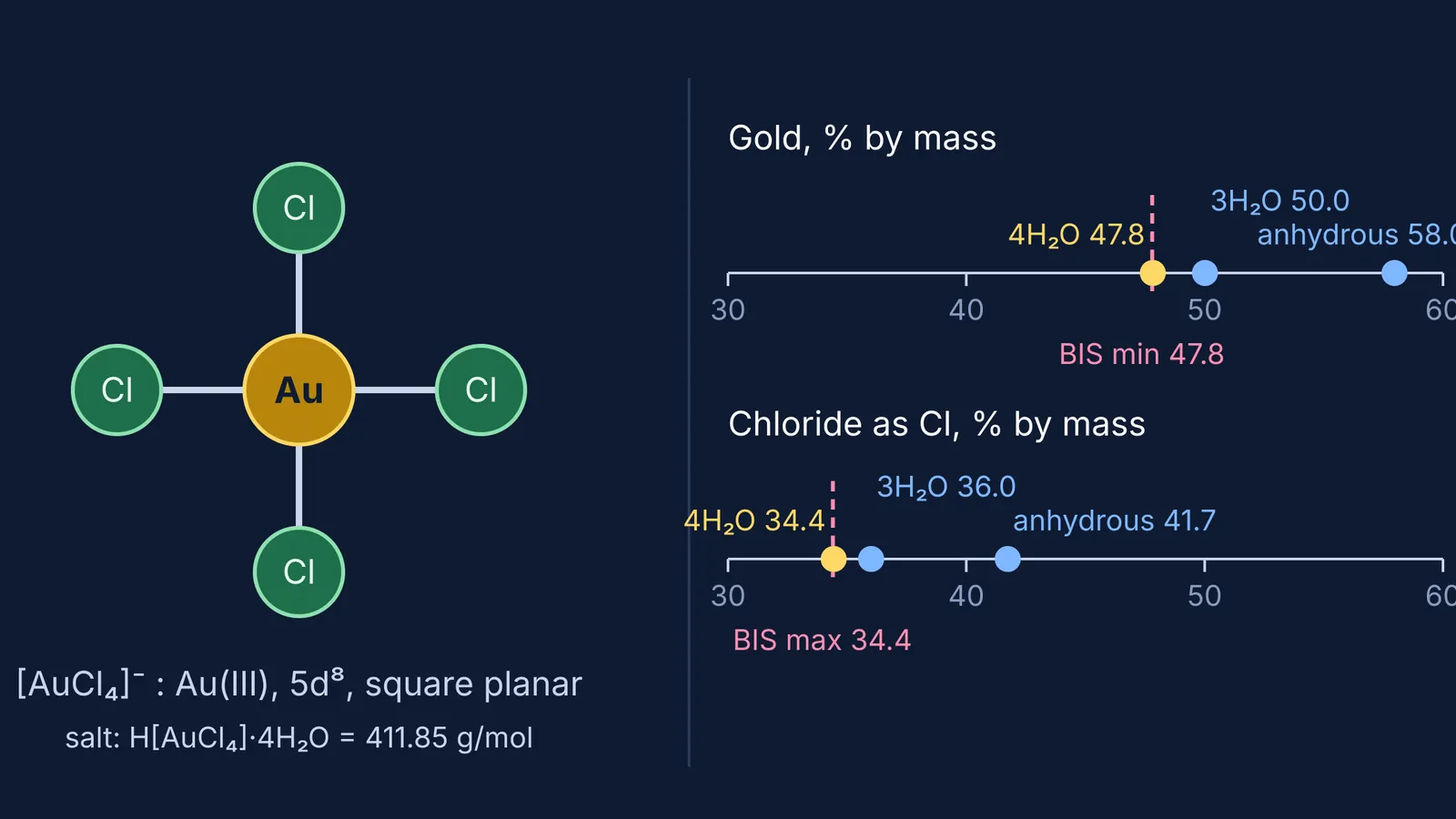
Gold. 196.967/411.85 × 100 = 47.83%. BIS minimum: 47.8.
Chloride. 4 × 35.453/411.85 × 100 = 141.81/411.85 × 100 = 34.43%. BIS maximum: 34.4.
Water. 4 × 18.015/411.85 × 100 = 17.50%. The remaining 0.24% is the acidic hydrogen.
Both limits are the formula, rounded to one decimal as the standard's foreword requires. So a pure, exactly hydrated sample only just passes both. Now try other hydrates:
trihydrate, H[AuCl₄]·3H₂O (393.83 g/mol): 50.01% Au, 36.01% Cl
anhydrous H[AuCl₄] (339.79 g/mol): 57.97% Au, 41.74% Cl
Losing water raises the gold figure, which the minimum allows. But it raises chloride too, and 36.0% fails the 34.4% maximum. Extra moisture does the opposite: just 0.2% of it pulls gold down to 47.73%, which rounds to 47.7 and fails. Between them, the two limits pin the crystals to the tetrahydrate. That is also why the label must show "net mass, with mass of equivalent gold in bracket": 100 g of salt carries 47.8 g of gold, and 1 g of gold needs 2.09 g of salt.
How does oxalic acid get the gold back?
Section A-3 of the standard evaporates the ether solution from the first test, redissolves the residue in water, adds sulphuric acid and saturated oxalic acid, boils for an hour, filters off the metal and ignites it at 900 °C. The residue is weighed as gold. % Au = W₂/W × 100.
Balance the redox step with oxidation numbers:
Au goes from +3 in AuCl₄⁻ to 0: gains 3 electrons.
C goes from +3 in H₂C₂O₄ to +4 in CO₂: two carbons, so each oxalic acid loses 2 electrons.
Least common multiple 6: two AuCl₄⁻ take six electrons from three H₂C₂O₄.
2AuCl₄⁻ + 3H₂C₂O₄ → 2Au + 6CO₂ + 8Cl⁻ + 6H⁺
Check atoms: 2 Au, 8 Cl, 6 C, 12 O and 6 H on each side. Check charge: −2 on the left, −8 + 6 = −2 on the right. The n-factor of Au(III) here is 3, so its equivalent mass is 196.967/3 = 65.66. Oxalic acid's n-factor is 2. The same 2-electron change is behind the KMnO₄ titration in your practical; see the n-factor and the equivalent concept.
Notice that all four chlorines end up as free Cl⁻. That is what the next test needs.
Why is the chloride factor 24.74?
Section A-4 takes the filtrate from the gold step, adds nitric acid and silver nitrate, and weighs the AgCl precipitate (W₃). The standard's formula is % Cl = 24.74 × W₃/W.
The factor is the fraction of AgCl that is chlorine, times 100: 100 × 35.453/143.32 = 24.74. It matches BIS exactly.
Numbers for the sample size the standard uses, about 2.5 g:
Moles of salt = 2.5/411.85 = 6.07 × 10⁻³ mol.
Gold expected = 6.07 × 10⁻³ × 196.967 = 1.196 g.
Chloride = 4 × 6.07 × 10⁻³ = 0.0243 mol, so AgCl expected = 0.0243 × 143.32 = 3.48 g.
Check: 24.74 × 3.48/2.5 = 34.4%.
Oxalic acid needed = 1.5 × 6.07 × 10⁻³ = 9.1 × 10⁻³ mol (0.82 g anhydrous), giving 0.0182 mol CO₂.
The standard adds 30 mL of about 1 N silver nitrate, roughly 0.030 mol. That is about 1.2 times the 0.0243 mol of chloride, so the precipitation is complete with some excess, which the standard then removes in A-5.
Why is AuCl₄⁻ square planar?
Gold is [Xe]4f¹⁴5d¹⁰6s¹. Au³⁺ has lost three electrons, leaving 5d⁸. Like Pt²⁺ in [PtCl₄]²⁻ and Ni²⁺ in [Ni(CN)₄]²⁻, it is a d⁸ ion with four ligands arranged in a square plane. For 5d ions the crystal field splitting is large, so square planar is the rule even with Cl⁻ (unlike [NiCl₄]²⁻, which is tetrahedral). All eight d electrons pair up in the four lower d orbitals, so AuCl₄⁻ is diamagnetic. In fact AuCl₄⁻ and [PtCl₄]²⁻ are isoelectronic. For why heavy d⁸ ions prefer this shape, see why d⁸ ions like Pt²⁺ form square planar complexes.
Why test for ether-insoluble matter and nitrate?
The standard gives the methods but not the reasons, so treat these as reasoned guesses. Section A-2 dissolves the sample in ether and weighs whatever stays behind, so the acid itself must dissolve in ether. Why might that be useful? Dirt and many inorganic salts would not dissolve, so they show up as residue. Why might nitrate matter? Gold is usually brought into solution with aqua regia, which contains nitric acid, so nitrate is a plausible leftover. The indigo carmine test passes if "the blue colour does not stay longer than 30 seconds".
For more percentage-composition and n-factor practice in exam format, Fermi Test Prep is built for JEE Main and Advanced preparation with an AI tutor. If d⁸ geometry still feels shaky, the Concept Library gives each concept its own lesson.
Quick checklist
BIS "gold chloride" is H[AuCl₄]·4H₂O, M = 411.85 g/mol.
Au 47.83% and Cl 34.43% are the BIS limits 47.8 and 34.4.
The trihydrate would fail the chloride maximum.
2AuCl₄⁻ + 3H₂C₂O₄ → 2Au + 6CO₂ + 8Cl⁻ + 6H⁺: n = 3 for Au(III), 2 for oxalic acid.
AgCl factor: 100 × 35.453/143.32 = 24.74.
Au³⁺ is 5d⁸, so AuCl₄⁻ is square planar and diamagnetic.