

On this page
If you have learned that Ni²⁺, Pd²⁺ and Pt²⁺ all have eight d electrons, the next exam question is usually why their four-coordinate complexes so often lie flat, with the four ligands at the corners of a square. The short answer: a square planar field pushes one d orbital far above the other four, and eight electrons fit exactly into those four lower orbitals.
Why does a square planar field split the d orbitals so unevenly?
Crystal field theory treats the ligands as negative charges that repel the metal's d electrons, so the orbitals closest to the ligands rise in energy (Wikipedia: crystal field theory). For the history of the idea, see our piece on Hans Bethe and the crystal field that splits d orbitals.
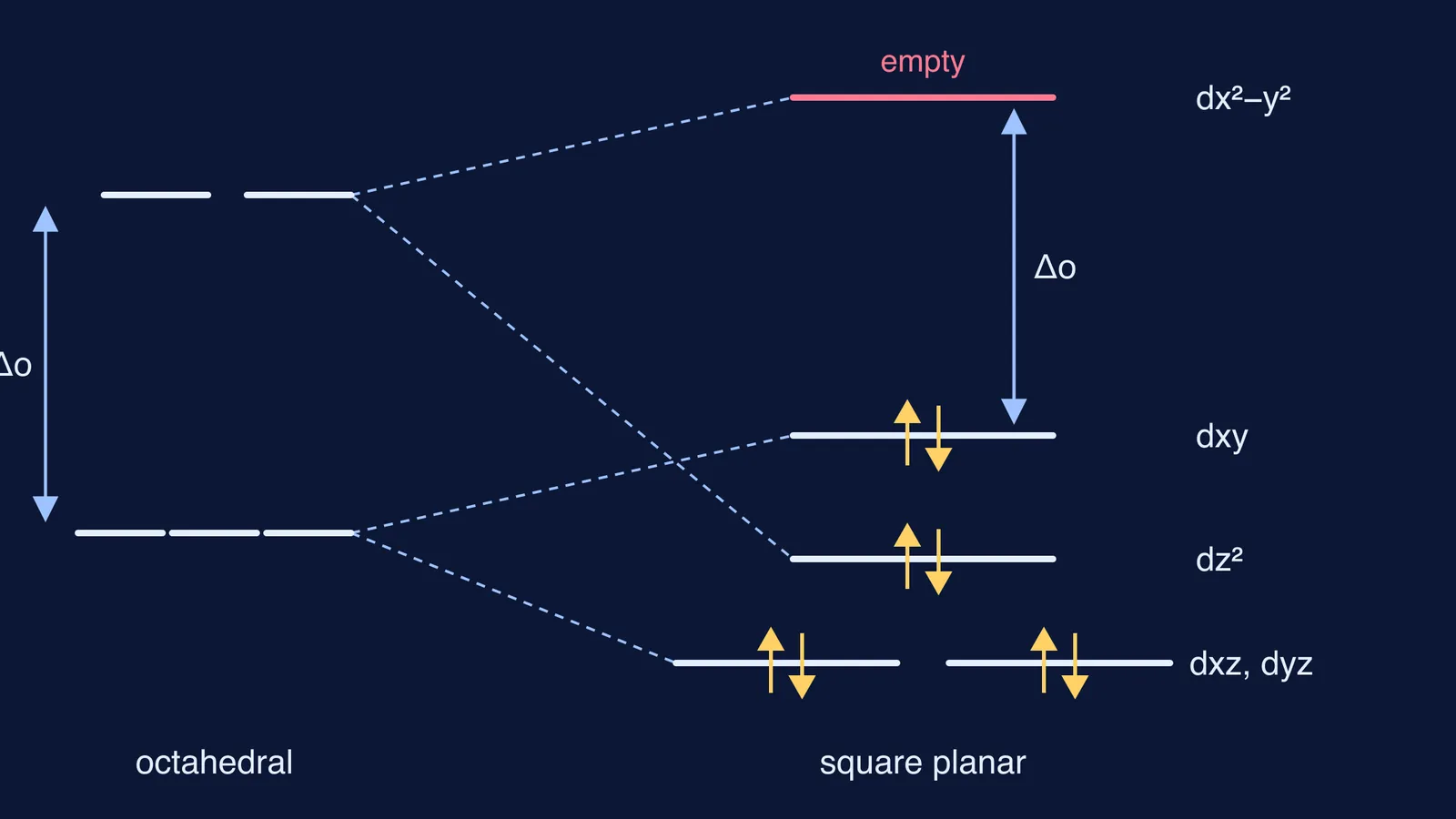
Now put four ligands on the x and y axes. The dx²−y² orbital points its four lobes straight at all four ligands, so it is pushed highest. The other four orbitals sit well below it, and their exact order depends on the ligands (Wikipedia: square planar molecular geometry).
In the simple crystal field model, the gap between dx²−y² and dxy is equal in size to Δo, the full octahedral splitting (LibreTexts: non-octahedral complexes).
Why does the dx²−y² orbital stay empty in d8 complexes?
Count the electrons. Eight d electrons fill four orbitals exactly, two in each. The same LibreTexts page puts it plainly: the dx²−y² level is the most destabilised and is left unfilled (LibreTexts). Every electron is paired, so the complex is diamagnetic.
Pairing has a cost: two electrons in one orbital repel each other. The alternative is to lift one electron into dx²−y², which means climbing that Δo-sized step. Square planar wins when the step is bigger than the pairing cost, and a strong-field ligand or a heavy metal makes the step bigger.
The tetrahedral shape is the competitor. A tetrahedral field splits the d orbitals only about 4/9 as much as an octahedral one with the same metal and ligands (Wikipedia: crystal field theory), so the electrons spread out instead. A LibreTexts course page uses this exact pair: [PdCl₄]²⁻ is diamagnetic, which points to square planar, while [NiCl₄]²⁻, also d8, has two unpaired electrons, which points to tetrahedral (LibreTexts: high spin and low spin).
Why does Ni²⁺ need CN⁻ but Pt²⁺ does not?
Two things set the size of the step: the ligand and the metal.
The ligand first. The spectrochemical series puts Cl⁻ near the weak end and CN⁻ near the strong end (Wikipedia: crystal field theory). With cyanide, [Ni(CN)₄]²⁻ is square planar, low-spin and diamagnetic (Wikipedia: spin states). With chloride, nickel goes tetrahedral.
Then the metal. Pd²⁺ has a larger d-orbital splitting than Ni²⁺ (LibreTexts: high spin and low spin), and complexes of second- and third-row transition metals are low-spin (Wikipedia: spin states). One course text says practically all 4d and 5d d8 ML₄ complexes adopt a square planar geometry, whether or not the ligands are strong-field (LibreTexts, Westminster College). That is why [PdCl₄]²⁻ is square planar even though chloride is a weak ligand.
Platinum is the textbook case. The anticancer drug cisplatin, [PtCl₂(NH₃)₂], is square planar, and the same geometry is common for Rh(I), Ir(I), Pd(II) and Au(III) (Wikipedia: square planar molecular geometry). Our guide to deciding between high spin and low spin has more examples.
How do you predict the shape of a d8 complex in an exam?
Use these four checks, in order:
Confirm d8. In [Ni(CN)₄]²⁻, four CN⁻ give −4 and the overall charge is −2, so nickel is +2. Ni is 3d⁸4s², so Ni²⁺ is 3d⁸.
Count the ligands. Six ligands means octahedral, as in [Ni(NH₃)₆]²⁺, which has two unpaired electrons (Wikipedia: spin states). The square planar question only comes up with four.
Check the row. A 4d or 5d d8 ion (Pd²⁺, Pt²⁺, Au³⁺) with four ligands: square planar is almost always the answer.
For a 3d ion such as Ni²⁺, check the ligand. Strong field (CN⁻): square planar, diamagnetic, dsp² in valence bond language. Weak field (Cl⁻): tetrahedral, two unpaired electrons, sp³.
Try it on [PtCl₄]²⁻. Pt is +2 and d8, there are four ligands, and platinum is a 5d metal, so step 3 settles it: square planar, even with chloride.
If a problem trips you up at one of these steps, the Fermi Problem Library has worked problems with a step-by-step solver that explains the reasoning rather than printing an answer. If crystal field splitting itself is the gap, the Fermi Concept Library gives each chemistry concept its own lesson and its place in the map.
The same splitting also explains colour: read our explainer on why transition metal complexes are coloured.


