

On this page
In 1929 Hans Bethe asked what happens to an atom's energy levels inside a crystal, surrounded by other ions. His answer became crystal field theory, the reason your NCERT textbook can explain why titanium(III) in water is violet.
Who was Hans Bethe in 1929?
Bethe was born on 2 July 1906 in Strasbourg and finished his PhD under Arnold Sommerfeld in Munich in 1928, according to his Wikipedia biography. Much later he won the 1967 Nobel Prize in Physics for explaining how stars make their energy, a story we tell in Hans Bethe and the nuclear reactions that make stars shine. The crystal field paper came first, when quantum mechanics was only a few years old.
How did Hans Bethe develop crystal field theory?
His paper, Termaufspaltung in Kristallen (Term splitting in crystals), filled pages 133 to 208 of Annalen der Physik. As its abstract describes it, the approach comes down to three steps.
Replace the neighbouring ions with an electric field that has the symmetry of the crystal, the crystal field.
Treat the atom in that field with wave mechanics (the Schrodinger equation).
Use the field's symmetry to work out which energy levels split and into how many groups.
The central finding: an atom's levels split in a way set by the symmetry of the field and the angular momentum l of the electrons. In a cubic field, for example, p levels do not split at all.
The key move was symmetry: the shape of the surroundings, not every detail of the crystal, decides how the levels break apart.
Others carried the idea into chemistry: John Van Vleck applied it to the magnetism of iron-group salts in 1932, and Leslie Orgel to the properties of transition-metal ions in 1952.
Why do d orbitals split, and why does that make colour?
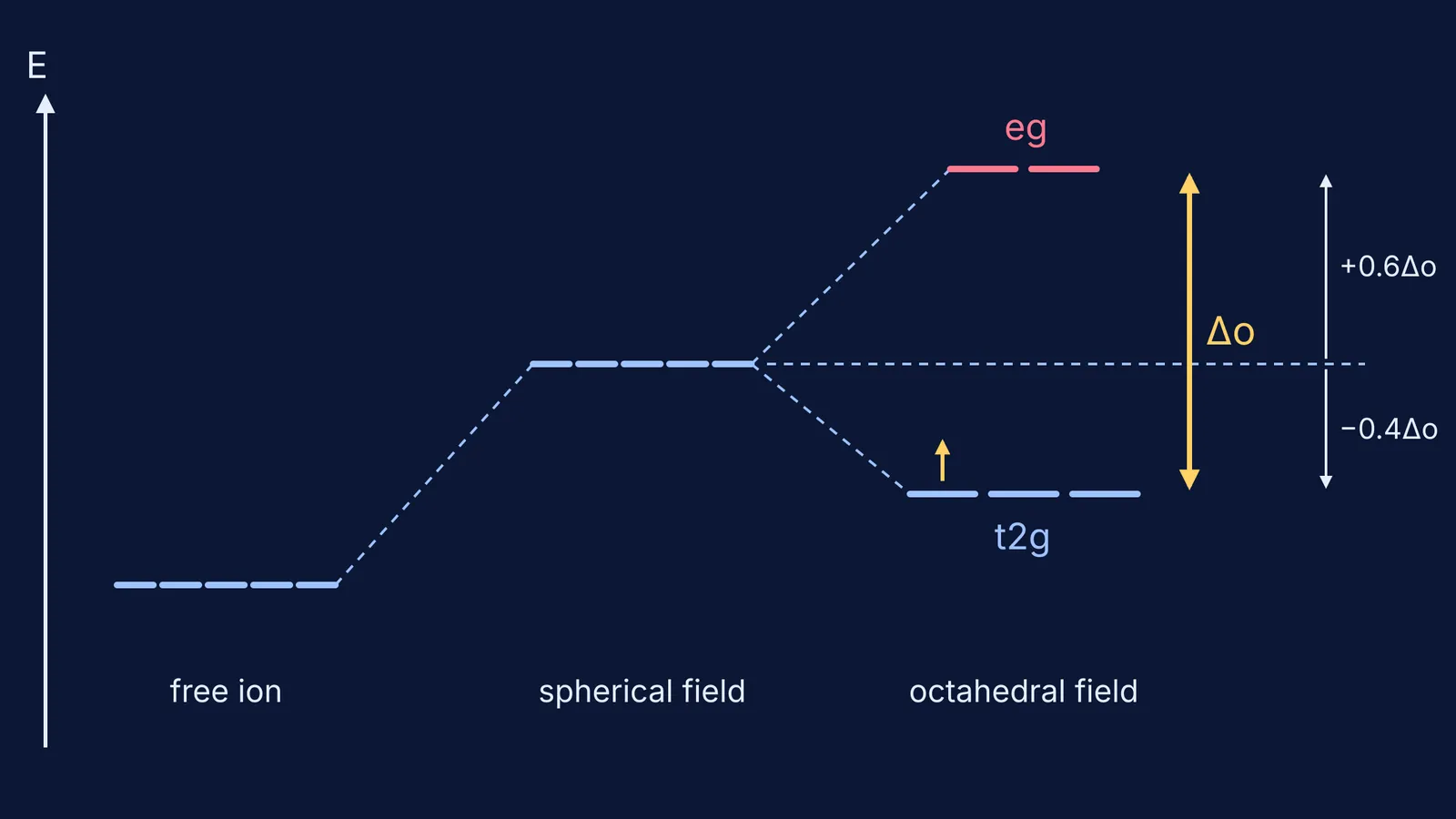
The NCERT Class 12 chemistry chapter on coordination compounds (section 5.5.4) gives the version you need for board exams, JEE Main and NEET-UG. It treats ligands as point charges or dipoles. In a free ion the five d orbitals have the same energy. Now place six ligands along the x, y and z axes, an octahedron. The dx²-y² and dz² orbitals point straight at the ligands, so their electrons are repelled more and rise in energy; these two form the eg set. The dxy, dyz and dxz orbitals point between the axes and drop; these three form the t2g set. The gap between them is the crystal field splitting, Δo.
NCERT states that the eg orbitals rise by 3/5 Δo and the t2g orbitals fall by 2/5 Δo, measured from the average energy (NCERT, Fig. 5.8). For a tetrahedral complex the splitting is inverted and Δt = (4/9) Δo.
Colour follows: a complex absorbs the light whose energy matches the jump from t2g to eg, and you see the complementary colour of what is left.
Worked example: how big is Δo for violet titanium(III)?
NCERT's Table 5.3 says [Ti(H2O)6]3+ absorbs at 498 nm, in the blue-green, and so looks violet (NCERT, section 5.5.5). Ti3+ is 3d¹, so its one electron sits in t2g and jumps to eg. That makes the absorbed photon's energy a direct estimate of Δo.
Photon energy: E = hc/λ = (6.626 × 10⁻³⁴ J s × 2.998 × 10⁸ m/s) / (498 × 10⁻⁹ m) = 3.99 × 10⁻¹⁹ J.
In electronvolts: 3.99 × 10⁻¹⁹ J ÷ 1.602 × 10⁻¹⁹ J/eV = 2.49 eV.
Per mole: 3.99 × 10⁻¹⁹ J × 6.022 × 10²³ mol⁻¹ = 2.40 × 10⁵ J/mol, about 240 kJ/mol.
As a wavenumber: 1 / (498 × 10⁻⁷ cm) = about 20,100 cm⁻¹.
Try it yourself: NCERT lists [Cu(H2O)4]2+ as absorbing at 600 nm. Longer wavelength means a smaller gap, about 2.07 eV.
How do you answer crystal field questions in exams?
Use this four-step check on any complex.
Geometry: octahedral (eg above t2g) or tetrahedral (inverted, and smaller)?
Electron count: work out the metal's oxidation state and its dⁿ configuration.
Ligand strength: place each ligand in the spectrochemical series. NCERT gives I⁻ < Br⁻ < SCN⁻ < Cl⁻ < S²⁻ < F⁻ < OH⁻ < C2O4²⁻ < H2O < NCS⁻ < edta⁴⁻ < NH3 < en < CN⁻ < CO. Stronger ligands give a larger Δo.
Pairing: if Δo is larger than the pairing energy P, electrons pair in t2g (low spin); if smaller, they enter eg (high spin).
For naming and isomerism before you get here, see coordination compounds: naming, isomerism and crystal field basics. To compare with the hybridisation picture, which NCERT says cannot explain colour, read valence bond theory for complexes.
If the five orbitals are hard to picture in three dimensions, the Fermi Simulation Lab has interactive simulations for ideas that are easier to see than to read. For a gap in an earlier idea, such as orbital shapes or electron configuration, the Fermi Concept Library gives each concept its own lesson.


