On this page
Why does the Sun keep shining? Physicists knew that nuclear reactions can release huge amounts of energy, but nobody had shown which reactions a star actually uses. In 1939 Hans Bethe answered that question in one long paper, and in 1967 it won him the Nobel Prize in Physics. This post covers what he found, works through the mass-energy sum behind sunlight, and shows what a student can learn from his method.
Who was Hans Bethe?
His Nobel Prize facts page says he was born in Strasbourg on 2 July 1906 and died in Ithaca, New York, on 6 March 2005. His Nobel biography records a PhD in theoretical physics under Arnold Sommerfeld in Munich in 1928. He lost his post at Tübingen when the Nazis came to power, moved to England in 1933 and joined Cornell University in February 1935, where he stayed for the rest of his career. During the Second World War he worked on the atomic bomb; he later opposed nuclear weapons.
The prize citation reads: "for his contributions to the theory of nuclear reactions, especially his discoveries concerning the energy production in stars".
What did the 1939 paper show?
The paper, Energy Production in Stars, appeared in Physical Review on 1 March 1939. Its abstract says the most important source of energy in ordinary stars is a cycle of reactions of carbon and nitrogen with protons:
C-12 + H → N-13, then N-13 → C-13 + positron
C-13 + H → N-14
N-14 + H → O-15, then O-15 → N-15 + positron
N-15 + H → C-12 + He-4
The carbon-12 comes back at the end. Carbon and nitrogen are only catalysts for joining four protons into one helium nucleus. For fainter, cooler stars he pointed to a second route that begins with two protons forming deuterium, the proton-proton chain.
He checked the answer against astronomy. To give the Sun's energy output, his cycle needed a central temperature of 18.5 million degrees; the Eddington equations of stellar structure gave 19 million. The Nobel biography adds that his "main achievement" was ruling out the other possible nuclear reactions.
Which process powers the Sun?
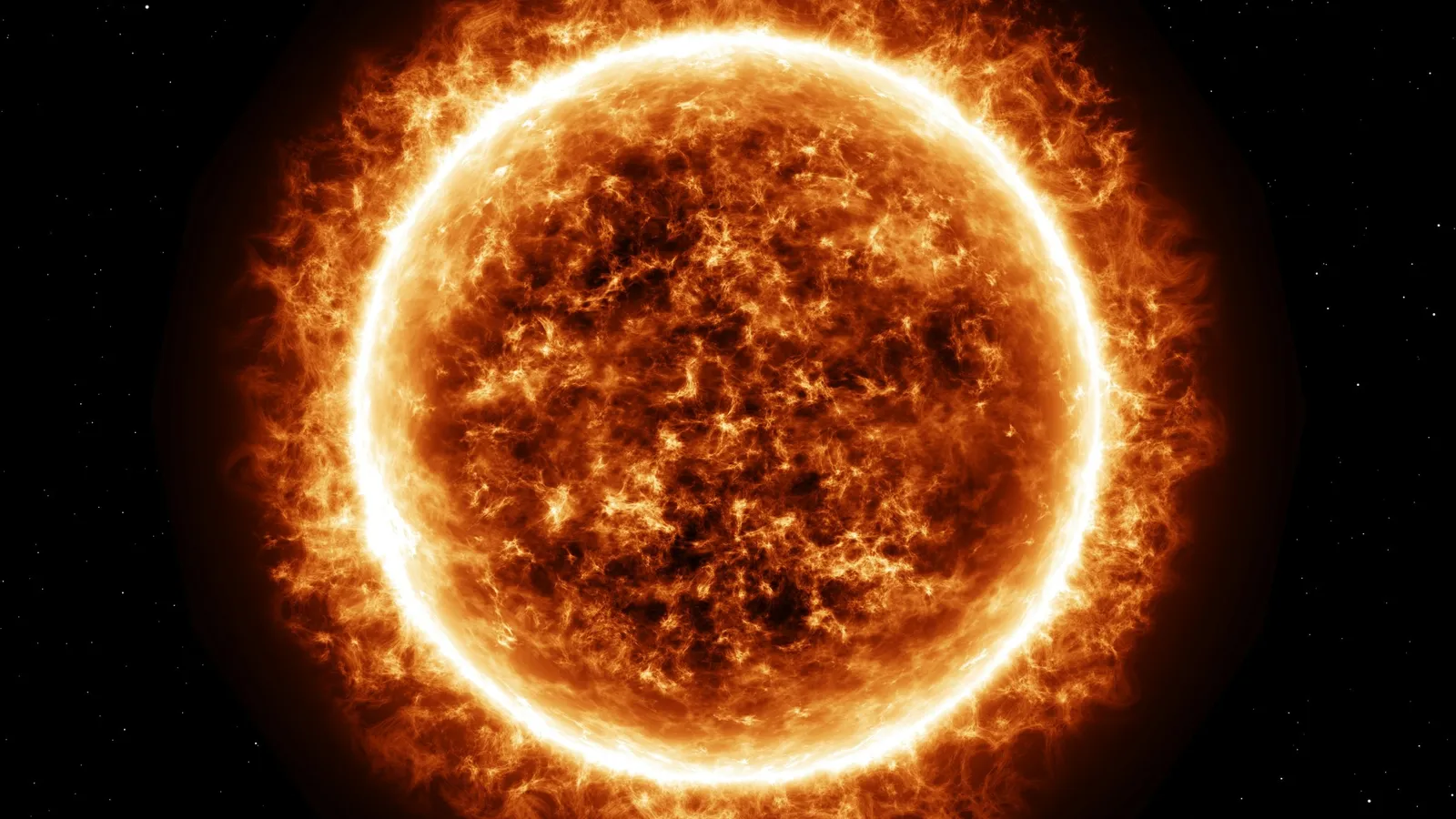
Here the story has a correction. The 1939 abstract named the carbon-nitrogen cycle as the main source in ordinary stars. Later work showed that the Sun runs mostly on the proton-proton chain, as Bethe's own Nobel biography states. In 2020 the Borexino experiment reported the first detection of neutrinos from the CNO cycle in the Sun. Its paper says the pp chain produces about 99 per cent of solar energy and the CNO cycle about 1 per cent, while in stars more massive than the Sun the CNO cycle dominates.
Worked example: how much mass does sunlight cost?
Whichever route a star uses, the net result is four hydrogen atoms becoming one helium atom. Take atomic masses from NIST: hydrogen-1 is 1.007825 u and helium-4 is 4.002603 u.
Mass of four hydrogen atoms: 4 × 1.007825 = 4.031300 u.
Mass lost: 4.031300 − 4.002603 = 0.028697 u.
Energy: 1 u is equivalent to 931.494 MeV, so 0.028697 × 931.494 ≈ 26.73 MeV per helium nucleus formed. Neutrinos carry a small part of this out of the star.
Fraction of mass turned into energy: 0.028697 / 4.031300 ≈ 0.0071, or about 0.7%.
Now scale up. NASA's Sun fact sheet gives the Sun's luminosity as 3.828 × 10²⁶ W. From E = mc², the Sun loses mass at L / c² = 3.828 × 10²⁶ / (2.998 × 10⁸)² ≈ 4.26 × 10⁹ kg every second, which matches the fact sheet's mass conversion rate. Since only 0.71% of the hydrogen's mass becomes energy, the Sun must fuse about 4.26 × 10⁹ / 0.0071 ≈ 6 × 10¹¹ kg of hydrogen each second.
Common mistakes:
Mixing nuclear and atomic masses. Use atomic masses on both sides, as above, so the electrons balance.
Confusing mass lost with mass of helium made. The 0.7% is the mass that becomes energy; the other 99.3% ends up as helium.
Thinking the Sun burns hydrogen like a fire. Burning is a chemical reaction between atoms; fusion changes the nuclei, which is why it releases so much more energy per kilogram.
What can a student take from how Bethe worked?
Check every alternative. His result was as much about what cannot happen in stars as what does.
Test theory against numbers from another field. He compared nuclear reaction rates with temperatures from stellar models built by astronomers.
Expect revision. His main conclusion held, but the balance between the two routes in the Sun was later corrected, and that is how science is meant to work.
For the nuclear physics behind this, see our guides to nuclear fission and fusion energy and binding energy problems. If mass defect calculations still feel like a string of numbers, the Fermi Problem Library has a step-by-step solver that explains the reasoning behind each line.
Try this now: use the same numbers to find how many joules are released when one kilogram of hydrogen fuses into helium.