On this page
The Indian Standard for oil of Tagetes minuta, IS 18062:2023, starts with a plant most people would pull out. The foreword calls Tagetes minuta, the wild marigold, "a fast growing natural weed which can infest maize fields". Its leaves and stems are steam- or hydro-distilled to give a yellow to golden brown oil used as a flavouring agent and a fragrance ingredient. The standard then lists seven compounds the oil must contain. Some carry an E or Z label, one does not, and one has a chiral carbon. Working out why is the whole geometrical and optical isomerism chapter in one bottle.
What does the BIS standard list in tagetes oil?
Table 2 of IS 18062 gives each component as a percentage of the gas chromatogram (peak area):
(Z)-β-ocimene: 20–70%
dihydrotagetone: 10–30%
(Z)-tagetone: 1–21%
(E)-tagetone: 0.2–5%
(E)-ocimenone: 1–15%
(Z)-ocimenone: traces to 8%
limonene: up to 10%
Table 1 adds the physical checks: relative density 0.800–0.970 at 20 °C, refractive index 1.4600–1.5000 at 20 °C, flash point at least 69 °C, and an optical rotation of +2° to +8°. Keep that last number in mind.
How do you decide whether a C=C can show E/Z?
A double bond is stereogenic only if each of its two carbons carries two different groups. Check both ends. One failing carbon is enough to rule the bond out. Two common failures:
A terminal =CH₂ end. Its two groups are both H.
A =C(CH₃)₂ end. Its two groups are both CH₃.
The same check, applied to geraniol, is in why geraniol has two C=C bonds but only two geometric isomers.
Which double bonds in ocimene, tagetone and ocimenone can be E or Z?
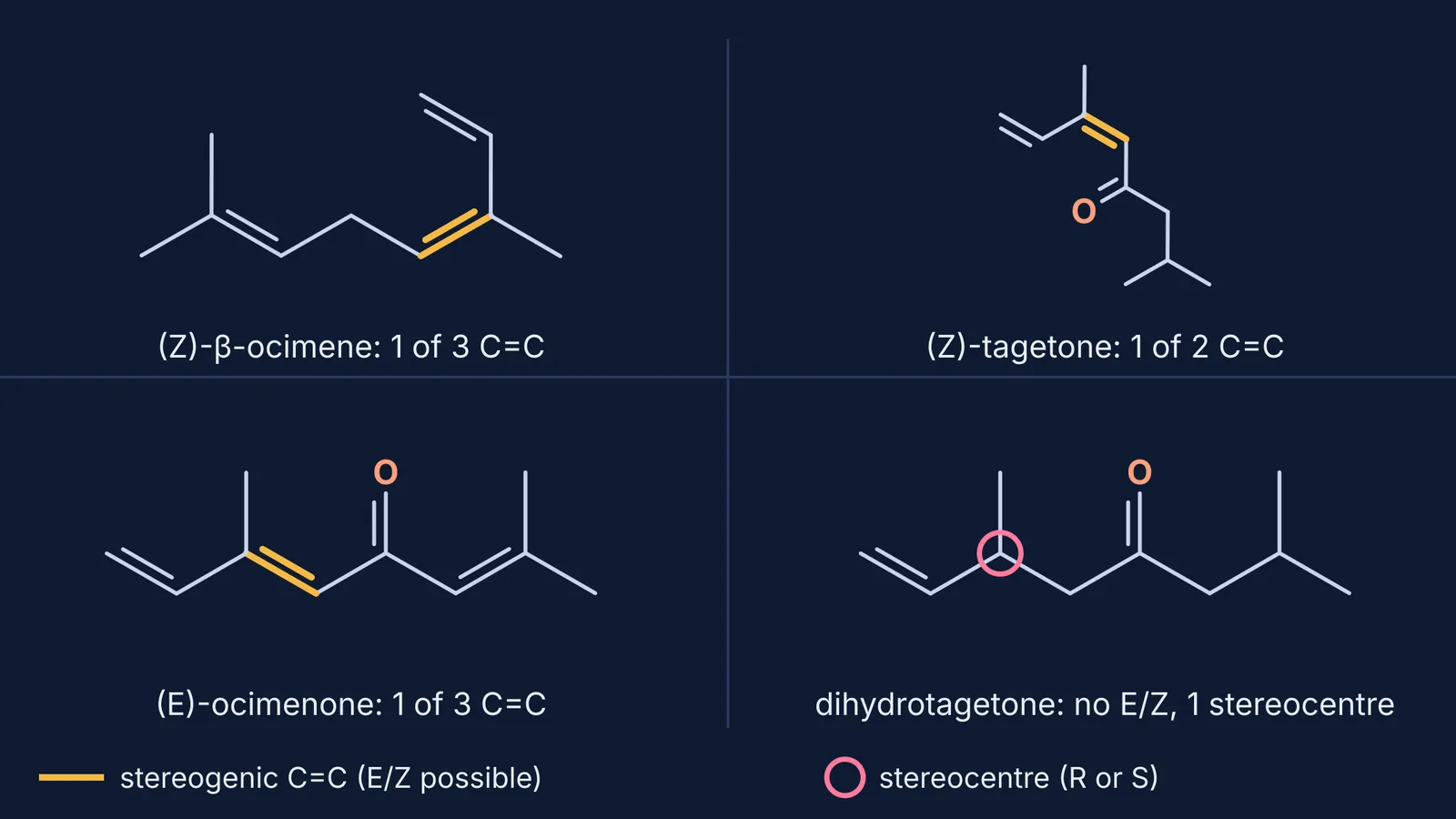
β-Ocimene, 3,7-dimethylocta-1,3,6-triene, C₁₀H₁₆: CH₂=CH–C(CH₃)=CH–CH₂–CH=C(CH₃)₂.
C1=C2: C1 carries two H. Not stereogenic.
C3=C4: C3 carries CH₃ and CH=CH₂; C4 carries H and CH₂. Stereogenic.
C6=C7: C7 carries two CH₃. Not stereogenic.
So ocimene has two geometric isomers; BIS names Z. Check it by CIP: on C3, vinyl (attached atoms C, C, H, because the double bond counts its partner twice) beats CH₃ (H, H, H). On C4, CH₂ beats H. Z means vinyl and CH₂ are on the same side. PubChem lists this isomer as (3Z)-3,7-dimethylocta-1,3,6-triene.
Tagetone, 2,6-dimethylocta-5,7-dien-4-one, C₁₀H₁₆O: (CH₃)₂CH–CH₂–CO–CH=C(CH₃)–CH=CH₂.
C5=C6: C5 carries H and the C=O carbon; C6 carries CH₃ and CH=CH₂. Stereogenic.
C7=C8: terminal. Not stereogenic.
The C=O is not an E/Z candidate: oxygen does not carry two groups.
Two isomers, and BIS lists both. On C6 the vinyl group outranks CH₃, so in (Z)-tagetone the C=O carbon and the vinyl group are on the same side. PubChem gives (5E)- and (5Z)-2,6-dimethylocta-5,7-dien-4-one.
Ocimenone, 2,6-dimethylocta-2,5,7-trien-4-one, C₁₀H₁₄O: (CH₃)₂C=CH–CO–CH=C(CH₃)–CH=CH₂.
C2=C3: C2 carries two CH₃. Not stereogenic.
C5=C6: the same arrangement as in tagetone. Stereogenic.
C7=C8: terminal. Not stereogenic.
Two isomers again, both listed. "Ocimenone" is a common name; PubChem uses (5E)- and (5Z)-2,6-dimethylocta-2,5,7-trien-4-one.
Three, three and two C=C, and one stereogenic C=C every time. Apply 2ⁿ only to bonds that pass the check, as the 2ⁿ rule and its exception explains.
Why does dihydrotagetone have no E/Z isomers but a chiral carbon?
Dihydrotagetone, 2,6-dimethyloct-7-en-4-one, C₁₀H₁₈O: (CH₃)₂CH–CH₂–CO–CH₂–CH(CH₃)–CH=CH₂.
Its only C=C is C7=C8, which is terminal, so there is no E/Z isomerism. But look at C6. It carries H, CH₃, CH=CH₂ and CH₂–CO–. Four different groups make C6 a stereocentre, so dihydrotagetone exists as R and S enantiomers. C2 is not a stereocentre, because it carries two CH₃ groups.
The CIP ranking at C6 is vinyl (C, C, H) > CH₂CO (C, H, H) > CH₃ > H.
Compare it with tagetone. On paper, adding H₂ across tagetone's C5=C6 gives dihydrotagetone:
C₁₀H₁₆O + H₂ → C₁₀H₁₈O
Check: 10 C, 18 H and 1 O on each side. The stereogenic double bond disappears, and C6 becomes an sp³ carbon with four different groups. One kind of stereo element is traded for the other. This compares structures; it says nothing about how the plant makes them.
Why does the oil rotate plane-polarised light?
E and Z isomers are diastereomers, not mirror images. Ocimene, tagetone and ocimenone have no stereocentre and are achiral, so neither their E nor their Z form rotates plane-polarised light. Among the seven compounds in Table 2, only dihydrotagetone and limonene (stereocentre at C4) are chiral.
So the +2° to +8° rotation that BIS requires is consistent with an excess of one enantiomer of dihydrotagetone, of limonene, or of both. The standard does not say which enantiomers are present, and the oil also holds minor compounds not on the list, so you cannot assign the rotation to one compound.
Worked example: degree of unsaturation and hydrogen uptake
(a) Degree of unsaturation. DU = (2C + 2 − H) ÷ 2, ignoring O, as derived in the degree of unsaturation formula.
Ocimene, C₁₀H₁₆: (22 − 16) ÷ 2 = 3, three C=C.
Tagetone, C₁₀H₁₆O: 3, two C=C and one C=O.
Ocimenone, C₁₀H₁₄O: 4, three C=C and one C=O.
Dihydrotagetone, C₁₀H₁₈O: 2, one C=C and one C=O.
Limonene, C₁₀H₁₆: 3, one ring and two C=C.
Ocimene and limonene share C₁₀H₁₆ and DU 3 but split it differently, so DU cannot tell a ring from a C=C.
(b) Mass change from tagetone to dihydrotagetone. M(tagetone) = 152.24 g/mol and M(dihydrotagetone) = 154.25 g/mol. The gain is one H₂, 2.016 g/mol: 2.016 ÷ 152.24 × 100 = 1.32%.
(c) Hydrogen to saturate both C=C of 1 g of tagetone, leaving the C=O untouched:
C₁₀H₁₆O + 2H₂ → C₁₀H₂₀O
Check: 10 C, 20 H and 1 O on each side. Moles of tagetone = 1 ÷ 152.24 = 6.569 mmol. H₂ = 2 × 6.569 = 13.14 mmol. At 273 K and 1 atm (22.4 L/mol): 0.01314 × 22,400 = 294 mL. With the 1 bar value of 22.7 L/mol, about 298 mL.
(d) Is the product chiral? C₁₀H₂₀O is 2,6-dimethyloctan-4-one. C6 now carries H, CH₃, CH₂CH₃ and CH₂–CO–, still four different groups. So it is still chiral: removing the vinyl double bond did not remove the stereocentre.
What to write in the exam
This oil touches Class 11 Organic Chemistry (conditions for geometrical isomerism, E/Z by CIP, chirality, degree of unsaturation), Class 11 Hydrocarbons (hydrogenation of C=C) and Class 12 Haloalkanes and Haloarenes (optical activity and chirality).
A model line: "In tagetone only C5=C6 is stereogenic (C7=C8 is terminal), so it has 2 geometrical isomers. Dihydrotagetone has no stereogenic C=C but C6 is a stereocentre, so it has 2 optical isomers."
If isomer counts keep costing you marks, Fermi's AI tutor for JEE prep can work out what you already know and build a plan for the session. For more counting problems, the Fermi Problem Library has a step-by-step solver that explains the reasoning.
Quick checklist
Check both carbons of every C=C; =CH₂ and =C(CH₃)₂ ends fail.
Ocimene, tagetone and ocimenone: one stereogenic C=C each, so 2 geometrical isomers each.
Dihydrotagetone: no E/Z, one stereocentre at C6, so R and S.
E/Z isomers here are achiral; the oil's rotation can only come from chiral components such as dihydrotagetone and limonene.
DU counts rings plus π bonds, C=O included.
1 g tagetone takes about 294 mL H₂ at 273 K and 1 atm to saturate both C=C.