On this page
NCERT tells you to acetylate aniline before you halogenate it, so that you get one halogen, mainly at the para position. In 1899 F. D. Chattaway and K. J. P. Orton asked how the chlorine actually gets onto the ring. Their answer: it goes onto the nitrogen first, and only later moves to the ring.
The paper is F. D. Chattaway and K. J. P. Orton, "A Series of Substituted Nitrogen Chlorides and their Relation to the Substitution of Halogen in Anilides and Anilines", J. Chem. Soc. Trans. 75 (1899) 1046–1054 (DOI 10.1039/CT8997501046; scan on the Internet Archive). It is signed from St. Bartholomew's Hospital, London. Numbers and quotes below were checked against the page images.
What did Chattaway and Orton find in 1899?
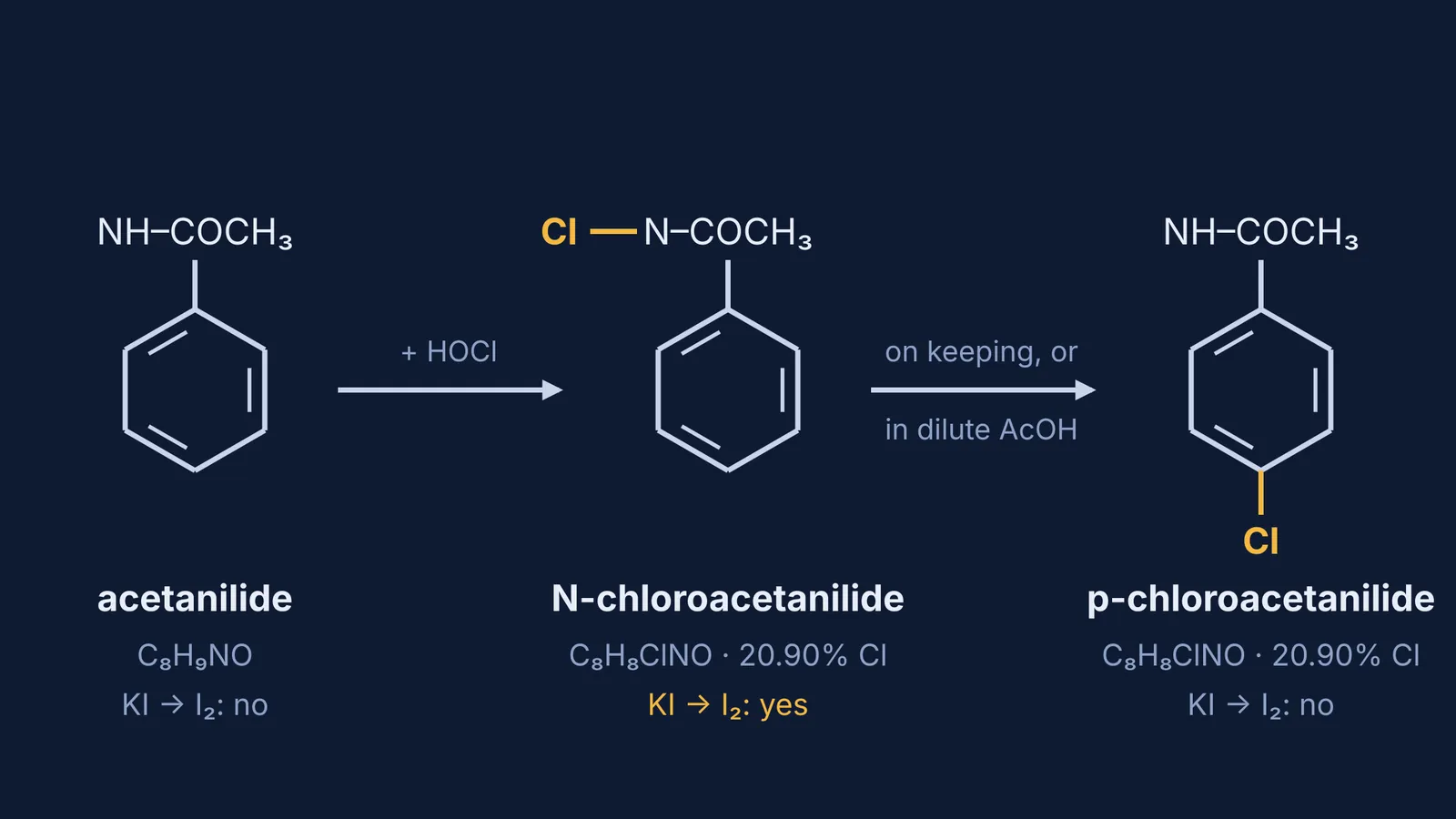
They found that hypochlorous acid swaps the N–H hydrogen of an anilide for chlorine. Their general equation, written for acetanilide:
C₆H₅NHCOCH₃ + HOCl → C₆H₅NClCOCH₃ + H₂O
The product, which they called phenyl acetyl nitrogen chloride, is N-chloroacetanilide. Bender first made it in 1886, but Castoro failed to repeat his method in 1898. Chattaway and Orton used bleaching powder with acetanilide in the presence of potassium bicarbonate and reported a 96% yield. The crystals melted at 91 °C.
The compound did not stay put. It "dissolves readily in dilute acetic acid, long needles of parachloracetanilide separating as the liquid cools". On simple keeping, the same change was "nearly complete in 2 or 3 weeks". The authors also warn that related N-chlorides change "almost explosively" or "may become violent" when heated in quantity. That is why this post gives no procedure.
The paper lists five reactions of the N–Cl group. With strong HCl, chlorine is set free: R·CO·NR′Cl + HCl → R·CO·NR′H + Cl₂. With acidified KI, iodine is set free: R·CO·NR′Cl + 2HI → R·CO·NR′H + HCl + I₂. Both balance, and in both the anilide comes back unchanged.
Why did they think chlorine goes to nitrogen first?
Their key sentence: "in the chlorination of anilides or anilines, the halogen first replaces a hydrogen atom of the NH- or NH₂-group, the nitrogen chloride thus formed becoming subsequently transformed into an isomeric substituted anilide or aniline."
They saw a clear pattern:
If the para position is free, the chlorine moves there.
If para is taken, it moves to an ortho position.
If para and one ortho are taken, it moves to the other ortho position.
Repeating the cycle leads on to 2,4,6-trichloroacetanilide.
They wrote that they had "never, so far, observed the simultaneous formation of ortho- and para-compounds". Other ring groups, they argued, "have no opportunity of exerting any specific orientating influence".
Was the 1899 picture right?
It was only partly right. The N-chloride is real, and it really does turn into ring-chlorinated anilides. But the "para only" claim did not last, and Orton himself overturned it.
In 1909, W. J. Jones and K. J. P. Orton, writing from University College of North Wales, Bangor, published "The Chlorination of Acetanilide" (DOI 10.1039/CT9099501056; scan). Puzzled that pure p-chloroacetanilide came out at "at most 40 per cent", they looked for the rest and reported that:
chlorination by bleaching powder in acetic acid turned "some 40 to 46 per cent." of the acetanilide into o-chloroacetanilide. It had been missed because it is more soluble and stayed in the mother liquor;
chlorine in glacial acetic acid gave about 30% ortho;
the N-chloride itself, rearranging in glacial acetic acid, gave ortho and para "in the same proportion" as bleaching powder did.
So the N-chloride route gives a mixture too. If you weigh only the product that crystallises, you can miss a large part of the reaction. How the chlorine actually travels from N to the ring was studied in later work that we have not checked, so we draw no mechanism arrow here.
Why does –NHCOCH₃ direct ortho and para?
Here is the modern textbook reason. The nitrogen lone pair is donated into the ring by resonance, which builds up electron density at the ortho and para carbons. An electrophile attacking there gives a σ-complex in which the positive charge can sit on nitrogen. Attack at meta gets no such help.
The lone pair is also shared with the C=O group, so –NHCOCH₃ is a weaker activator than –NH₂. That is why one substitution can be controlled, as explained in why aniline is acetylated before nitration. Para is usually favoured over ortho because the bulky acetamido group crowds the ortho positions. The 1909 numbers are a reminder that "major product" does not mean "only product".
How do you tell N-chloroacetanilide from p-chloroacetanilide?
Here is a worked example using the paper's own data.
Same formula. Both are C₈H₈ClNO, M = 169.61 g mol⁻¹, with Cl = 35.453 ÷ 169.61 × 100 = 20.90%. Total-chlorine analysis cannot tell them apart.
Use the KI test. Only the N–Cl compound oxidises iodide: C₆H₅NClCOCH₃ + 2I⁻ + H⁺ → C₆H₅NHCOCH₃ + Cl⁻ + I₂. The charge is −1 on both sides. The iodine is then titrated: I₂ + 2S₂O₃²⁻ → 2I⁻ + S₄O₆²⁻.
Read the data. 0.3952 g liberated iodine equal to 46.02 mL of N/10 iodine. That is 46.02 × 0.1 = 4.602 milliequivalents. Each I₂ is 2 equivalents, so I₂ = 2.301 mmol, and that equals the N–Cl present.
Percent Cl as N–Cl. 2.301 × 35.453 = 81.58 mg in 395.2 mg, which gives 20.64%. The paper also gives 20.64, against a theoretical 20.9. So the sample was 2.301 × 169.61 ÷ 395.2 = 98.8% pure.
Titre factor. The n-factor is 2, so the equivalent mass is 169.61 ÷ 2 = 84.81. That means 1 mL of 0.1 N thiosulphate ≡ 8.48 mg of N-chloroacetanilide.
A compound with two chlorines. p-Chlorophenyl acetyl N-chloride, C₈H₇Cl₂NO (M = 204.06), has one Cl on the ring and one on N.
Weighed as AgCl. 0.1942 g gave 0.2718 g AgCl. Cl = 0.2718 × 35.453 ÷ 143.32 = 0.06723 g, which is 34.62% (paper 34.61; theory 34.75).
By KI. 0.4426 g gave 42.9 mL of N/10, which is 2.145 mmol of N–Cl, or 17.18% Cl (paper 17.18; theory 17.37).
Compare. The ratio is almost exactly 2 : 1. AgCl counts every chlorine, while KI counts only the one on nitrogen.
The paper's theory figures differ slightly from ours because it used 1899 atomic masses. For how organic chlorine ends up as AgCl, see the Carius method.
Where does this show up in JEE and NEET?
Three places: Class 12 Amines (why acetanilide is halogenated, and why –NHCOCH₃ gives mainly para), Class 11 redox titrations (n-factor in iodometry), and Class 11 quantitative organic analysis (percent halogen from AgCl). For exam-focused practice on these chapters, Fermi Test Prep offers JEE Main and Advanced preparation with an AI tutor. For more stoichiometry and titration problems, the Fermi Problem Library has a step-by-step solver that explains the reasoning.
Quick checklist
1899: acetanilide + HOCl gives N-chloroacetanilide (m.p. 91 °C, 96% yield).
It rearranges to p-chloroacetanilide on keeping or in dilute acetic acid.
Chattaway and Orton's claim: halogen goes to N first, then to the ring.
1909, Jones and Orton: 40–46% ortho product too, so "para only" was wrong.
Isomers have the same % Cl; only the N–Cl compound liberates I₂ from KI.
n-factor of N–Cl in iodometry is 2; 1 mL of 0.1 N ≡ 8.48 mg.