On this page
A chemist in the 1850s with a new organic compound faced an awkward question: how much chlorine or bromine is in it? The halogen is held in covalent bonds, out of reach of silver nitrate. Georg Ludwig Carius answered this in 1860 by sealing the sample in thick glass with fuming nitric acid and heating it until the molecule broke apart. Class 11 students in India meet his tube in NCERT's organic chemistry chapter.
Who was Georg Ludwig Carius?
According to the Deutsche Biographie, Carius was born on 24 August 1829 in Barbis, in the Kingdom of Hanover (the entry notes 1831 as a possible birth year). He studied chemistry at Göttingen and took his doctorate in 1853.
From 1852 to 1858 he was an assistant in the Heidelberg university laboratory, taking part in Robert Bunsen's measurements on gases. In 1865 he became professor of chemistry at Marburg, where he died on 24 April 1875 after a long illness.
What did Carius publish in 1860?
His paper 'Ueber die Elementaranalyse organischer Verbindungen' (On the elemental analysis of organic compounds) filled pages 1 to 30 of volume 116 of the journal now indexed as Justus Liebigs Annalen der Chemie, according to its Crossref record (DOI 10.1002/jlac.18601160102).
The footnotes listed in that record show a working laboratory. Carius warns that if the empty space in the tube is too small, explosions happen easily. He notes that the furnace temperature can be judged from the length of a Bunsen burner flame, to within 4 to 10 degrees, so no thermometer is needed. He also thanks a 'Herr D. Mendelejeff' for two samples, one of them Br2C2H4, prepared to measure physical properties. Dmitri Mendeleev was working in Heidelberg between 1859 and 1861 on the capillarity of liquids, as his Wikipedia biography records.
The Deutsche Biographie says his method for sulphur, phosphorus and halogens came into general use.
How does the Carius method estimate halogens?
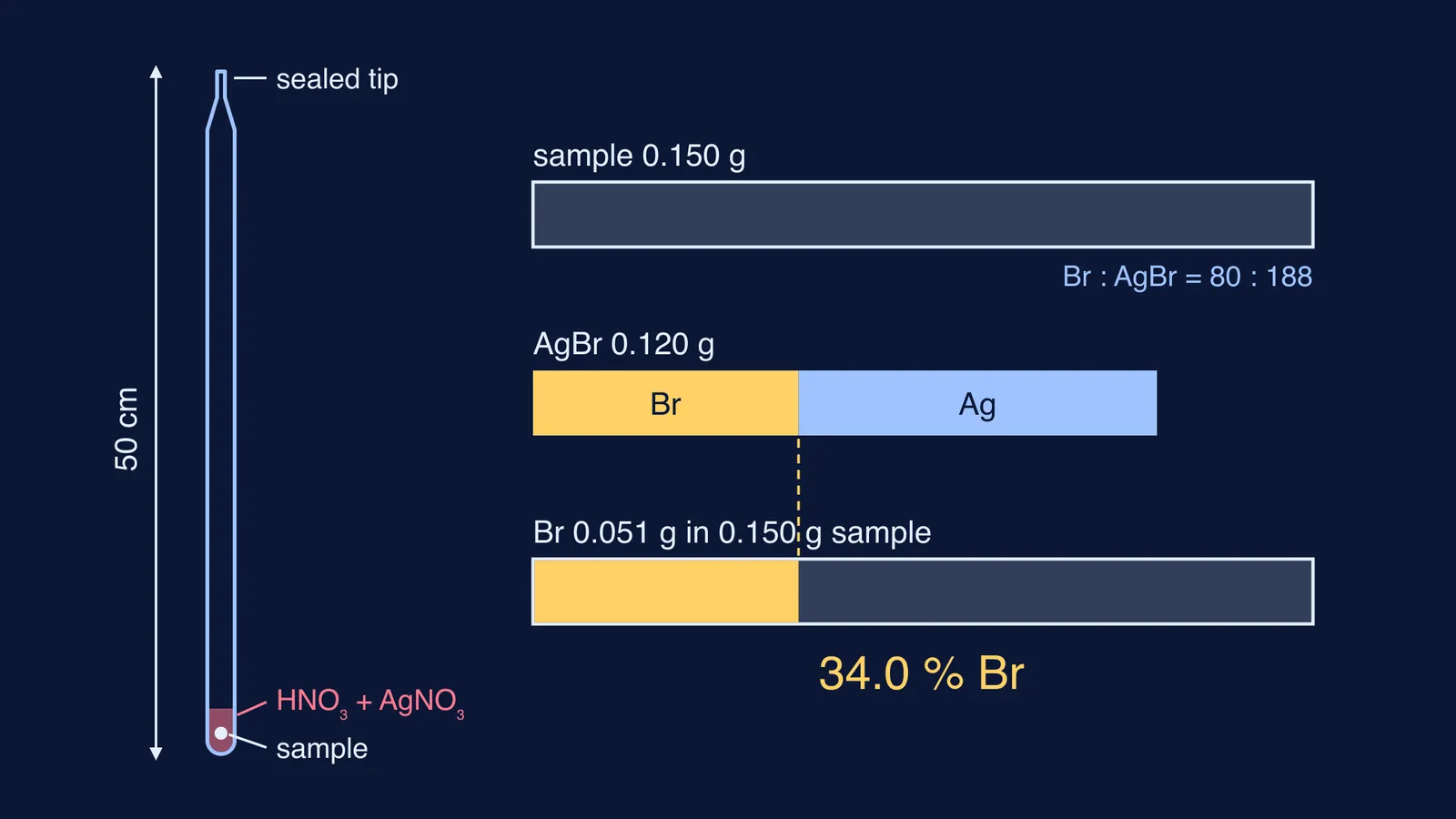
In the Carius method, a known mass of an organic compound is heated with fuming nitric acid and silver nitrate in a hard glass tube, the Carius tube, in a furnace (NCERT Class 11 Chemistry, Unit 8). Carbon and hydrogen are oxidised to carbon dioxide and water, and the halogen forms silver halide, AgX, which is filtered, washed, dried and weighed. The NCERT figure shows a tube about 50 cm long and 2 cm wide, closed at the top by a sealed capillary.
If m is the mass of compound and m1 the mass of AgX, NCERT gives: per cent halogen = (atomic mass of X × m1 × 100) / (molecular mass of AgX × m). In its worked problem, 0.15 g of compound gave 0.12 g of AgBr, so bromine = 80 × 0.12 × 100 / (188 × 0.15) = 34.04 per cent.
How is sulphur estimated in a Carius tube?
For sulphur, the compound is heated in a Carius tube with sodium peroxide or fuming nitric acid, which oxidises the sulphur to sulphuric acid (NCERT). Excess barium chloride solution precipitates barium sulphate, which is weighed. Per cent sulphur = (32 × m1 × 100) / (233 × m), where m1 is the mass of BaSO4. In the NCERT problem, 0.157 g of compound gave 0.4813 g of BaSO4, which works out to 42.10 per cent sulphur.
How do you check a Carius answer before you write it down?
Here is a worked example you can check by hand, using the atomic masses in the NCERT chapter (Br = 80, Ag = 108) plus C = 12 and H = 1. Take Br2C2H4, the compound Mendeleev supplied, today written C2H4Br2.
Its molar mass is 24 + 4 + 160 = 188 g/mol, the same as AgBr.
Each molecule carries two bromine atoms, so 0.150 g of it gives 2 × 0.150 = 0.300 g of AgBr.
Per cent bromine = 80 × 0.300 × 100 / (188 × 0.150) = 85.1.
Check from the formula alone: 160 / 188 = 85.1 per cent. The two routes agree.
Before you submit any Carius numerical, run this four-point check:
Divide the precipitate mass by the sample mass first. For AgBr the ratio can never exceed 188 / 80, about 2.35, because bromine cannot be more than 100 per cent of the compound. For BaSO4 the ceiling is 233 / 32, about 7.3.
Put the halogen's atomic mass on top and the silver halide's molar mass below, never the reverse.
For sulphur, use 32 over 233 (BaSO4), not 32 over 96 (the sulphate ion).
Divide by m, the sample, not m1, the precipitate.
For more practice, the Fermi Problem Library has worked problems with a step-by-step solver that explains the reasoning rather than printing an answer. If Lassaigne, Carius and Kjeldahl feel like unconnected tricks, the Fermi Concept Library gives each concept its own lesson and its place in the map.
Carius was one link in a chain. Read how Lassaigne's test detects which elements are present before you measure them, how Liebig's Kaliapparat made combustion analysis of carbon reliable, and how Jean-Baptiste Dumas measured nitrogen.