

On this page
In the autumn of 1830, Justus Liebig built a triangle of glass about as broad as an outstretched hand. According to C&EN's 2015 history of the device, it gave chemists their first precise way to measure how much carbon a substance contains, and within a decade it had spread to labs across Europe.
Liebig (1803-1873) published the method in 1831 in Annalen der Physik, as the American Chemical Society's page on its own logo records. If you are learning combustion analysis for Class 11 or JEE, this device is where your formulas came from.
What was Liebig's Kaliapparat?
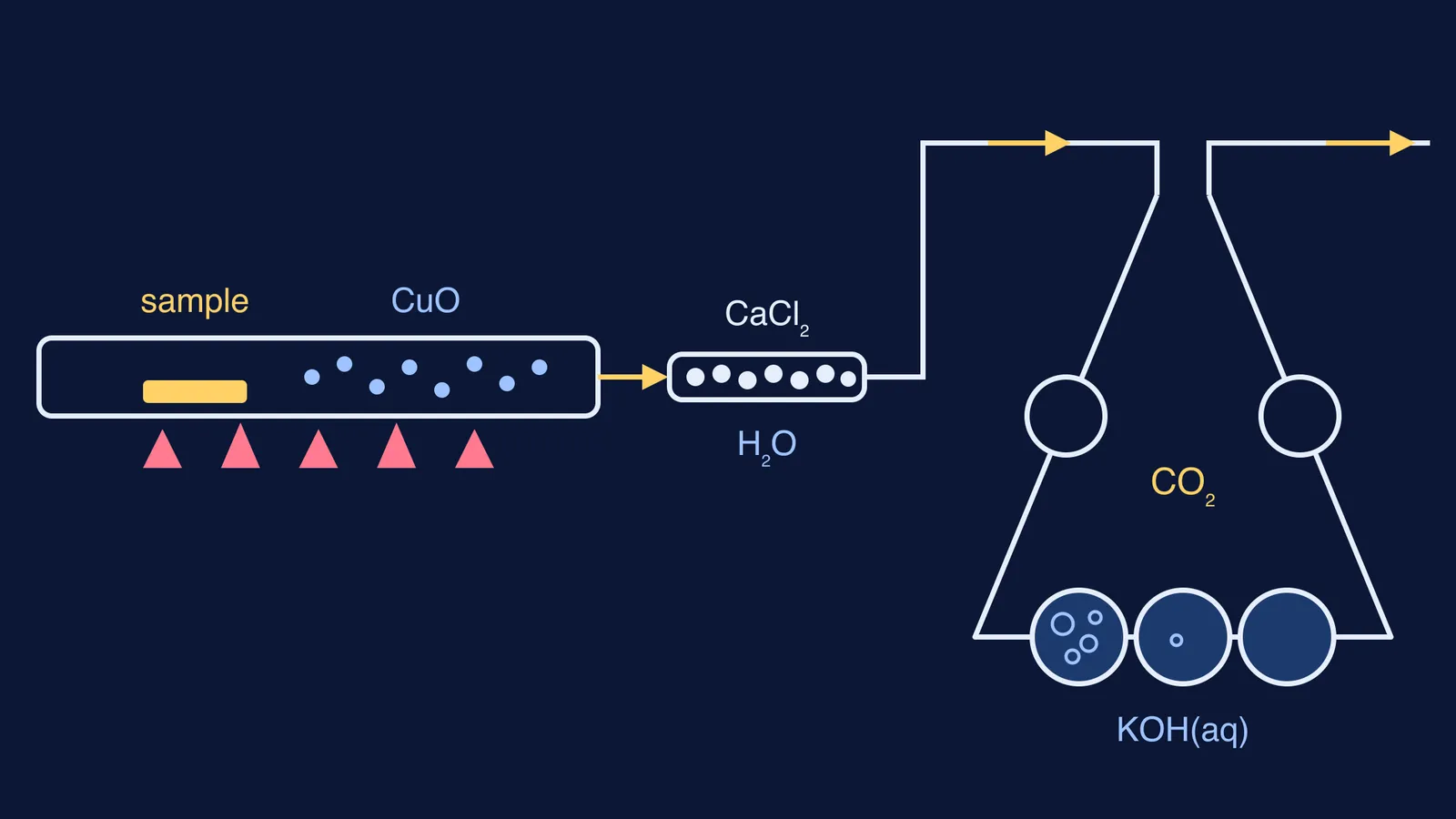
The Kaliapparat is a glass tube bent into a triangle with five bulbs blown into it, holding caustic potash (potassium hydroxide) solution that absorbs carbon dioxide (ACS).
Each bulb had a job, as Alan Rocke, a historian of chemistry at Case Western Reserve University, explained to C&EN:
Three bulbs along the bottom hold the potassium hydroxide, which absorbs the gas.
One bulb on the upstream arm is a leak test: solution sucked into it should stay level if the system is airtight.
One bulb on the downstream arm catches overflow, so the solution does not bubble out.
The device checked itself. Violent bubbling shows that carbon dioxide is being absorbed, and by the time the gas reaches the third bulb there should be little or no bubbling, a sign that all of it has been absorbed. "So you can tell by eye if you've done the experiment right," Rocke said.
How does Liebig's combustion analysis measure carbon and hydrogen?
The sample is heated with copper oxide, and the gases pass through two absorbers that are weighed before and after (Wikipedia summary; ACS):
Weigh the dry sample and burn it with copper oxide, so its carbon becomes carbon dioxide and its hydrogen becomes water.
Pass the gases through a tube of calcium chloride, which absorbs the water vapour.
Pass them on into the Kaliapparat, where potassium hydroxide absorbs the carbon dioxide.
Weigh both again. The calcium chloride tube's gain is the water; the Kaliapparat's gain is the carbon dioxide.
The rest is arithmetic. Carbon is 12 parts in 44 of carbon dioxide, and hydrogen is 2 parts in 18 of water:
% carbon = (12/44) x (mass of CO2 / mass of sample) x 100
% hydrogen = (2/18) x (mass of H2O / mass of sample) x 100
% oxygen, for a compound of only C, H and O = 100 minus the other two
Worked example: can you get a formula from two weighings?
We built these numbers from pure glucose, so you can check the answer.
You burn 0.300 g of an unknown sugar. The calcium chloride tube gains 0.180 g and the Kaliapparat gains 0.440 g.
Carbon: (12/44) x 0.440 g = 0.120 g, which is 40.0% of the sample.
Hydrogen: (2/18) x 0.180 g = 0.020 g, which is 6.7% of the sample.
Oxygen by difference: 100 - 40.0 - 6.7 = 53.3%.
Divide by atomic mass: C 40.0/12 = 3.33; H 6.7/1 = 6.7; O 53.3/16 = 3.33.
Divide by the smallest: C 1, H 2, O 1. The empirical formula is CH2O, which is consistent with glucose, C6H12O6.
A common slip is using 1/18 for hydrogen; water has two hydrogen atoms. For more practice, see our guide to finding an empirical formula from combustion analysis and the post on estimating carbon, hydrogen, halogens and sulphur in Class 11. If you keep getting the method wrong rather than the arithmetic, the Fermi Problem Library has worked problems with a step-by-step solver that explains the reasoning rather than printing an answer.
How accurate was the Kaliapparat, really?
Some historians suspected the device's reputation was hype, so Melvyn Usselman, Alan Rocke, Christina Reinhart and Kelly Foulser restaged Liebig's experiments and published the results in Annals of Science in 2005. As C&EN reported, Reinhart and Foulser measured the carbon in tartaric acid, urea, cinchonine and narcotine and found the method remarkably accurate. "It's mind-boggling that the simple apparatus can give you the quality of modern analyses," Rocke said.
It had limits. The team found that the device gave "erratic results for nitrogen", and Catherine Jackson, a historian of chemistry at the University of Wisconsin-Madison, told C&EN that Liebig could not crack the analysis of alkaloids such as morphine or quinine with it. Even so, the method stayed in use essentially as Liebig described it until Fritz Pregl's work on micro-analysis in the early twentieth century (ACS).
Why did one piece of glassware change chemistry?
Because, as the story goes, beginners could master it. Jackson told C&EN that Liebig used it to build a system of large-scale practical training in Giessen, and with large teams of students running analyses he could outperform his competitors in France and England.
Next time you meet a combustion question, sketch the train first: sample, calcium chloride, Kaliapparat. Then do the sums.


