On this page
Every order here is from NCERT Class 12 Biology, Chapter 10 (Reprint 2026-27), which the NMC NEET (UG) 2026 syllabus places in Biology Unit 9. All 12 questions are original.
Gene therapy and diagnosis follow NCERT only: a study summary, not medical advice.
Which sequences does NCERT give in Biotechnology and its Applications?
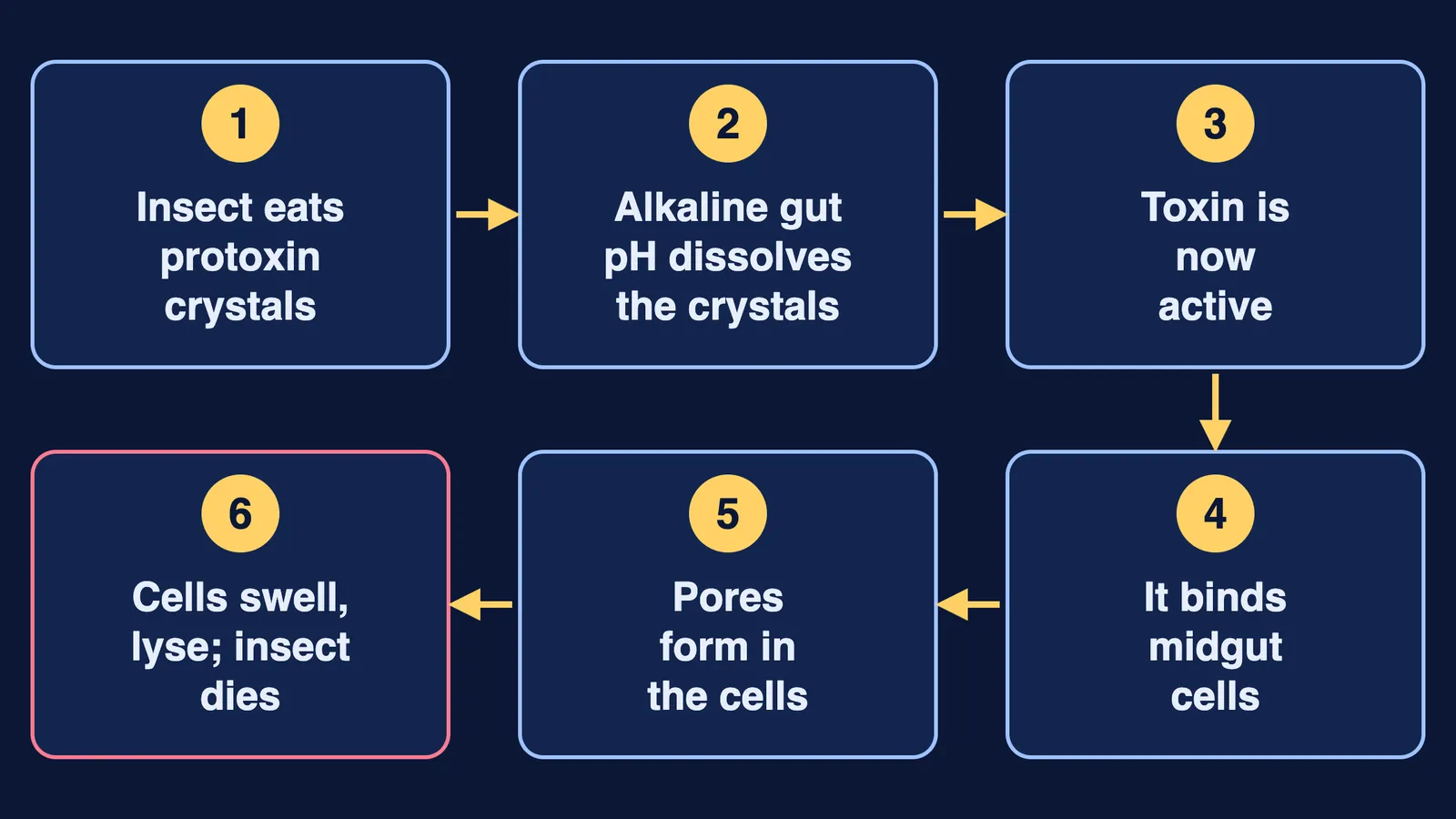
Bt toxin (10.1): insect eats protoxin crystals → alkaline gut pH dissolves them, activating the toxin → toxin binds midgut epithelial cells → pores form → cells swell and lyse → insect dies.
RNAi in tobacco (10.1): *Agrobacterium* vectors carry nematode-specific genes in → host makes sense and antisense RNA → they pair into dsRNA → RNAi silences a nematode mRNA → the parasite cannot survive.
Somatic hybridisation (10.1): isolate single cells → digest cell walls → naked protoplasts → fuse protoplasts of two varieties → grow the hybrid into a plant (e.g. pomato).
Virus-free plants (10.1): cut the virus-free meristem from an infected plant → grow it in vitro → healthy plants.
Insulin, 1983 (10.2.1): prepare DNA for chains A and B → insert into *E. coli* plasmids → make each chain separately → extract → join by disulphide bonds.
ADA gene therapy (10.2.2): culture the patient's lymphocytes outside the body → add functional ADA cDNA via a retroviral vector → return the cells → periodic infusions (the cells are not immortal).
Radioactive probe (10.2.3): label single-stranded DNA or RNA radioactively → it pairs with complementary DNA in a clone → autoradiography → a mutated-gene clone is missing from the film.
Chemical safety testing (10.3): make transgenic animals more sensitive to toxic substances → expose them → study the effects.
Dates NCERT prints: the 1950s (whole plants from explants), 1983 (insulin chains), 1990 (first clinical gene therapy) and 1997 (Rosie, the transgenic cow).
How do you attack arrange-in-the-correct-order questions?
Fix the first and last steps and strike codes that break either. Of the two codes left, find the adjacent pair where they differ and ask what the later step needs from the earlier one.
Arrange-in-order questions
Q1. RNAi tobacco: A. Host makes sense and antisense RNA B. *Agrobacterium* vectors add nematode-specific genes C. A nematode mRNA is silenced D. dsRNA forms E. The parasite cannot survive (1) B, D, A, C, E (2) A, B, D, C, E (3) B, A, D, C, E (4) B, A, C, D, E Answer: (3). dsRNA needs both strands, and dsRNA starts RNAi (10.1).
Q2. Somatic hybridisation: A. Protoplasts of two varieties fused B. Cell walls digested C. Single cells isolated D. New plant grown E. Naked protoplasts obtained (1) B, C, E, A, D (2) C, E, B, A, D (3) C, B, E, D, A (4) C, B, E, A, D Answer: (4). No protoplast until the wall is gone (10.1).
Q3. Insulin, 1983: A. Chains extracted B. DNA for chains A and B prepared C. Disulphide bonds created D. Sequences put into *E. coli* plasmids E. Chains made separately (1) B, D, E, A, C (2) D, B, E, A, C (3) B, D, E, C, A (4) B, E, D, A, C Answer: (1). Chains are joined only after being made and extracted (10.2.1).
Q4. ADA gene therapy: A. ADA cDNA added with a retroviral vector B. Lymphocytes cultured outside the body C. Cells returned to the patient D. Periodic infusion (1) A, B, C, D (2) B, C, A, D (3) B, A, C, D (4) B, A, D, C Answer: (3). The returned cells are not immortal, so infusions repeat (10.2.2).
Q5. Probe test: A. Autoradiography B. Radioactive labelling of single-stranded DNA or RNA C. Probe pairs with complementary DNA in a clone D. Mutated-gene clone missing from the film (1) C, B, A, D (2) B, A, C, D (3) B, C, D, A (4) B, C, A, D Answer: (4). Label, pair, detect, then read the film (10.2.3).
Q6. Time order: A. First clinical gene therapy B. Insulin chains made in *E. coli* C. Whole plants shown to regrow from explants D. Rosie's enriched milk (1) C, A, B, D (2) C, B, A, D (3) B, C, A, D (4) C, B, D, A Answer: (2). 1950s, 1983, 1990, 1997.
Before-after, out-of-place and statement questions
Q7. In chemical safety testing, what comes right after making the sensitive animals? (1) Studying effects (2) Exposure to toxic substances (3) Polio vaccine tests (4) Enzyme injection Answer: (2). Effects are studied after exposure (10.3).
Q8. In the 1983 method, what came right after the two DNA sequences went into *E. coli* plasmids? (1) Chains A and B made separately (2) Chains extracted (3) Disulphide bonds created (4) Protoplasts fused Answer: (1). Production comes before extraction and joining (10.2.1).
Q9. In ADA gene therapy, what comes right before functional ADA cDNA is introduced? (1) Cells returned to the patient (2) Periodic infusion (3) Functional ADA given by injection (4) The patient's lymphocytes grown in culture Answer: (4). The cDNA goes into cultured lymphocytes (10.2.2).
Q10. Somatic hybridisation as written: P. Isolate single cells, Q. Digest cell walls, R. Grow a new plant, S. Obtain naked protoplasts, T. Fuse protoplasts of two varieties. Which step is out of place? (1) P (2) Q (3) R (4) T Answer: (3). R belongs at the end, after fusion (10.1).
Key for Q11 and Q12: (1) both correct (2) both incorrect (3) only I correct (4) only II correct.
Q11. I: In RNAi tobacco, sense and antisense RNA are made before they pair into dsRNA. II: Whole plants were found to regrow from explants before the first clinical gene therapy. Answer: (1). The two RNAs pair into dsRNA (10.1); 1950s precedes 1990.
Q12. I: In somatic hybridisation, naked protoplasts are obtained only after cell walls are digested. II: Rosie's protein-enriched milk came before Eli Lilly's insulin chains. Answer: (3). Walls go first (10.1); Rosie is 1997, insulin 1983.
How should you review a wrong order?
Rewrite each missed sequence from memory and check it. For other formats, try the statement and match-the-list set, the diagram-based questions and the assertion-reason set.
Which of these orders keeps slipping? Fermi's AI tutor works out what you already know and builds a plan for the session.