On this page
These 10 original questions cover Chapter 10 of NCERT Class 12 Biology. Every statement was checked against the NCERT chapter (Reprint 2026-27), and the topics sit inside the NEET (UG)-2026 syllabus, Biology Unit 9. Need the chapter first? See our Class 12 guide to biotechnology and its applications.
How do you answer assertion-reason and Statement I/II questions?
For assertion-reason items, run three checks in order:
Is the Assertion (A) true?
Is the Reason (R) true on its own?
If both are true, join them with "because": "A, because R". Pick (A) only if R is the direct cause NCERT gives for A.
Assertion-reason key, used for Q1 to Q6:
(A) Both A and R are true and R is the correct explanation of A.
(B) Both A and R are true but R is NOT the correct explanation of A.
(C) A is true but R is false.
(D) A is false but R is true.
Statement pair key, used for Q7 to Q10:
(A) Both statements are correct.
(B) Both statements are incorrect.
(C) Statement I is correct, Statement II is incorrect.
(D) Statement I is incorrect, Statement II is correct.
Assertion-reason questions: can you find the real cause?
Source: NCERT Chapter 10.
Q1 (easy). Assertion (A): Bacillus thuringiensis survives the insecticidal crystals it makes. Reason (R): The crystal protein is stored as an inactive protoxin and becomes an active toxin only when the alkaline pH of an insect's gut dissolves the crystals.
Answer: (A). Both are true, and R is the reason NCERT gives: the toxin is switched on only in the insect gut. Trap: guessing that the bacterium is simply resistant to its own toxin.
Q2 (easy). Assertion (A): Virus-free plants can be recovered from a virus-infected plant by growing its meristem in vitro. Reason (R): Plants raised by micropropagation are genetically identical to the plant they came from.
Answer: (B). Both are true, but R explains why micropropagated plants are somaclones, not why they are free of virus. The real reason is that the apical and axillary meristems stay free of virus even in an infected plant. Trap: both are about tissue culture.
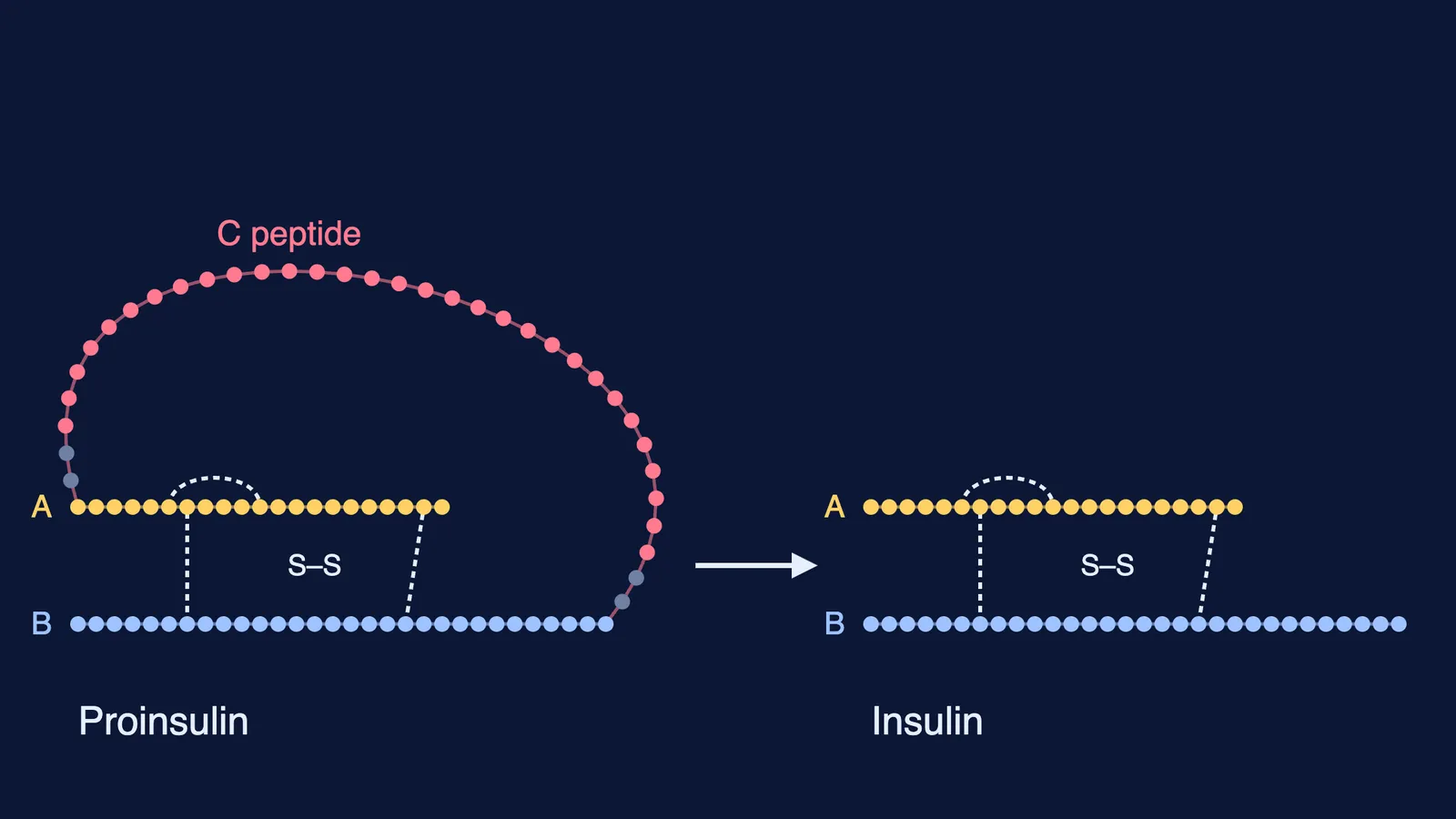
Q3 (medium). Assertion (A): In Eli Lilly's 1983 method, chains A and B of human insulin were made separately in E. coli and then joined by disulphide bonds. Reason (R): Mature insulin keeps the C peptide, which holds chains A and B together.
Answer: (C). A is true. R is false: the C peptide is part of the pro-hormone and is removed when it matures, so it is not present in mature insulin. Trap: picturing the C peptide as a permanent link.
Q4 (medium). Assertion (A): Transgenic tobacco resists the nematode Meloidogyne incognita because it makes a protein toxin that kills the nematode. Reason (R): In RNA interference, a complementary double-stranded RNA binds a specific mRNA and stops it from being translated.
Answer: (D). A is false: no toxin is involved. Sense and anti-sense RNA made by the introduced genes pair into dsRNA that silences a specific nematode mRNA. R is true. Trap: carrying the Bt cotton idea over to the RNAi example.
Q5 (medium). Assertion (A): ADA gene therapy using the patient's own engineered lymphocytes is not a one-time treatment. Reason (R): The lymphocytes carrying the functional ADA cDNA are not immortal.
Answer: (A). Both are true, and R is the direct cause NCERT gives. Trap: mixing this up with enzyme replacement therapy, where the enzyme itself is injected.
Q6 (hard). Assertion (A): Human insulin made by recombinant DNA technology avoids the allergic reactions some patients had to insulin from cattle and pigs. Reason (R): In humans, insulin is first made as a pro-hormone that contains an extra stretch called the C peptide.
Answer: (B). Both are true, but R describes how insulin matures in the body. The reason for A is that recombinant human insulin is not a foreign protein, so it does not trigger the unwanted immune responses seen with non-human products. Trap: a true insulin fact beside an insulin claim.
Statement I and Statement II questions: which half is wrong?
Source: NCERT Chapter 10.
Q7 (easy). Statement I: Over 95 per cent of all existing transgenic animals are mice. Statement II: Rosie, the first transgenic cow, produced milk containing human alpha-lactalbumin in 1997.
Answer: (A). Both match NCERT. Trap: assuming one statement in every pair must be wrong.
Q8 (medium). Statement I: Golden rice is rice enriched with vitamin A. Statement II: Biopiracy is the use of a country's bio-resources by companies with proper authorisation and compensatory payment.
Answer: (C). Statement I is correct. Statement II is incorrect: biopiracy is the use of bio-resources without proper authorisation and without compensatory payment. Trap: missing that "with" replaced "without".
Q9 (medium). Statement I: Fusing protoplasts of tomato and potato produced the pomato, a somatic hybrid with every character needed for commercial use. Statement II: A plant tissue culture medium must supply a carbon source such as sucrose, along with inorganic salts, vitamins, amino acids and growth regulators such as auxins and cytokinins.
Answer: (D). Statement I is incorrect: the pomato was made, but NCERT says it did not have all the desired characters for commercial use. Statement II is correct. Trap: its first half is true.
Q10 (hard). Statement I: ELISA detects an infection only by finding antibodies made against the pathogen, never the pathogen's own antigens. Statement II: The protein coded by the gene cryIAb controls cotton bollworms.
Answer: (B). Statement I is incorrect: ELISA can detect either the pathogen's antigens or the antibodies made against it. Statement II is incorrect: cryIAb controls the corn borer; cryIAc and cryIIAb control cotton bollworms. Trap: an "only" claim, and two gene names that differ by one letter.
How should you use this set?
Cover each answer, mark your key, then check.
For every miss, note which check failed: A, R or the link.
Re-read that NCERT paragraph.
Redo the missed items two days later.
For the MCQ side of the chapter, see our NEET notes on Bt crops, RNAi and gene therapy. For the method across subjects, see our assertion-reason question strategy.
When a miss is a concept gap rather than a slip, the Fermi Concept Library covers every concept in biology, each with its own lesson and its place in the map.