On this page
Organisms and Populations is Chapter 11 of NCERT Class 12 Biology (Reprint 2026-27); the NEET (UG) 2026 syllabus places it in Unit 10, Ecology and Environment. The orders come from NCERT, with sections; the 11 questions are original.
Which sequences does NCERT give in Organisms and Populations?
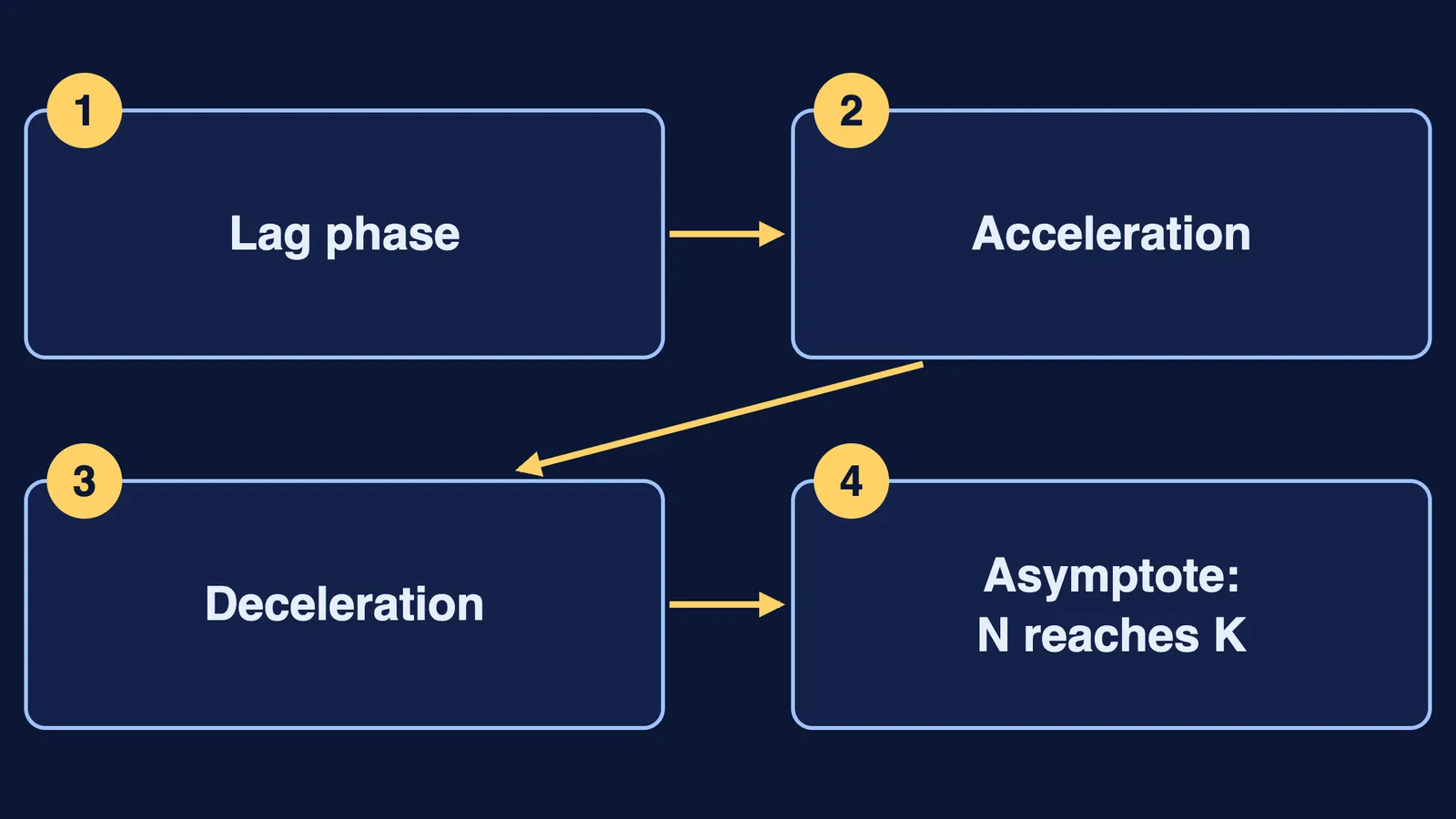
Logistic growth (11.1.2): lag phase → acceleration → deceleration → asymptote, where density reaches the carrying capacity K.
The chess-board bet (11.1.2): the king accepts the bet → the minister wins → one grain goes on Square 1, doubling on each square → by half the board, the kingdom's wheat proves too little.
Prickly pear in Australia (11.1.4 i): cactus introduced (early 1920s) → spreads over millions of hectares without natural predators → a cactus-feeding moth is introduced → cactus controlled.
Starfish removal (11.1.4 i): *Pisaster* preys on intertidal invertebrates → all starfish removed from an enclosed area → more than 10 invertebrate species extinct within a year.
Over-efficient predator (11.1.4 i): predator overexploits its prey → prey becomes extinct → predator becomes extinct for lack of food.
Competitive release (11.1.4 ii): a superior competitor confines a species to a small area → the competitor is experimentally removed → the species' range expands dramatically.
***Ophrys* pollination (11.1.4 v):** a petal resembles a female bee → a male bee is attracted → it pseudocopulates and is dusted with pollen → it pseudocopulates with another flower, transferring pollen.
Ramdeo Misra timeline (unit page in lebo111): born 1908 → PhD in Ecology, Leeds, 1937 → 1972, National Committee for Environmental Planning and Coordination → 1984, Ministry of Environment and Forests → died 1998.
How do you attack arrange-in-order questions?
Anchor the step nothing can precede, then the final outcome, such as an extinction, a range expansion or a death. Two anchors usually leave one option; if two survive, check the one pair where they differ.
Organisms and Populations arrange-in-order questions
Q1. Order the chess-board story: A. The minister wins the game B. The king accepts the minister's bet C. Half-way across the board, the king sees the wheat will fall short D. The king puts a single grain on Square 1. (1) B, D, A, C (2) B, A, D, C (3) A, B, D, C (4) B, A, C, D
Answer: (2). The board is filled after the game is lost (11.1.2).
Q2. Order the prickly pear events: A. A cactus-feeding moth is brought in B. The cactus reaches Australia C. The cactus is brought under control D. The cactus spreads over millions of hectares. (1) B, A, D, C (2) D, B, A, C (3) B, D, A, C (4) B, D, C, A
Answer: (3). Control followed the moth (11.1.4 i).
Q3. Order pollination in *Ophrys*: A. The bee pseudocopulates with a second flower, leaving pollen B. A male bee is drawn to the flower C. One petal mimics a female bee D. The bee pseudocopulates and picks up pollen. (1) C, B, D, A (2) B, C, D, A (3) C, D, B, A (4) C, B, A, D
Answer: (1). Pollen is picked up before it is passed on (11.1.4 v).
Q4. Order by date: A. Ministry of Environment and Forests formed B. Misra's PhD in Ecology C. Misra's birth D. National Committee for Environmental Planning and Coordination set up E. Misra's death. (1) C, D, B, A, E (2) C, B, A, D, E (3) C, B, D, E, A (4) C, B, D, A, E
Answer: (4). NCERT prints 1908, 1937, 1972, 1984 and 1998.
Before, after and out-of-place questions
Q5. In competitive release, what comes immediately before the confined species expands its range? (1) A superior competitor arrives (2) The superior competitor is experimentally removed (3) Resources become limiting (4) It evolves a new foraging pattern
Answer: (2). Expansion follows removal of the competitor (11.1.4 ii).
Q6. A host evolves ways to reject its host-specific parasite. What must follow for the parasite to keep succeeding with it? (1) It shifts to another host species (2) It loses its adhesive organs (3) It evolves mechanisms to counteract them (4) The host dies out
Answer: (3). NCERT's description of host-parasite co-evolution (11.1.4 iii).
Q7. A student lists grains on Squares 1 to 5 as 1, 8, 2, 4, 16. Moving which single number restores NCERT's doubling? (1) 1 (2) 2 (3) 8 (4) 16
Answer: (3). NCERT gives 1, 2, 4 and 8 for Squares 1 to 4, doubling each time (11.1.2).
Q8. Before a male bee pollinates a second *Ophrys* flower, what must already have happened? (1) It was dusted with pollen while pseudocopulating with an earlier flower (2) It collected nectar as a reward (3) It mated with a female bee (4) The petal changed colour
Answer: (1). *Ophrys* offers no reward; the pollen came from an earlier pseudocopulation (11.1.4 v).
Two-statement questions on order
Key: (1) I and II true (2) I and II false (3) I true, II false (4) I false, II true.
Q9. I: In competitive release, the species spreads only after its competitor is removed. II: The king saw the wheat would fall short only after filling all 64 squares.
Answer: (3). He saw it by half the board (11.1.2, 11.1.4 ii).
Q10. I: A parasite evolves counter-mechanisms before its host evolves ways to reject it. II: The National Committee for Environmental Planning and Coordination (1972) came before the Ministry of Environment and Forests (1984).
Answer: (4). NCERT puts the host's change first (11.1.4 iii).
Q11. I: The cactus-feeding moth reached Australia before the prickly pear did. II: In the chess story, the king began filling the board before the game was played.
Answer: (2). The moth came after the cactus spread; the board was filled after the game (11.1.2, 11.1.4 i).
What should you do after this set?
Tomorrow, write sequences 2, 3 and 7 from memory and tag each slip: start, end or neighbour swap. The hero's logistic phases are tested in the diagram-based questions on age pyramids and growth curves. Then try the Organisms and Populations statement and match-the-list set and the NCERT exceptions and odd-one-out set.
Which order keeps slipping? Fermi's AI tutor works out what you already know and builds a plan for the session.