On this page
Every order below comes from NCERT Class 11 Biology, Chapter 8, Cell: The Unit of Life (Reprint 2026-27), with its section number. The NEET (UG) 2026 syllabus places the chapter in Biology Unit 3, Cell Structure and Function. All 12 questions are original.
Which orders does NCERT give in Cell: The Unit of Life?
The chapter has few processes, so most orders are printed dates and layers that NCERT places in words, one inside the next.
Dates NCERT prints (8.2, 8.5.1 to 8.5.10): Brown describes the nucleus (1831), Schleiden studies plants (1838), Schwann studies animal cells (1839), Virchow says new cells come from pre-existing cells (1855), Golgi sees reticular structures near the nucleus (1898), Palade sees ribosomes (1953), Singer and Nicolson propose the fluid mosaic model (1972). Leeuwenhoek, undated, saw a live cell before Brown (8.1).
Bacterial cell envelope, outside in (8.4.1): glycocalyx, cell wall, plasma membrane; mesosomes are extensions of the membrane into the cell.
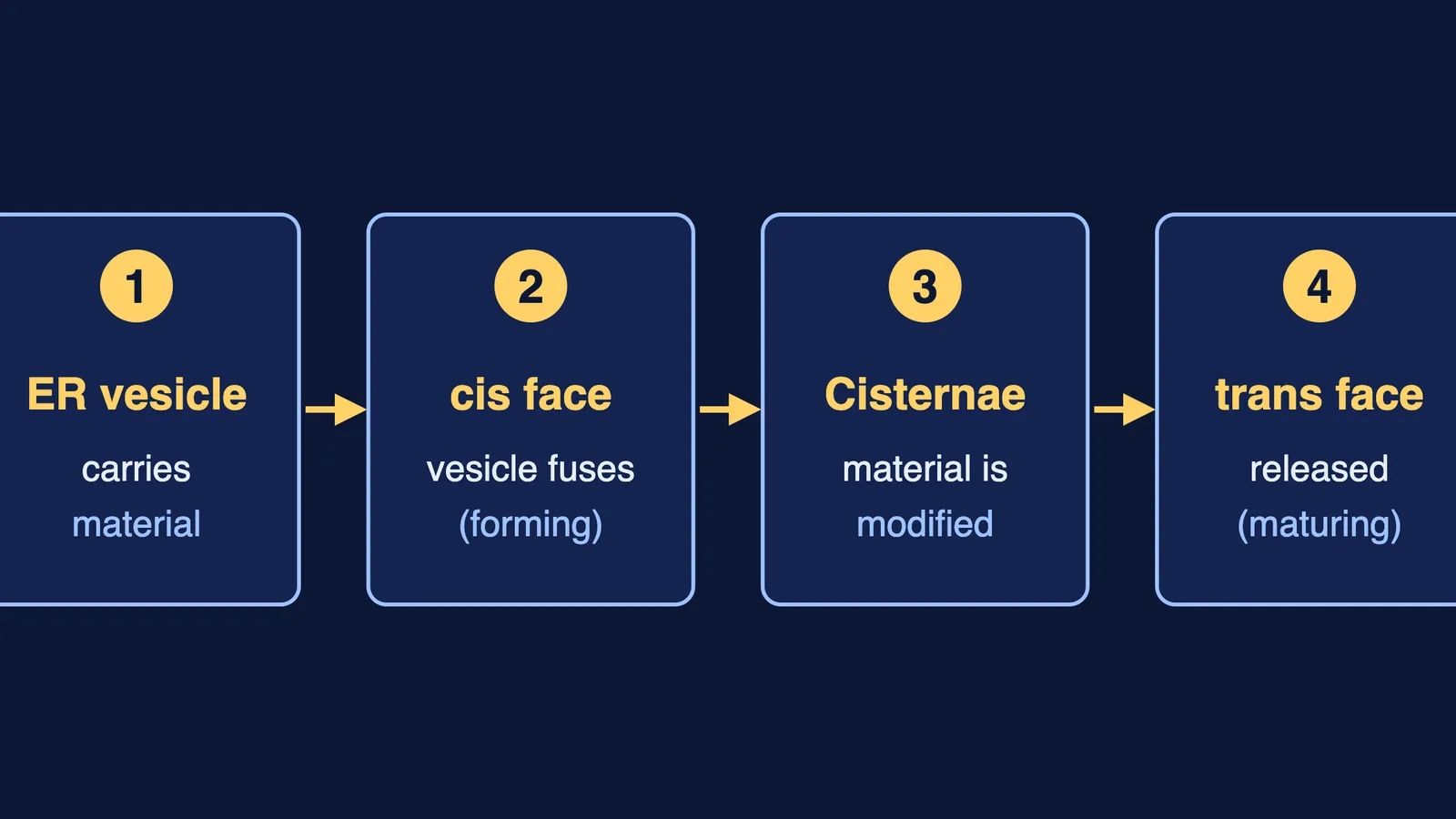
Golgi route (8.5.3.2), shown in the flow card above: ER vesicles fuse with the cis (forming) face, move towards the trans (maturing) face while material is modified in the cisternae, then leave from the trans face.
Chloroplast, inner membrane inwards (8.5.5): the inner membrane limits the stroma, thylakoids lie in the stroma, and the thylakoid membrane encloses the lumen.
Nuclear envelope, inside out (8.5.10): nucleoplasm, enclosed by the inner membrane, then the perinuclear space (10 to 50 nm) between the two membranes, then the outer membrane.
Cilium or flagellum, centre outwards (8.5.8): central pair of microtubules, central sheath, radial spokes (nine), peripheral doublets (nine), covering plasma membrane.
Centromere position (8.5.10): metacentric (middle), sub-metacentric (slightly away), acrocentric (close to an end), telocentric (terminal).
How do you attack arrange-in-order questions?
Settle both ends first: the earliest date or the outermost layer. That usually leaves two codes. Find the one neighbouring pair they disagree on and test it against one NCERT line, for example: material enters the Golgi at the cis face, so the trans face must come last.
Can you put these in NCERT's order?
Q1. A. Golgi sees reticular structures near the nucleus B. Brown describes the nucleus C. Virchow explains that cells come from pre-existing cells D. Palade sees ribosomes E. Schleiden examines many plants. (1) E-B-C-A-D (2) B-E-A-C-D (3) B-E-C-A-D (4) B-C-E-A-D
Q2. A. Singer and Nicolson propose the fluid mosaic model B. Schwann reports a thin outer layer on animal cells C. Golgi bodies are first observed D. The electron microscope reveals membrane detail. (1) C-B-D-A (2) B-C-D-A (3) B-D-C-A (4) B-C-A-D
Q3. From the outside of a bacterium inwards: A. Plasma membrane B. Glycocalyx C. Cell wall D. Mesosome. (1) C-B-A-D (2) B-A-C-D (3) B-C-D-A (4) B-C-A-D
Q4. In a chloroplast, from the inner membrane inwards: A. Lumen B. Inner membrane C. Thylakoid membrane D. Stroma. (1) B-D-C-A (2) B-C-D-A (3) D-B-C-A (4) B-D-A-C
Q5. In a cilium, from the centre outwards: A. Radial spoke B. Central pair of microtubules C. Peripheral doublet D. Central sheath E. Plasma membrane. (1) B-A-D-C-E (2) B-D-C-A-E (3) D-B-A-C-E (4) B-D-A-C-E
Q6. From inside the nucleus outwards: A. Outer membrane B. Inner membrane C. Nucleoplasm D. Perinuclear space. (1) C-D-B-A (2) C-B-D-A (3) B-C-D-A (4) C-B-A-D
Q7. By centromere position, from the middle towards the end: A. Acrocentric B. Metacentric C. Telocentric D. Sub-metacentric. (1) B-A-D-C (2) B-D-A-C (3) D-B-A-C (4) B-D-C-A
Answers. 1: (3). The dates run 1831, 1838, 1855, 1898, 1953 (8.2, 8.5.3.2, 8.5.6, 8.5.10). 2: (2). 1839, 1898, the 1950s, then 1972 (8.2, 8.5.1, 8.5.3.2). 3: (4). Glycocalyx is outermost; mesosomes extend into the cell (8.4.1). 4: (1). The inner membrane limits the stroma; thylakoids there enclose the lumen (8.5.5). 5: (4). A radial spoke joins the sheath to each doublet (8.5.8). 6: (2). The inner membrane encloses the nucleoplasm; the perinuclear space lies between the two membranes (8.5.10). 7: (2). The centromere moves from the middle to the tip (8.5.10).
Which before, after and out-of-place questions test the same orders?
Q8. Which event comes immediately before Schwann's work on animal cells? (1) Virchow's explanation of new cells (2) Brown's description of the nucleus (3) Schleiden's study of plants (4) Golgi's observation
Q9. Moving inwards through a bacterial envelope, which layer comes immediately after the cell wall? (1) Glycocalyx (2) Plasma membrane (3) Capsule (4) Chromatophore
Q10. This list should run from the middle centromere to the terminal one: metacentric, telocentric, sub-metacentric, acrocentric. Which single item must move? (1) Metacentric (2) Sub-metacentric (3) Acrocentric (4) Telocentric
For Q11 and Q12: (1) Both I and II are correct (2) Both are incorrect (3) I is correct, II is incorrect (4) I is incorrect, II is correct.
Q11. I: In the bacterial envelope, the cell wall lies outside the glycocalyx. II: Thylakoids lie in the stroma, the space limited by the inner chloroplast membrane.
Q12. I: Brown described the nucleus before Schleiden examined plant tissues. II: The detailed structure of the membrane was worked out before the electron microscope arrived in the 1950s.
Answers. 8: (3). Schleiden 1838, Schwann 1839 (8.2). 9: (2). The plasma membrane follows the wall (8.4.1). 10: (4). Telocentric has a terminal centromere, so it ends the list (8.5.10). 11: (4). Glycocalyx is the outermost layer (8.4.1); II matches 8.5.5. 12: (3). Brown 1831, Schleiden 1838; membrane detail needed the electron microscope (8.5.1).
Where should you practise next?
Practise other formats with our statement and match-the-list set, the diagram-based questions and the NCERT exceptions and odd-one-out set.
Not sure which organelle to revise first? Fermi's AI tutor works out what you already know and builds a plan for the session.