On this page
In the cell chapter of NCERT Class 11 Biology (Chapter 8, 2026-27 reprint), many NEET questions test a rule; the harder ones test where NCERT itself breaks it. In the NEET (UG) 2026 syllabus, it belongs to Biology Unit 3, titled Cell Structure and Function.
Below are 10 rules, each with the exception NCERT names and its section, then 12 original questions with NCERT reasons. If the chapter is new to you, start with how to prepare Cell: The Unit of Life for NEET.
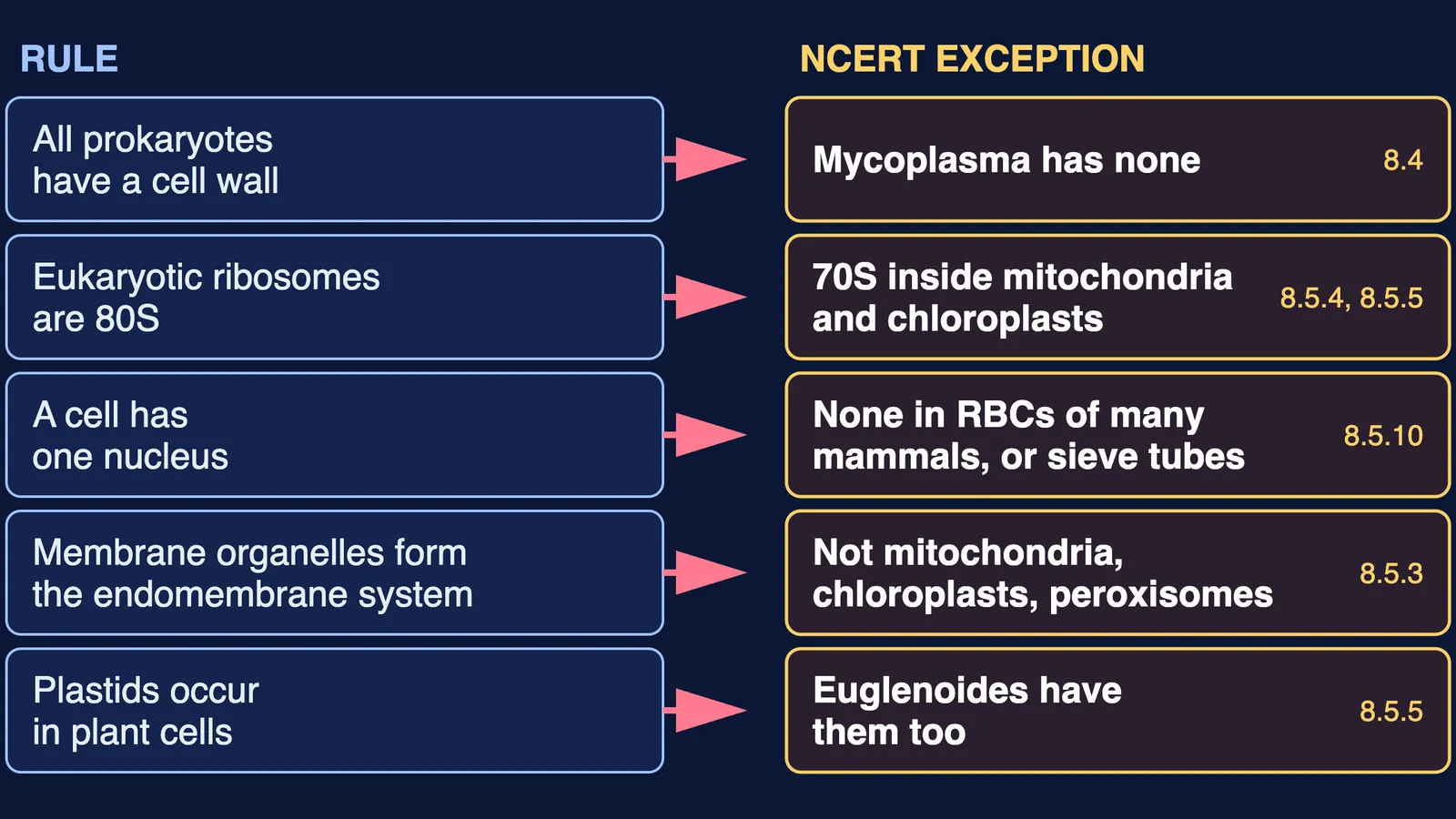
What are the NCERT exceptions in Cell: The Unit of Life?
Rule: a cell wall is a feature of plant cells, as Schwann concluded (8.2). Exception: fungi also have a cell wall outside the plasma membrane (8.5.2).
Rule: every prokaryote has a cell wall around its cell membrane. Exception: Mycoplasma (8.4).
Rule: prokaryotes lack the organelles found in eukaryotes. Exception: ribosomes, present in both (8.3, 8.4).
Rule: organelles of a eukaryotic cell are membrane bound. Exceptions: ribosomes and the centrosome (8.3), and the nucleolus (8.5.10).
Rule: a cell normally has one nucleus. Exception: some mature cells have none, such as red blood cells (erythrocytes) in many mammals and the sieve tube cells found in vascular plants (8.5.10).
Rule: eukaryotic ribosomes are 80S. Exception: the ribosomes inside mitochondria (8.5.4) and chloroplasts (8.5.5) are 70S.
Rule: membrane-bound organelles whose work is coordinated form the endomembrane system. Exception: mitochondria, chloroplasts and peroxisomes stay outside it (8.5.3).
Rule: plastids belong to plant cells. Exception: euglenoides have them too (8.5.5).
Rule: many molecules cross the membrane without spending energy, down their concentration gradient. Exception: active transport moves some ions uphill using ATP, as in the Na+/K+ pump (8.5.1).
Rule: a bacterium's surface extensions, the flagella, serve movement. Exception: pili and fimbriae are surface structures too, yet play no part in motility (8.4.1).
How do you handle odd-one-out and exception questions?
Name the shared feature before hunting for the misfit, in two or three words such as "no membrane" or "70S".
Then try the reverse: could another option be odd on a different feature, such as prokaryote versus eukaryote? If two answers survive, your feature is too loose.
For "which is NOT an exception", check that the rule is real and the item truly breaks it.
For statement pairs, judge each statement alone first.
Can you answer 12 odd-one-out and exception questions?
Odd one out
Q1. By presence of a cell wall, which is the odd one out? (1) A fungal cell (2) An algal cell (3) Mycoplasma (4) A typical bacterium
Q2. By ribosome size, which is the odd one out? (1) Ribosomes in the mitochondrial matrix (2) Ribosomes in the chloroplast stroma (3) Ribosomes of a bacterium (4) Ribosomes attached to rough ER
Q3. By whether the mature cell has a membrane-bound nucleus, which is the odd one out? (1) A mammalian erythrocyte that has lost its nucleus (2) A sieve tube cell of a vascular plant (3) Mycoplasma (4) A human cheek cell
Q4. By membership of the endomembrane system, which is the odd one out? (1) Vacuole (2) Mitochondrion (3) Lysosome (4) Endoplasmic reticulum
Answers.
Q1: (3). Fungi and algae have walls (8.5.2), as do prokaryotes except Mycoplasma (8.4).
Q2: (4). Ribosomes on rough ER are 80S; the other three are 70S (8.4.2, 8.5.4 to 8.5.6).
Q3: (4). The cheek cell is the only one with a membrane-bound nucleus; the other three have none (8.4, 8.5.10).
Q4: (2). Only the mitochondrion sits outside the endomembrane system (8.5.3).
Which is NOT an exception?
Q5. Each option pairs a rule with a claimed exception. Which is NOT a genuine exception? (1) "Prokaryotes have a cell wall": Mycoplasma (2) "A cell has one nucleus": sieve tube cells (3) "Plastids occur in plant cells": euglenoides (4) "Eukaryotic ribosomes are 80S": ribosomes on rough ER
Q6. Which is NOT an exception to "organelles of a eukaryotic cell are membrane bound"? (1) Ribosome (2) Centrosome (3) Nucleolus (4) Microbody
Answers.
Q5: (4). Ribosomes on rough ER are ordinary eukaryotic 80S ribosomes; the real exceptions sit inside mitochondria and chloroplasts (8.5.6).
Q6: (4). NCERT calls microbodies membrane bound vesicles (8.5.11); the other three have no membrane.
Statement I and Statement II
For Q7 to Q9: (1) Both correct (2) Both incorrect (3) I correct, II incorrect (4) I incorrect, II correct.
Q7. I: The Na+/K+ pump moves ions from lower to higher concentration and uses ATP. II: Neutral solutes can cross the membrane by simple diffusion, from higher to lower concentration.
Q8. I: Prokaryotic cells contain no organelle of any kind. II: Prokaryotic ribosomes are 70S, built from 50S and 30S subunits.
Q9. I: Euglenoides carry plastids, so plastids are not limited to plant cells. II: Each cell of Chlamydomonas holds 20 to 40 chloroplasts.
Answers.
Q7: (1). Both match section 8.5.1; the pump is NCERT's example of active transport.
Q8: (4). Ribosomes are the one organelle prokaryotes have (8.4); II matches 8.4.2.
Q9: (3). Chlamydomonas has one chloroplast per cell; 20 to 40 is the mesophyll figure (8.5.5).
Single-correct MCQs
Q10. NCERT calls the pigment-containing membranous extensions of cyanobacteria: (1) mesosomes (2) chromatophores (3) plastids (4) polysomes
Q11. Fimbriae do not help a bacterium move. What does NCERT say they do in some bacteria? (1) Attach the cell to rocks in streams and to host tissues (2) Carry out respiration (3) Store phosphate granules (4) Form the capsule
Q12. Schwann held that a cell wall is unique to plant cells. Which group in NCERT section 8.5.2 breaks this? (1) Fungi (2) Animals (3) Mycoplasma (4) Human red blood cells
Answers.
Q10: (2). Section 8.4.1 names chromatophores; NCERT gives mesosomes no pigment, and plastids are eukaryotic (8.5.5).
Q11: (1). Section 8.4.1 gives attachment as their role, not motility.
Q12: (1). Fungi have a wall alongside plants (8.5.2); Mycoplasma has none.
What should you do after the set?
Score a question only when your reason matches NCERT.
For each miss, write the rule and its exception on one card.
Redo the misses after three days.
For other formats, try the statement and match-the-list set and the diagram-based questions.
Not sure which exceptions you have already learnt? Fermi's AI tutor works out what you already know and builds a plan for the session.