

On this page
NCERT Class 11 Biology covers Cell: The Unit of Life in Chapter 8 (Reprint 2026-27), listed in the NEET (UG) 2026 syllabus under Biology Unit 3, Cell Structure and Function.
These 14 original questions target often-skipped parts: wall chemistry, inclusion bodies, the nuclear envelope, cell shapes and the centrosome. Each answer has a one-line NCERT reason. If the chapter is fresh, read our guide on how to prepare Cell: The Unit of Life for NEET.
How do you answer Statement I and Statement II questions on the cell?
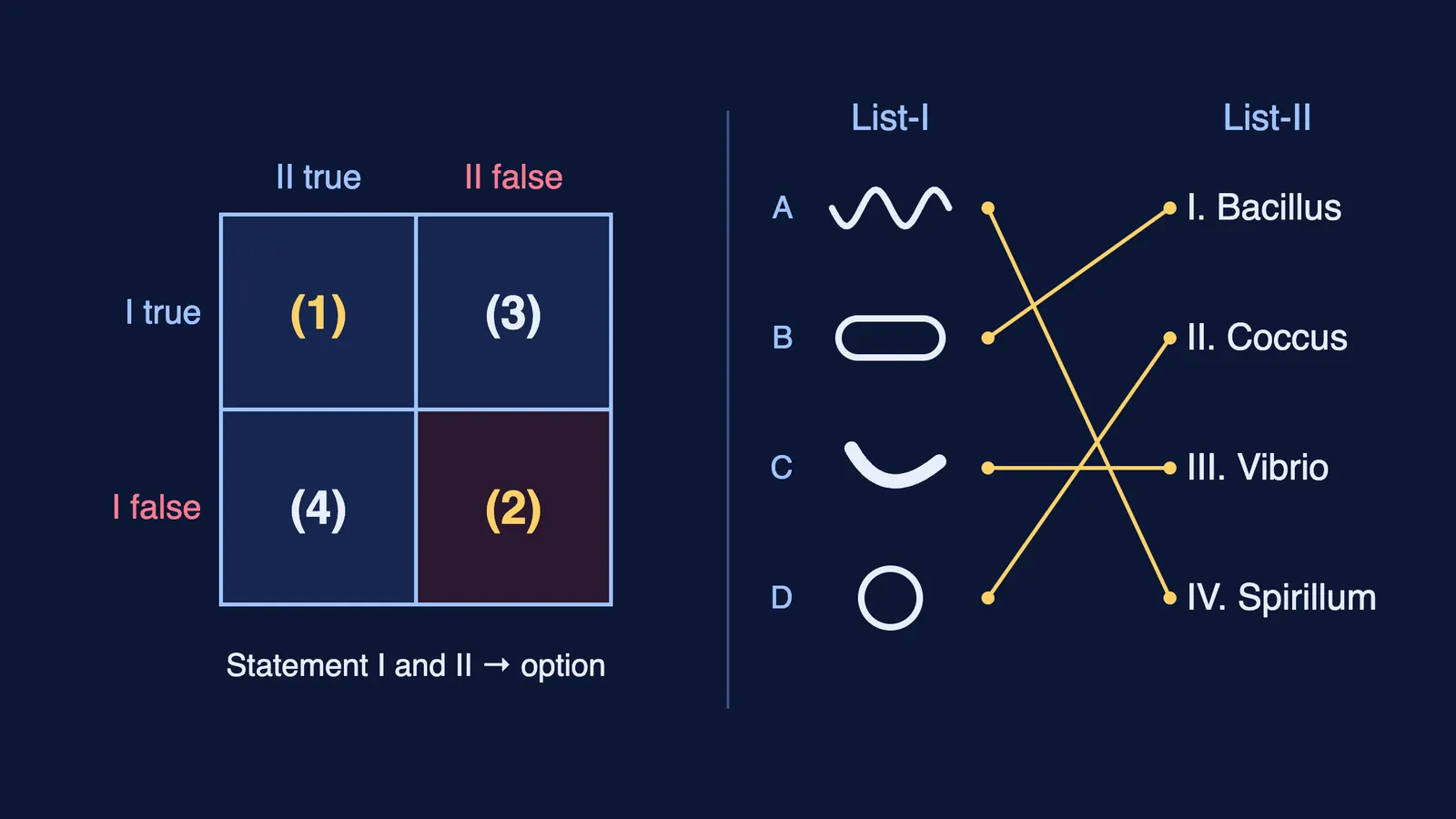
Find the one word carrying each claim (inner or outer, along or against) and mark T or F. Then read the diagram's grid: true-true is (1), false-false (2), true-false (3), false-true (4).
For Q1 to Q6: (1) Both I and II are correct (2) Both I and II are incorrect (3) I is correct, II is incorrect (4) I is incorrect, II is correct.
I: The ER divides a cell's inner space into luminal (inside the ER) and extra-luminal (cytoplasm) compartments. II: Rough ER is continuous with the inner membrane of the nuclear envelope.
I: A cell wall covers the plasma membrane of fungi as well as plants. II: The primary wall of a young plant cell can grow, and this ability shrinks as the cell matures.
I: Gas vacuoles occur in blue-green algae and in purple and green photosynthetic bacteria. II: Inclusion bodies such as cyanophycean granules are wrapped in a single membrane.
I: Flemming was the first to describe the nucleus as a cell organelle. II: Nuclear pores arise from fusion of the nuclear envelope's two membranes.
I: The tonoplast moves ions into the plant vacuole down their concentration gradient. II: In Amoeba, the contractile vacuole works in osmoregulation and excretion.
I: Integral proteins sit on the membrane surface; peripheral proteins are buried in it. II: Membrane proteins are classed as integral or peripheral by molecular mass.
Answers.
1: (3). NCERT makes rough ER continuous with the outer nuclear membrane.
2: (1). Both match NCERT section 8.5.2.
3: (3). Inclusion bodies have no membrane and lie free in the cytoplasm.
4: (4). Robert Brown described the nucleus; Flemming named chromatin.
5: (4). The tonoplast moves ions against the gradient, so the vacuole holds more.
6: (2). The roles are reversed, and NCERT sorts them by ease of extraction.
How do you handle a "which statements are correct" question?
Cross out every option holding the statement you are surest is false, then check only what is left.
Which statements about plastids are correct? A. They occur in all plant cells and in euglenoides. B. Chlorophyll lies in the stroma. C. Chloroplasts are 2 to 4 µm wide. D. The stroma holds enzymes for making carbohydrates and proteins. E. Chromoplast pigments are water soluble. Options: (1) A, B and E only (2) A, C and D only (3) B, C and D only (4) A, D and E only
Answer. 7: (2). Chlorophyll is in the thylakoids; chromoplast carotenoids are fat soluble.
How do you pair List-I with List-II on cell structures?
Fix first the List-II entry that fits only one item. In the diagram's solved example, the spiral can only be spirillum and the comma only vibrio. Then keep the option row holding every pair you fixed.
List-I: A. Polysome B. Perinuclear space C. Food vacuole D. Secondary wall. List-II: I. Formed by engulfing food II. Formed on the membrane side III. Ribosomes reading one mRNA IV. 10 to 50 nm across. Options: (1) A-III, B-IV, C-I, D-II (2) A-IV, B-III, C-I, D-II (3) A-III, B-IV, C-II, D-I (4) A-I, B-IV, C-III, D-II
List-I: A. Algal cell wall B. Cell wall of other plants C. Lysosomal vesicles D. Chromatin. List-II: I. DNA, histones, non-histone proteins, RNA II. Cellulose, hemicellulose, pectins, proteins III. Lipases, proteases, carbohydrases IV. Cellulose, galactans, mannans, calcium carbonate. Options: (1) A-II, B-IV, C-III, D-I (2) A-IV, B-II, C-I, D-III (3) A-IV, B-III, C-II, D-I (4) A-IV, B-II, C-III, D-I
List-I (cell, as drawn in NCERT Figure 8.1): A. White blood cell B. Red blood cell C. Columnar epithelial cell D. Tracheid. List-II (shape): I. Elongated II. Round and biconcave III. Long and narrow IV. Amoeboid. Options: (1) A-IV, B-III, C-II, D-I (2) A-II, B-IV, C-III, D-I (3) A-IV, B-II, C-III, D-I (4) A-I, B-II, C-III, D-IV
Answers.
8: (1). NCERT sections 8.4.2, 8.5.2, 8.5.3.4 and 8.5.10.
9: (4). NCERT sections 8.5.2, 8.5.3.3 and 8.5.10 give these contents.
10: (3). Figure 8.1 labels these shapes.
Which single-correct MCQs test the rest of the chapter?
Cover the options and answer from memory. If your answer is missing, you have found a gap, not a trick.
According to NCERT, the largest isolated single cell is (1) a nerve cell (2) the egg of an ostrich (3) a tracheid (4) a mesophyll cell
Which statement about the centrosome is correct? (1) Its two centrioles lie parallel to each other (2) It is bounded by a single membrane (3) Its centrioles are surrounded by amorphous pericentriolar materials (4) It is found in almost all plant cells
About how much DNA does one human cell hold, across how many chromosomes? (1) 2 metres; 46 (2) 2 metres; 23 (3) 1 metre; 46 (4) 20 centimetres; 46
Which pair is NOT correctly matched? (1) Euglenoides: contain plastids (2) Golgi cisternae: 0.5 to 1.0 µm in diameter (3) Thylakoid membrane: encloses a space called the lumen (4) Gram-positive bacteria: do not take up the stain
Answers.
11: (2). NCERT names the ostrich egg; nerve cells are among the longest, a different claim.
12: (3). The centrioles lie perpendicular, the centrosome has no membrane, and almost all plant cells lack centrioles.
13: (1). About two metres, across 46 chromosomes (23 pairs).
14: (4). Gram-positive bacteria take it up.
What should you do after the set?
Count a question only if your reason matched.
Sort misses: a fact never read (reread NCERT) or one swapped (write true and false versions side by side).
Redo misses after three days.
More on the formats: statement-based NEET questions and match-the-list questions in NEET.
Keep confusing which structure owns which feature? Fermi's AI tutor works out what you already know and builds a plan for the session.


