On this page
Octyl gallate is a phenolic antioxidant that Indian rules allow in edible oils and fats. Its Bureau of Indian Standards specification, IS 6798:1997, gives a purity test with one odd feature: you weigh a bismuth precipitate and multiply by 0.5574, but the standard never says what the precipitate is. You can work it out. Run the factor backwards, check the answer against a second standard, and you get a formula that fits both to within 0.05%. That formula is our inference, not a BIS statement.
What is octyl gallate, and how does BIS test its purity?
Octyl gallate is the n-octyl ester of gallic acid (3,4,5-trihydroxybenzoic acid). IS 6798 gives its formula as C₁₅H₂₂O₅ and its molar mass as 282.34. The foreword says it is permitted under the Prevention of Food Adulteration Rules, 1955 as an antioxidant in edible oils and fats except ghee and butter. Its job is chemical: it slows the radical chain that makes fats rancid, through the chain-breaking step ArOH + ROO• → ArO• + ROOH, where the phenol turns into a phenoxyl radical. That step is explained in how BHT and BHA keep fats from going rancid.
The standard offers two purity methods. One is UV absorbance. The other, in Annex A-1.2, goes like this:
Weigh 100 mg of the dried sample. Add 15 ml acetone and 10 ml water and bring to the boil.
Add 10 ml of bismuth nitrate reagent (made up with acetic acid) and boil again.
Cool, filter, wash (acetic acid, water, warm dilute nitric acid) and dry at 110 °C to constant mass.
Octyl gallate, percent = mass of precipitate × 0.5574 / mass of sample × 100.
The same standard lists the melting range as 99 to 102 °C and describes octyl gallate as insoluble in water and freely soluble in ethanol, ether, propylene glycol and fat. The sister standard for propyl gallate, IS 6796:1997, gives 146 to 150 °C. The longer hydrocarbon chain makes the octyl ester more fat-like and less water-like.
What is a gravimetric factor?
A gravimetric factor converts the mass of what you weigh into the mass of what you want. If one formula unit of precipitate contains one molecule of analyte:
gravimetric factor = M(analyte) / M(precipitate)
Take chloride weighed as AgCl. M(Cl) = 35.45 and M(AgCl) = 143.32, so the factor is 35.45 / 143.32 = 0.2474. Every gram of AgCl holds 0.2474 g of chloride.
Turn it around. If you know the factor and the analyte, then M(precipitate) = M(analyte) / factor. That gives you a molar mass, and a molar mass is the first clue to a formula. The same backwards reasoning shows up in counting periodate to find the ring size of glucose. For more practice at this kind of reasoning, the Fermi Problem Library has worked problems with a step-by-step solver that explains the reasoning.
How do you get the precipitate's formula from 0.5574?
Assume one ester molecule per formula unit of precipitate (the simplest case; we test it below).
Molar mass of the precipitate. 282.34 / 0.5574 = 506.53 g/mol.
What was added to the ester? 506.53 − 282.34 = 224.19 g/mol.
Find the pieces. Bismuth is 208.98, leaving about 15.2. That is one O (16.00) minus one H (1.01). So the add-on is Bi + O − H, which is the same as −2H + Bi + OH: two phenolic H atoms leave and Bi plus one hydroxide join.
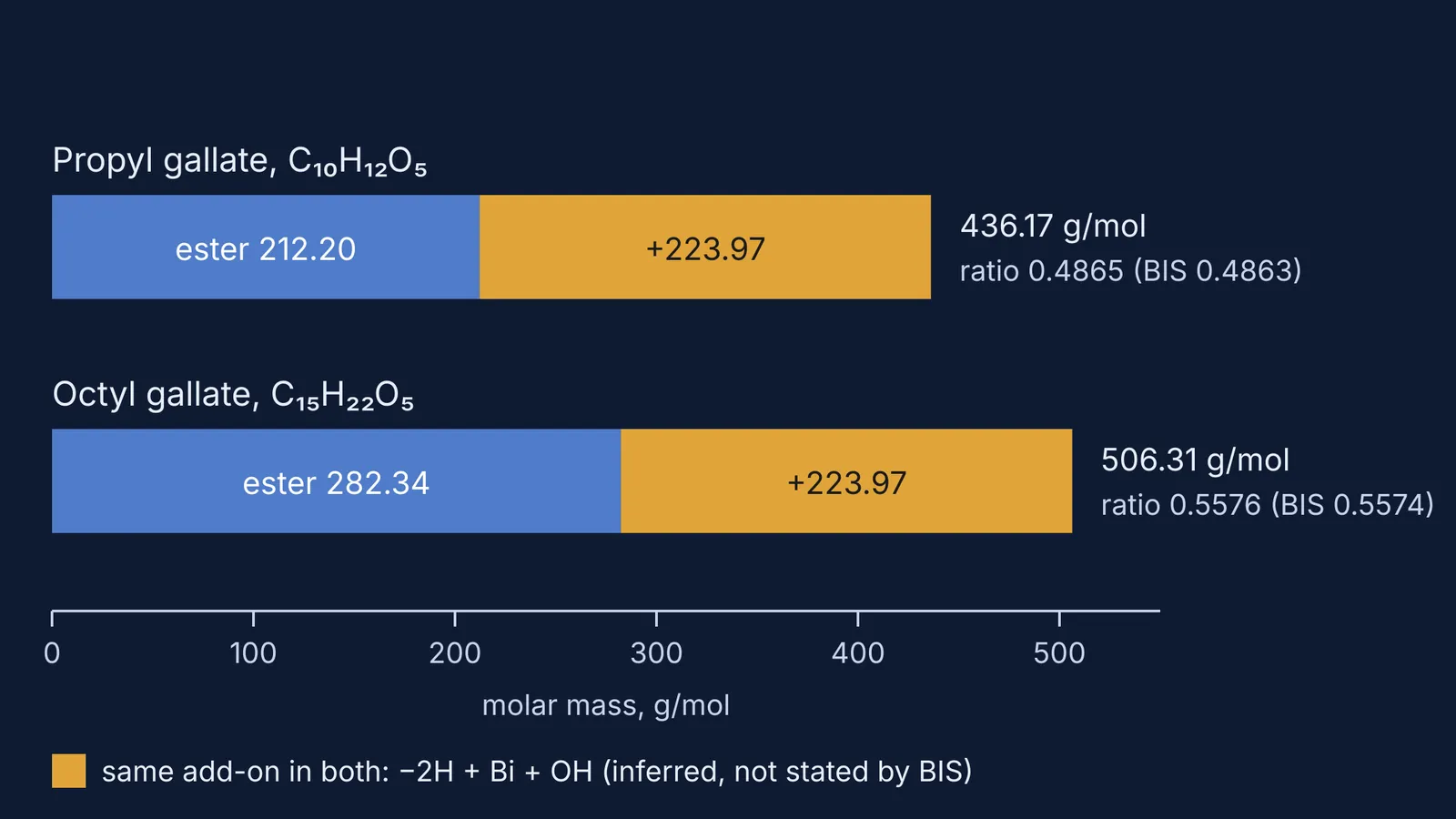
Write the formula. C₁₅H₂₂O₅ − 2H + Bi + OH = C₁₅H₂₁BiO₆, molar mass 506.31.
Check the factor. 282.34 / 506.31 = 0.5576, against BIS's 0.5574. The gap is 0.04%.
What does 0.04% mean on the balance? From 100 mg of pure ester you expect about 179.3 mg of precipitate. BIS's factor implies 179.4 mg. The difference, about 0.08 mg, is smaller than a 0.1 mg balance can show. We do not know where BIS's last digit comes from, and older atomic mass tables do not obviously explain it.
Other candidates miss clearly:
Ester − 3H + Bi (C₁₅H₁₉BiO₅, 488.29): factor 0.5782.
C₁₅H₂₁BiO₆ with one extra water (524.32): factor 0.5385.
Ester − 2H + Bi + NO₃ (551.30): factor 0.5121.
Three esters per Bi, Bi(ester − H)₃ (1052.96): factor 0.2681.
Only C₁₅H₂₁BiO₆ lands near 0.5574.
Written with Bi³⁺ for simplicity, the precipitation balances as:
C₁₅H₂₂O₅ + Bi³⁺ + H₂O → C₁₅H₂₁BiO₆↓ + 3H⁺
Check: C 15 = 15; H 22 + 2 = 21 + 3; O 5 + 1 = 6; Bi 1 = 1; charge +3 = +3. Bi³⁺ hydrolyses easily in water, as you can see in why BiCl₃ turns milky on dilution, so a hydroxide on bismuth is not surprising.
Does propyl gallate's factor give the same answer?
One fit could be luck. A second, independent number is a real test. IS 6796 uses a different procedure: 200 mg of ester in hot water, bismuth nitrate in nitric acid, a yellow precipitate, factor 0.4863, ester molar mass 212.21.
212.21 / 0.4863 = 436.38 g/mol.
Add-on: 436.38 − 212.21 = 224.17, the same 224 as for octyl.
Predicted formula C₁₀H₁₁BiO₆ = 436.17, so the factor should be 212.20 / 436.17 (using 212.20 from current atomic masses) = 0.4865. BIS has 0.4863, again 0.04 to 0.05% low.
There is a neat extra check. The two implied precipitate masses differ by 506.53 − 436.38 = 70.15. Octyl and propyl differ by five CH₂ groups, 5 × 14.03 = 70.13. The bismuth part is the same in both.
Which oxygen atoms hold the bismuth?
The factor fixes the composition, not the structure. Ester − 2H + Bi + OH and ester − H + BiO have the same formula, so the mass alone cannot tell them apart.
Support comes from a related compound. PubChem's entry for bismuth subgallate lists C₇H₅BiO₆, which is gallic acid (C₇H₆O₅) − 2H + Bi + OH, the same pattern. PubChem draws it as Bi³⁺, a hydroxide ion and a benzene-1,2-diolate: two adjacent phenolic oxygens, each without its H. Two adjacent oxygens and bismuth close a five-membered ring, Bi–O–C–C–O, a chelate. The ester's C=O is not part of it.
For the gallate esters we assume the same binding by analogy. Which adjacent pair binds in octyl gallate has not been shown. In a gallate, the 3- and 5-OH groups are equivalent, so an adjacent pair always means the middle OH plus one neighbour.
What should you remember for the exam?
Exam line: gravimetric factors and molar mass (Class 11, Some Basic Concepts of Chemistry), phenols and esters (Class 12), and homologous series.
Quick checklist:
282.34 / 0.5574 = 506.5, and 212.21 / 0.4863 = 436.4.
Both add about 224 = Bi + OH − 2H, giving C₁₅H₂₁BiO₆ and C₁₀H₁₁BiO₆.
The precipitate masses differ by 70.1, five CH₂ groups.
Adjacent phenolic oxygens can chelate Bi in a five-membered ring.
The formula is an inference from the factors. Mass gives composition, not structure.
If you are preparing for JEE, Fermi Test Prep for JEE Main and Advanced has an AI tutor that can walk you through mole-concept numericals like these.