

On this page
A geometrical isomer question looks like a counting problem, but many lost marks come from the step before counting: deciding which double bonds can show isomerism at all. Get that right, check the two ends of the chain, and the arithmetic takes seconds.
Which double bonds can show geometrical isomerism?
A C=C bond shows cis-trans (geometrical) isomerism only if rotation about it is restricted and each of its two carbons carries two different groups, as Chemistry LibreTexts/13:_Alkenes_Alkynes_and_Aromatic_Compounds/13.03:_The_Structure_of_Alkenes-_Cis-Trans_Isomerism) sets out. Chemists call such a bond stereogenic. The NCERT Class 11 chapter on hydrocarbons uses exactly this test in its Problem 9.11, ruling out (CH₃)₂C=CH–C₂H₅ and CH₂=CBr₂ because two identical groups sit on one of the doubly bonded carbons (NCERT Chemistry Part II, Unit 9).
So scan each double bond and ask one question per carbon:
Does this carbon carry two different groups? A terminal =CH₂ fails straight away.
Does the other carbon also carry two different groups? An isopropylidene end, (CH₃)₂C=, fails too.
Only bonds that pass both checks enter the count. Call that number n.
The same NCERT chapter notes that cis-but-2-ene has a dipole moment of 0.33 D while the trans form's is almost zero, and gives their boiling points as 277 K and 274 K. Same atoms, same bonds, different compounds.
How many geometrical isomers are there with n double bonds?
Each stereogenic double bond can be E or Z independently of the others. With n of them, there are 2 × 2 × 2 and so on, which is 2ⁿ sequences of E and Z. When the two ends of the chain are different, every sequence is a different compound.
Unsymmetrical polyene: number of geometrical isomers = 2ⁿ.
Ph–CH=CH–CH=CH–COOH has two stereogenic double bonds and different ends (phenyl and carboxyl), so it has 2² = 4 geometrical isomers: (E,E), (E,Z), (Z,E) and (Z,Z).
Why is the count lower when both ends are identical?
If the chain reads the same from either end, you can number it from the left or the right. The sequence E,E,Z read from one end is Z,E,E read from the other, so those two are the same molecule. Hexa-2,4-diene, CH₃–CH=CH–CH=CH–CH₃, shows this. PubChem holds records for (2E,4E)-hexa-2,4-diene, (2Z,4Z)-hexa-2,4-diene and (2Z,4E)-hexa-2,4-diene; the (2E,4Z) form is simply the (2Z,4E) molecule numbered from the other end. Three isomers, not four.
The general count comes from one idea. Of the 2ⁿ sequences, each palindrome (one that reads the same backwards, like E,Z,E) is one molecule on its own. Every other sequence pairs up with its reverse. There are 2ᵖ palindromes, where p = n/2 for even n and p = (n+1)/2 for odd n, so the number of distinct isomers is (2ⁿ + 2ᵖ)/2.
Symmetrical polyene: number of geometrical isomers = 2ⁿ⁻¹ + 2ᵖ⁻¹.
Check it on hexa-2,4-diene: n = 2 and p = 1, so 2¹ + 2⁰ = 3, matching the three PubChem records.
Worked examples: how do you apply the method?
Use the same three steps every time: find the stereogenic double bonds (n), compare the two ends, then pick the formula.
CH₃–CH=CH–CH=CH–CH=CH₂. Three double bonds, but the terminal carbon carries two hydrogens, so n = 2. The ends differ. Answer: 2² = 4.
(CH₃)₂C=CH–CH=CH–CH₃. The first double bond fails because one carbon carries two methyl groups, so n = 1. Answer: 2¹ = 2.
CH₃–CH=CH–CH=CH–CH₃. Here n = 2, the ends are identical and p = 1. Answer: 2 + 1 = 3.
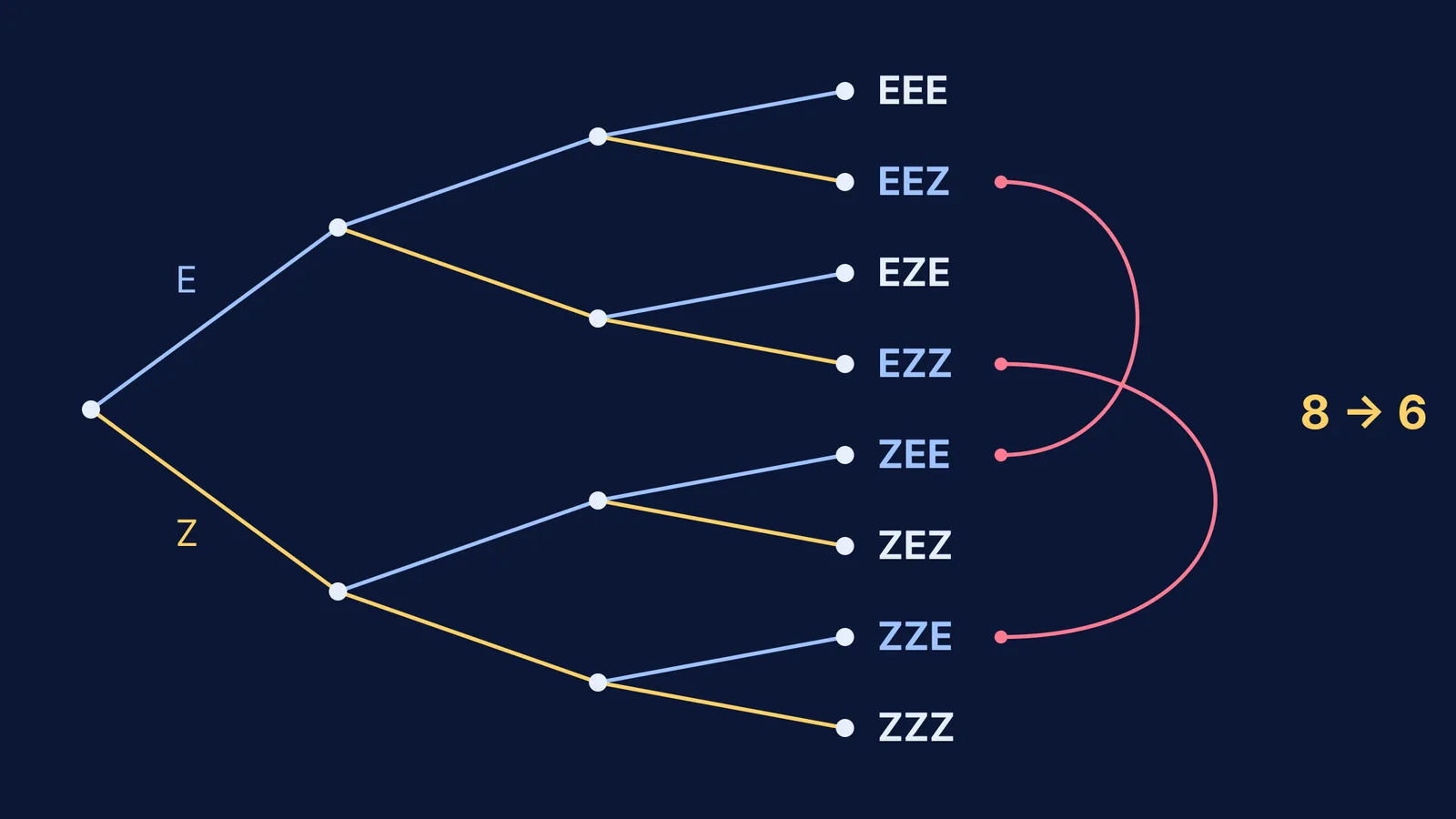
CH₃–CH=CH–CH=CH–CH=CH–CH₃ (octa-2,4,6-triene). Here n = 3, the ends are identical and p = 2. Answer: 2² + 2¹ = 6.
For example 4, list them. EEE, ZZZ, EZE and ZEZ are palindromes, so each counts once. EEZ is the same molecule as ZEE, and EZZ the same as ZZE. That gives 4 + 2 = 6, the reduction from eight to six drawn in the diagram at the top of this post.
If the molecule also has chiral centres, geometrical isomers are only part of the answer. Our guide to counting stereoisomers from the number of chiral centres covers how those multiply, and the walk-through of chirality, meso compounds, R/S and E/Z shows how to name each isomer you have counted. Naming slips cost marks too, so keep the IUPAC naming rules for organic compounds fresh.
What should you do if you keep getting these wrong?
Watch for three common slips: counting a terminal or =CR₂ double bond, calling a chain symmetrical when its ends differ by one carbon, and forgetting that E,Z and Z,E collapse into one in a symmetrical chain. Before you compute anything, write n and "same ends: yes or no" in the margin. That one line catches all three.
If the reason a bond is or is not stereogenic still feels shaky, the Fermi Concept Library covers every concept in physics, chemistry, biology, mathematics and computing, each with its own lesson. For practice, the Fermi Problem Library has worked problems with a step-by-step solver that explains the reasoning rather than printing an answer, so you can see where a count went wrong.


