On this page
Palmarosa is an aromatic grass grown in India for a rose-scented oil, and most of that oil is geraniol. Geraniol has two C=C bonds, so the 2ⁿ rule tempts you to say four geometric isomers. The right answer is two. One of its double bonds ends in a carbon carrying two methyl groups, and that bond cannot be cis or trans. This single check is the slip that costs the most marks in JEE isomer counts, and geraniol is a clean real example of it.
What is in palmarosa oil?
PubChem's geraniol record gives the IUPAC name (2E)-3,7-dimethylocta-2,6-dien-1-ol, formula C₁₀H₁₈O (154.25 g/mol), and a boiling point of 229–230 °C. It describes geraniol as a colourless to pale yellow oily liquid with a sweet rose odour and says it occurs naturally in oil of rose, oil of palmarosa, citronella and lemon grass.
The National Horticulture Board's palmarosa varieties sheet gives the composition the breeders report for each variety:
IW-31245: oil contains 90 % total geraniol.
Trishna: oil contains 93 % geraniol.
Jamrosa: geraniol 54–83 % and geranyl acetate 17.89 %.
These are figures from a one-page variety sheet, so quote the variety with the number. Some of the geraniol is present as its ester, geranyl acetate. PubChem's manufacturing notes say a higher-geraniol product is made by fractionating palmarosa oil after saponification of the geranyl esters, which frees the bound geraniol.
How many geometric isomers does geraniol have?
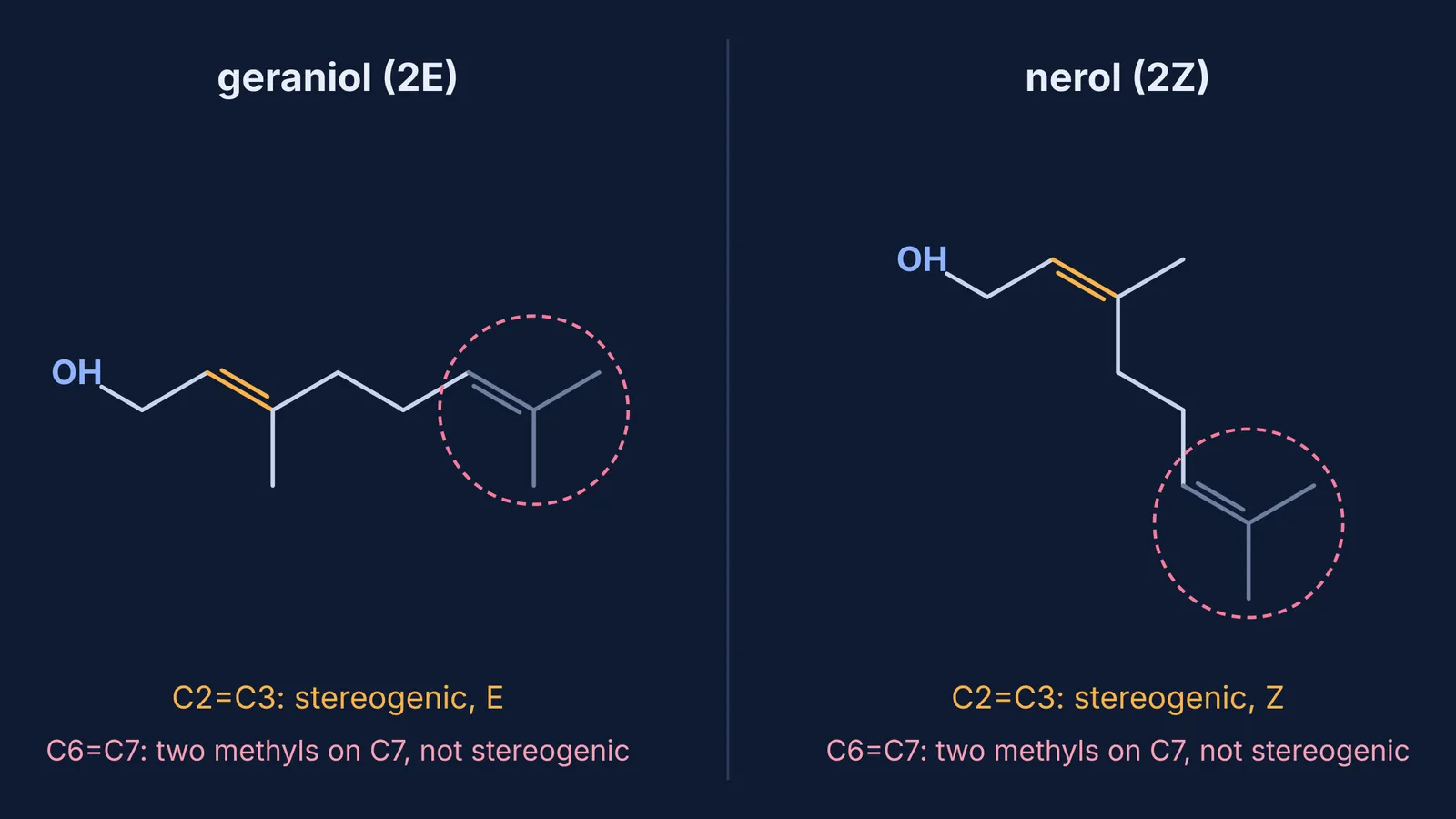
Write the chain: HOCH₂–CH=C(CH₃)–CH₂–CH₂–CH=C(CH₃)₂. The double bonds are C2=C3 and C6=C7. Check every carbon of each one, as in our guide to counting geometrical isomers with the 2ⁿ rule.
C2: carries H and CH₂OH. Two different groups. Pass.
C3: carries CH₃ and CH₂CH₂CH=C(CH₃)₂. Different. Pass.
C6: carries H and CH₂. Different. Pass.
C7: carries CH₃ and CH₃. The same. Fail.
One failing carbon is enough to rule a bond out. Swapping two identical methyl groups gives the same molecule, so C6=C7 has no cis or trans form. That leaves n = 1, and the count is 2¹ = 2 geometric isomers, not 2² = 4.
Both isomers are real, separate compounds. The E form is geraniol. The Z form is nerol, which PubChem lists as (2Z)-3,7-dimethylocta-2,6-dien-1-ol with the same formula and a boiling point of about 225 °C (PubChem also gives 227 °C from another source). PubChem's manufacturing notes say some synthetic routes give a geraniol–nerol mixture, and high-purity geraniol is then obtained by fractional distillation.
Is geraniol cis or trans, and why use E/Z instead?
At C3 the two groups are CH₃ and a longer chain. Cis and trans do not say which of those to compare, so use the CIP priorities.
On C2: CH₂OH beats H.
On C3: compare CH₃ (attached atoms H, H, H) with CH₂CH₂… (attached atoms C, H, H). The chain wins at the first point of difference.
Geraniol: CH₂OH and the chain are on opposite sides, so it is E.
Nerol: they are on the same side, so it is Z.
In this molecule E matches what older books call trans, because the higher-priority groups are also the two main-chain carbons. That is not true in general, which is why JEE expects E/Z.
Worked example: count, bromine uptake and saponification
(a) Count. n = 1 (C2=C3 only), so 2 isomers: geraniol (E) and nerol (Z).
(b) How much bromine does geraniol take up? Each C=C adds one Br₂. Both bonds add bromine, whether or not they show isomerism.
C₁₀H₁₈O + 2Br₂ → C₁₀H₁₈Br₄O
Check: C 10 = 10, H 18 = 18, O 1 = 1, Br 4 = 4.
Moles in 1 g: 1 ÷ 154.25 = 0.006483 mol, or 6.48 mmol.
Br₂ needed: 2 × 6.48 = 12.97 mmol.
Mass of Br₂: 0.012966 × 159.81 = 2.07 g Br₂ per g of geraniol.
For an oil with 90 % geraniol (the IW-31245 figure), if nothing else added bromine: 0.90 × 2.07 = 1.86 g per g of oil.
That last figure is idealised. Geranyl acetate also has two C=C, and other unsaturated compounds in a real oil take bromine too. Notice that nerol gives exactly the same answer, because it has the same two C=C. So decolourising bromine water, the test in our post on testing for a double bond with bromine water, shows that unsaturation is present. It cannot tell geraniol from nerol. PubChem lists nerol's tetrabromide as crystals melting at 118 °C, the product of this same addition.
(c) How much KOH frees the ester-bound geraniol?
C₁₂H₂₀O₂ + KOH → C₁₀H₁₈O + CH₃COOK
Check: C 12 = 10 + 2, H 20 + 1 = 21 = 18 + 3, O 2 + 1 = 3 = 1 + 2, K 1 = 1.
Geranyl acetate (PubChem: [(2E)-3,7-dimethylocta-2,6-dienyl] acetate) has M = 196.29 g/mol. One mole uses one mole of KOH (56.11 g/mol).
KOH per gram of ester: 56.11 ÷ 196.29 × 1000 = 285.8 mg.
Jamrosa's listed 17.89 % ester means 0.1789 g per g of oil, which needs 0.1789 × 285.8 = 51.1 mg KOH per g of oil. That is the ester part of the oil's saponification value.
Geraniol released: 0.1789 ÷ 196.29 × 154.25 = 0.141 g per g of oil.
Suppose an oil held 54 % free geraniol (the low end of Jamrosa's range) plus 17.89 % ester. After saponification it would hold 54 + 14.1 = 68.1 % geraniol on the original mass basis.
Treat this as a stoichiometry check, not a lab method. The same KOH arithmetic for fats is in our post on saponification value and iodine value.
Which chapters does this question come from?
Class 11 Organic Chemistry: conditions for geometrical isomerism, E/Z with CIP priorities.
Class 11 Hydrocarbons: addition of Br₂ across C=C, one Br₂ per double bond.
Class 12 Aldehydes, Ketones and Carboxylic Acids: ester hydrolysis with alkali (saponification).
Class 11 mole concept: every mass in the worked example.
What to write in the exam: "C7 carries two identical CH₃ groups, so C6=C7 is not stereogenic; n = 1; number of geometrical isomers = 2¹ = 2."
If isomer counts keep costing you marks, Fermi Test Prep for JEE Main and Advanced pairs your practice with an AI tutor.
Quick checklist
Check all four carbons of the two C=C before using 2ⁿ.
A =C(CH₃)₂ end means that bond does not count: geraniol gives 2, not 4.
Geraniol is E, nerol is Z; use CIP priorities at C3.
Bromine counts every C=C: 2.07 g Br₂ per g, the same for both isomers.
Geranyl acetate needs 285.8 mg KOH per g.