On this page
Helicopters are far slower than jet airliners. The official speed record for a conventional helicopter, set by a modified Westland Lynx in 1986 and ratified by the FAI, is 400.87 km/h. The reason is not mainly engine power. It is relative velocity: one side of the rotor moves into the air and the other side moves away from it, and both sides run into a limit as the helicopter speeds up.
Why does one rotor blade meet faster air than the other?
Look down on a rotor that turns at angular speed Ω while the helicopter flies forward at speed V. Measure a blade's position by the angle ψ from the tail, in the direction of rotation. A section of blade at radius r moves at Ωr relative to the hub. The air comes at the hub at V. So the air speed across that section, perpendicular to the blade, is
u = Ωr + V sin ψ
At ψ = 90° the blade points sideways and moves forward into the air: this is the advancing blade, u = Ωr + V. At ψ = 270° it moves backwards with the air: the retreating blade, u = Ωr − V. In between you add the two velocities as vectors, and only the component across the blade matters for lift.
The FAA Helicopter Flying Handbook gives the same picture with a tip speed of about 400 knots: at 100 knots forward, the advancing tip meets 500 knots and the retreating tip only 300. The post on Juan de la Cierva's autogyro tells how this imbalance rolled early rotorcraft over, and how flapping hinges fixed it. Here we put numbers on it and find the speed limits.
Worked example: air speeds on each side of the rotor
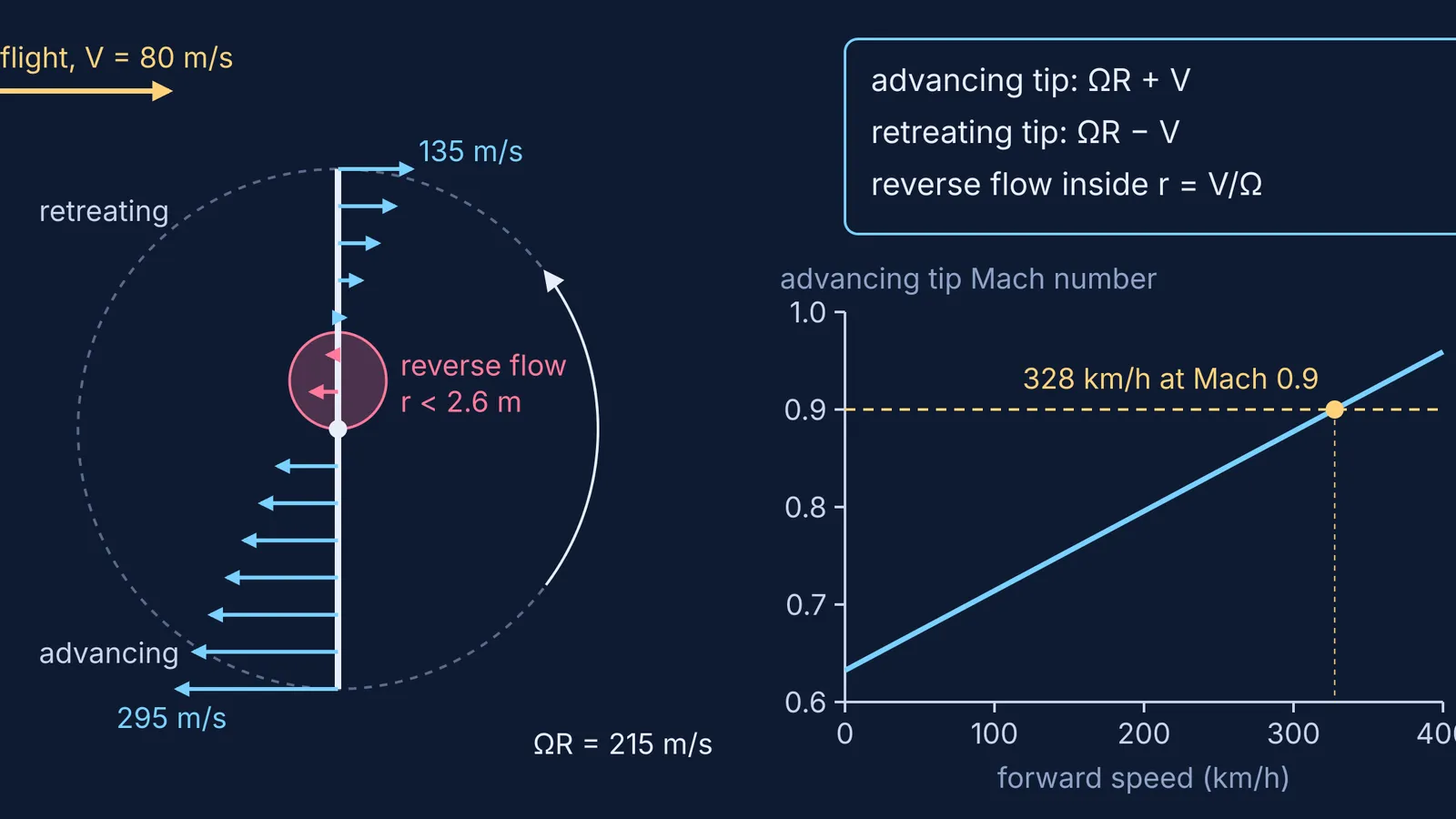
Take a rotor of radius R = 7 m with a tip speed ΩR = 215 m/s. These are illustrative round values, close to the FAA's 400-knot example (206 m/s).
Angular speed: Ω = 215/7 = 30.7 rad/s, which is 30.7 × 60/(2π) = 293 rpm.
Fly forward at V = 80 m/s (288 km/h).
Advancing tip: 215 + 80 = 295 m/s.
Retreating tip: 215 − 80 = 135 m/s.
Lift on a section goes as u² at a fixed angle of attack. The ratio is (295/135)² = 4.8. At the same blade angle, the advancing tip would make almost five times the lift of the retreating tip.
Halfway along the blade, at r = 3.5 m: Ωr = 107.5 m/s. The advancing side meets 187.5 m/s and the retreating side only 27.5 m/s.
Lift on the two sides must balance, or the helicopter rolls. So the blades flap and change pitch as they go round: the advancing blade flattens to a small angle of attack, and the retreating blade tilts to a large one. The same idea, tip speed set by rpm and radius, appears in why bigger wind turbines turn slower.
Where does air hit the blade from behind?
On the retreating side, u = Ωr − V is negative close to the hub. There the blade moves backwards more slowly than the air does, so the air arrives at the rear edge of the blade instead of the front edge.
Along the line ψ = 270°, reverse flow covers r < V/Ω = 80/30.7 = 2.6 m, which is 37% of the span.
Across the disc, the reverse-flow region is the set of points where Ωr + V sin ψ < 0. In the plane this is a circle of diameter V/Ω = 2.6 m, touching the hub, entirely on the retreating side. It is not centred on the hub.
Sections inside that circle make no useful lift and add drag. As V rises, the circle grows in proportion.
What actually limits a helicopter's speed?
There are two limits, one on each side.
Retreating blade stall. As V rises, the retreating blade meets slower air and must tilt further to carry its share of the lift. Past a critical angle of attack the airflow separates and the blade stalls. The FAA handbook says the combination of blade flapping and slow relative wind on the retreating blade normally limits a helicopter's maximum forward speed, and that pilots avoid it by staying below the never-exceed speed. It shows up as vibration, a nose pitch-up and a roll towards the retreating side.
Advancing tip near the speed of sound. The advancing tip moves at ΩR + V. As this approaches the speed of sound, shock waves form on the blade and drag rises sharply. NASA design studies of fast rotorcraft slow the rotor in cruise to reduce this compressible drag rise on the advancing blade.
Put numbers on the second limit. With the speed of sound at about 340 m/s near sea level, our 215 m/s rotor at 80 m/s has an advancing-tip Mach number of 295/340 = 0.87. Suppose the tip must stay below Mach 0.9. This is a round illustrative limit; the real value depends on the blade's shape.
Highest allowed tip speed: 0.9 × 340 = 306 m/s.
So V ≤ 306 − 215 = 91 m/s = 328 km/h.
Allow Mach 0.92 instead: V ≤ 312.8 − 215 = 97.8 m/s = 352 km/h.
Could you spin the rotor slower to give the advancing tip more room? Yes, but then ΩR − V shrinks on the retreating side and stall comes sooner. Spin it faster and the advancing tip goes transonic sooner. The two limits pull in opposite directions, which is why the speed of a conventional helicopter is boxed in. Hover power, the other main rotor question, is covered in power needed for a helicopter to hover.
How would JEE ask this?
JEE will not mention retreating blade stall. It will give you a disc rolling or spinning while it translates, and ask for the speed of a point on its rim relative to the ground or the air. That is exactly u = Ωr + V sin ψ. A rolling wheel is the special case ΩR = V: the bottom point is at rest and the top moves at 2V. A helicopter rotor is the case ΩR > V, so no point on the tip ever stops.
To practise relative-velocity problems with each step explained, try the Fermi Problem Library. If you want a structured plan for the exam, Fermi Test Prep offers personalised preparation for JEE Main & Advanced with an AI tutor, live classes, adaptive mocks, mentorship and a study plan that updates based on mastery.
Quick checklist:
Air speed across a blade section is Ωr + V sin ψ.
Advancing tip ΩR + V, retreating tip ΩR − V.
Lift at a fixed angle goes as u², so the imbalance is the square of the speed ratio.
Reverse flow fills a circle of diameter V/Ω on the retreating side.
Two limits set the top speed: retreating blade stall and the advancing tip nearing Mach 1.