

On this page
In January 1923, a strange aircraft with an unpowered rotor took off from an airfield in Madrid. Spanish engineer Juan de la Cierva's C.4 autogyro used a conventional engine and propeller for forward thrust, but relied entirely on a freely spinning overhead rotor for lift 1. It was a breakthrough that proved rotary-wing flight was possible.
Unlike an airplane, which relies on fixed wings and forward speed from an engine to generate lift, an autogyro uses a rotor that is not connected to the engine during flight. Instead, the forward motion of the aircraft forces air up through the rotor blades, causing them to autorotate—spin freely in the wind—and generate lift.
Before the C.4, previous prototypes rolled over and crashed as soon as they moved forward 1. Cierva's first three designs, the C.1, C.2, and C.3, all suffered from severe aerodynamic instability. They would tip over to the side before they could safely leave the ground. Cierva solved this with a simple but brilliant mechanical innovation: the flapping hinge.
Why did early rotors roll over?
The fundamental problem with a forward-moving rotor is known as dissymmetry of lift 1. A rotor blade spins in a circle. As the aircraft moves forward, the blade advancing into the wind experiences a much higher relative airspeed than the blade retreating on the other side.
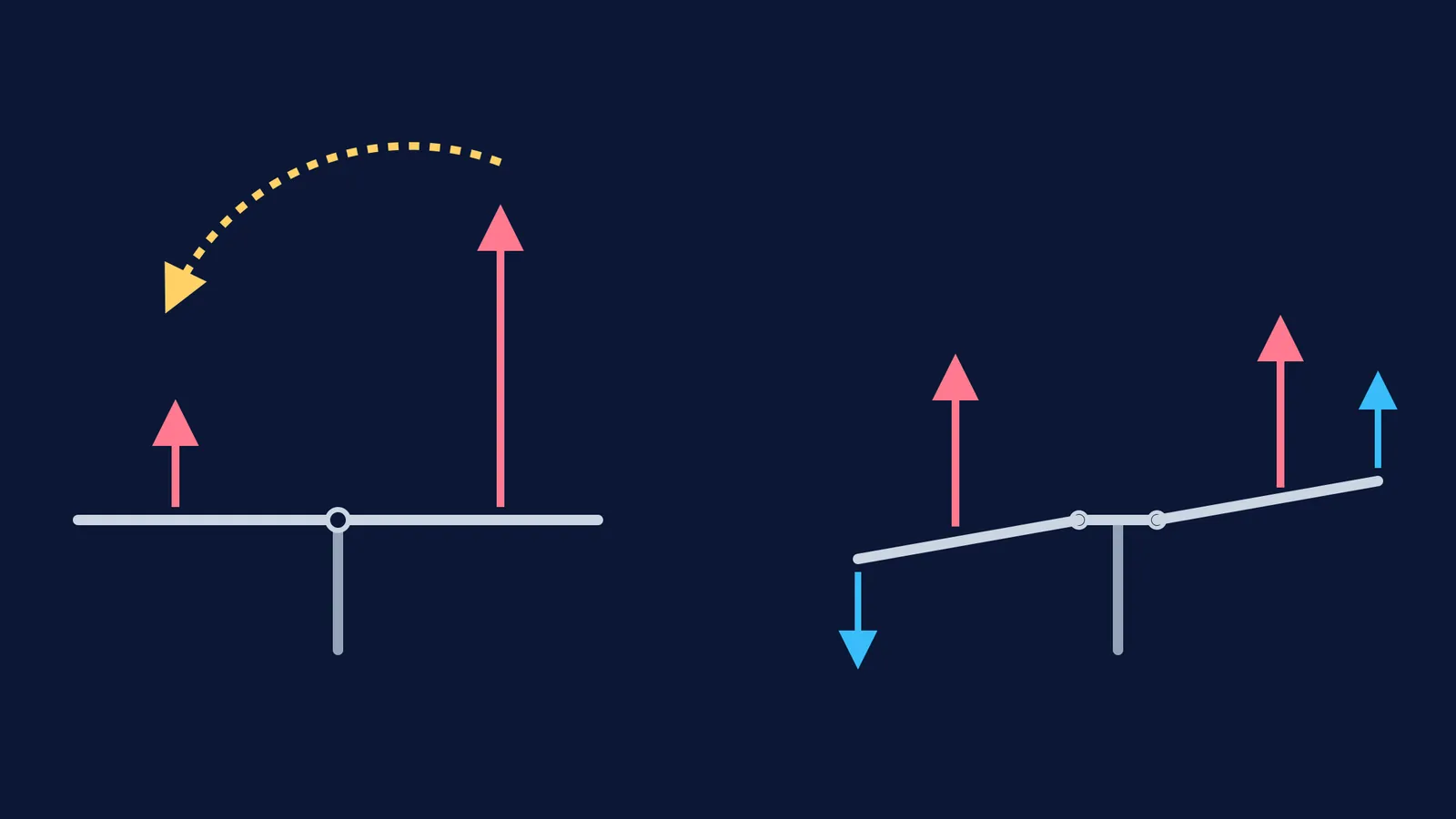
Because lift increases with airspeed, the advancing blade generates far more lift than the retreating one. On Cierva's rigid early models, this unequal force created a powerful torque that flipped the aircraft the moment it gained any significant forward speed 1. You can explore the mathematics of turning forces in our guide to finding torque about a point with vectors.
How can we visualise dissymmetry of lift?
If you need to understand how these forces act on a rotor blade in flight, use this three-step mental framework:
Combine the speeds: Add the aircraft's forward speed to the advancing blade's rotational speed. Subtract the forward speed from the retreating blade's speed.
Link speed to lift: The advancing blade now has faster airflow over it, creating much more lift. The retreating blade has slower airflow, creating proportionally less lift.
See the roll: Because the lift is wildly unequal on either side of the central mast, the entire aircraft will forcefully roll over towards the retreating side.
How did the flapping hinge equalise lift?
Cierva noticed that his small rubber-band models flew perfectly because their bamboo blades were flexible, while his full-size steel and wood blades were too rigid. His solution was to attach each blade to the central hub with a horizontal hinge 1.
This hinge allowed the blades to move up and down freely as they spun around the mast. When the advancing blade encountered higher airspeed, the extra lift caused it to flap upwards. This upward motion meant the relative wind struck the blade from a slightly higher angle, effectively reducing its angle of attack and shedding the excess lift 1.
On the opposite side of the aircraft, the retreating blade experienced less lift and flapped downwards. The downward motion meant the relative wind struck from below, increasing its angle of attack and regaining the lost lift. The aerodynamic forces balanced themselves automatically across the rotor disk, entirely through mechanical feedback without any pilot input.
What is the legacy of Cierva's 1923 flight?
Visualising how forces change continuously on a spinning object moving through the air is notoriously difficult. If you find yourself struggling to picture dynamic physical systems like this, the Fermi Simulation Lab provides interactive simulations for the ideas that are easier to see than to read.
Cierva's flapping hinge is considered one of the most important inventions in aviation history. Helicopters, which power their rotors directly, face the exact same aerodynamic physics when moving forward. Today, almost every modern rotary-wing aircraft—including the machines that followed Igor Sikorsky and the first practical single-rotor helicopter—uses a variation of Cierva's 1923 hinges or flexible equivalents to stay level in the air.


