On this page
You know Eugen Baumann's name from the Schotten–Baumann reaction, the benzoylation of amines and phenols in aqueous alkali. In late 1895 the same chemist reported something his own reagents made him doubt at first: the thyroid gland of sheep contains iodine, bound in an organic compound. He proved it with the method you use for Class 11 halogen estimation. He turned the iodine into silver iodide, weighed it and worked out the percentage. His own numbers make a clean Carius-type numerical.
Who was Eugen Baumann?
The Neue Deutsche Biographie (vol. 1, 1953, p. 651) says he was born in Cannstatt on 12 December 1846 and died in Freiburg on 3 November 1896. He trained as a pharmacist, studied chemistry and pharmacy at Tübingen and took his doctorate in 1872. He became assistant to the physiological chemist Felix Hoppe-Seyler, then led the chemical section of the physiological institute in Berlin from 1877. In 1883 he became full professor of chemistry in the medical faculty at Freiburg. The entry credits him with the discovery of organically bound iodine in the thyroid. After Hoppe-Seyler's death he edited the Zeitschrift für physiologische Chemie with Albrecht Kossel.
His half of the benzoylation reaction is a separate paper, "Ueber eine einfache Methode der Darstellung von Benzoësäureäthern", in the Berichte of 1886 (Crossref record). We have seen its record but not read the paper. The reaction itself is explained in the Schotten–Baumann benzoylation of amines.
How did Baumann find iodine in the thyroid?
His paper is "Ueber das normale Vorkommen von Jod im Thierkörper (I. Mittheilung)" (On the normal occurrence of iodine in the animal body, first report), in Hoppe-Seyler's Zeitschrift für physiologische Chemie, volume 21, pages 319–330 (DOI; a scan of the volume is on the Internet Archive). It is signed "Freiburg i. B., Anfang December 1895". Translations from German in this post are ours.
Baumann writes that his colleague Professor Kraske first drew his attention to the thyroid. He worked with Dr Roos, who tested each fraction for activity. The dye company Bayer in Elberfeld supplied the scale: the active substance came from "weit mehr als 1000 Hammelschilddrüsen", far more than 1,000 sheep thyroids.
The isolation was plain wet chemistry:
Boil the glands with 10% sulphuric acid. A fine brown precipitate separates as the liquid cools.
Extract the precipitate with hot alcohol (about 85%), then remove fats with petroleum ether.
Dissolve in 1% sodium hydroxide, filter, and precipitate again with dilute sulphuric acid.
The brown powder weighed 0.2 to 0.5% of the fresh gland. Bayer named it Thyrojodin.
How did he show the iodine was real?
He fused a trace of the powder with sodium hydroxide and saltpetre (KNO₃), dissolved the melt and acidified it with nitric acid. Shaken with chloroform, the liquid turned it violet: free iodine. His reaction was disbelief: "glaubte ich an alles Andere eher, als dass das Jod meiner Substanz angehöre", that is, I would have believed anything rather than that the iodine belonged to my substance. But every reagent proved free of iodine.
He then checked the weighed silver iodide again. Fused and redissolved, it gave a blue colour with starch, violet chloroform and a black precipitate of palladium iodide. Finally he heated palladium iodide in a sealed glass tube and watched violet iodine vapour condense into crystals. He kept the tube "zur Erinnerung", as a keepsake.
How did he measure the percentage?
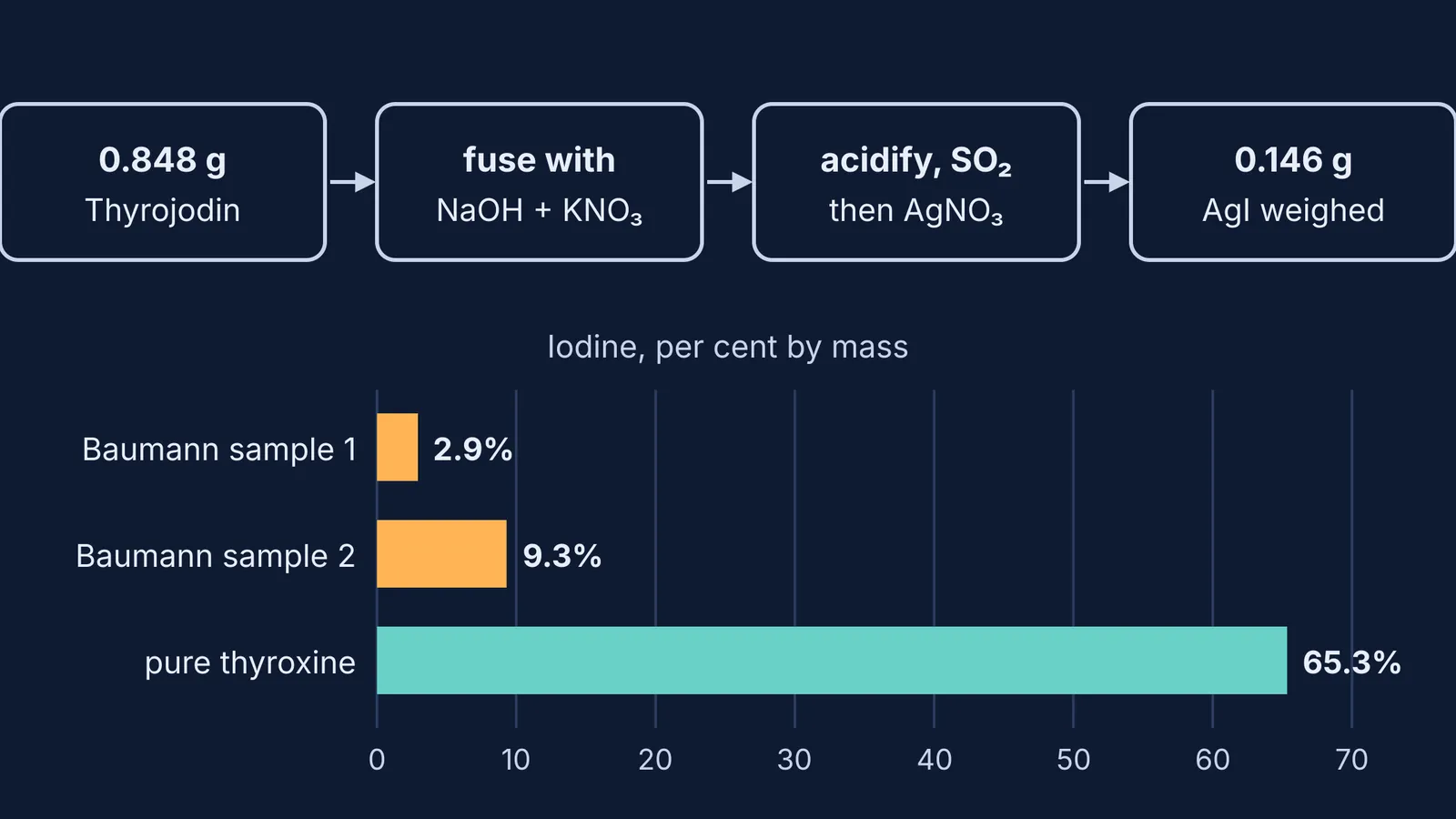
For the quantitative run, Baumann fused 0.313 g of Thyrojodin with 1.5 g of pure NaOH and a few crystals of KNO₃ in a silver crucible. The fusion destroys the organic compound and leaves the iodine as an inorganic salt in the melt. He dissolved the melt in 100 cm³ of water and acidified it with nitric acid. Then he added a few drops of sulphurous acid to turn the freed iodine back into iodide. Silver nitrate then gave a heavy yellow precipitate of AgI:
Ag⁺ + I⁻ → AgI
The precipitate weighed 0.017 g, which he gave as 0.00919 g iodine, or 2.9%. A purer sample from 600 g of fat-free gland, dissolved and reprecipitated twice, gave a higher value.
Worked example: Baumann's second sample
Question: 0.848 g of purified Thyrojodin gave 0.146 g of pure AgI. Find the percentage of iodine.
Molar mass of AgI. Using Ag = 107.868 and I = 126.904, AgI = 234.772 g/mol.
Fraction of iodine in AgI. 126.904 ÷ 234.772 = 0.5405.
Mass of iodine. 0.146 × 0.5405 = 0.07892 g.
Percentage. 0.07892 ÷ 0.848 × 100 = 9.31%.
Check with NCERT values. 127 × 0.146 × 100 ÷ (235 × 0.848) = 9.30%, exactly Baumann's printed "nicht weniger als 9,30 Procent", not less than 9.30 per cent.
Sanity check. 0.146 ÷ 0.848 = 0.17, well under the 1.85 ceiling.
The first sample works the same way: 0.017 × 0.5405 = 0.00919 g iodine, which is 2.94% of 0.313 g. Baumann's 0.00919 g matches to the last digit. For more practice with the same formula, see estimating carbon, hydrogen, halogens and sulphur in Class 11. For exam-style sets, Fermi Test Prep for JEE Main and Advanced comes with an AI tutor.
Why was 9.3% a lower limit?
Baumann said so himself: "Bei der bisher befolgten Methode der Jodbestimmung sind Verluste unvermeidlich", with the method used so far, losses are unavoidable. He does not say exactly where the iodine went missing, but iodine is volatile, so the values were, in his words, probably somewhat too low "in keinem Falle aber zu hoch", but in no case too high. That is a useful habit for any gravimetric result. Ask which way each error pushes the answer.
Thyrojodin was not a pure compound. Baumann noted that a substance with only about 3% iodine must have a very large molecular weight. The pure hormone came later. Edward Kendall crystallised thyroxine, which is 65.3% iodine, at the end of 1914, as told in how Edward Kendall isolated thyroxine from thyroid glands. Crossref lists a second report by Baumann and Roos (vol. 21, 1896) and a third by Baumann in vol. 22, dated 1897, after his death. We have not read those.
If the idea of gravimetric factors still feels shaky, the Fermi Concept Library gives each chemistry concept its own lesson.
Quick checklist
Baumann (1846–1896) is the Baumann of the Schotten–Baumann reaction.
In December 1895 he reported organically bound iodine in sheep thyroid, in a brown powder named Thyrojodin.
Method: fuse with NaOH + KNO₃, acidify, reduce I₂ back to I⁻, precipitate AgI, weigh.
% I = 127 × m(AgI) × 100 ÷ (235 × m). His data give 2.9% and 9.30%.
Losses make gravimetric halogen results low, never high.
Thyrojodin was a crude product, not thyroxine.