On this page
In 1914 nobody had purified the thyroid gland's hormone. A 28-year-old chemist at the Mayo Clinic in Minnesota changed that, and how he did it is a lesson in choosing what to measure.
Edward Calvin Kendall, born in 1886, earned his chemistry PhD at Columbia University in 1910 and worked on the thyroid at Parke, Davis and Co. in Detroit and St. Luke's Hospital in New York before joining the Mayo Foundation in 1914, according to his Nobel Prize biography.
How did Edward Kendall isolate thyroxine from thyroid glands?
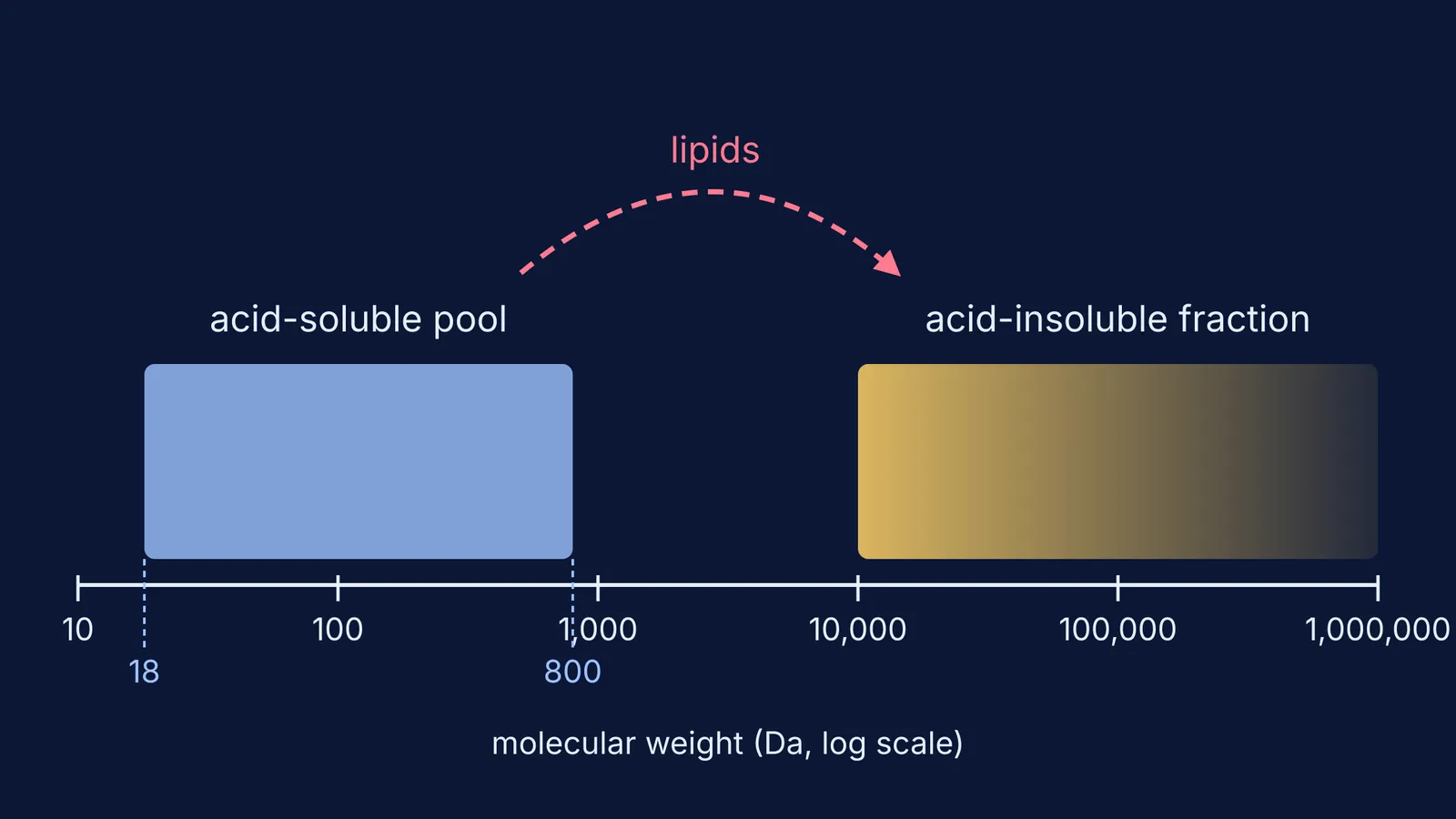
The hormone is locked inside the gland's proteins. In a 1913 report from St. Luke's, Kendall described dissolving whole glands in sodium hydroxide and a new method that split the gland's proteins into simpler pieces; one partly purified compound held 23.3 per cent iodine (Kendall, 1913).
A 1927 review of the thyroxine work summed up the finished process: alkaline hydrolysis of the gland to free it from fatty material, then repeated dissolving in alkali and precipitating with acid. Put simply:
Break down thyroid glands, mostly from pigs, in alkali so the proteins fall apart.
Add acid so the iodine-rich fraction comes out as a solid.
Redissolve it in alkali and precipitate it with acid again, many times.
Measure the iodine in each fraction. If it rises, the sample is purer.
Crystallise the purest fraction.
The American Thyroid Association's account of the discovery describes the last days. Kendall had a sample with 60 per cent iodine that would not crystallise. On 23 December 1914 he accidentally boiled off the alcoholic solution he was working with and was left with an insoluble white crust that had the highest iodine content yet. On Christmas Day he saw crystals under his microscope.
The yield was tiny: by 1919, about 33 grams of thyroxine from more than 3 tons of fresh glands, according to the 1927 review.
Why did Kendall track iodine instead of testing on animals?
Animal tests are slow. Kendall bet that the hormone carried the gland's iodine, so he mainly measured iodine and ran only occasional bioassays (American Thyroid Association). Class 11 mole concept shows why that worked.
Worked example: how much iodine is in pure thyroxine?
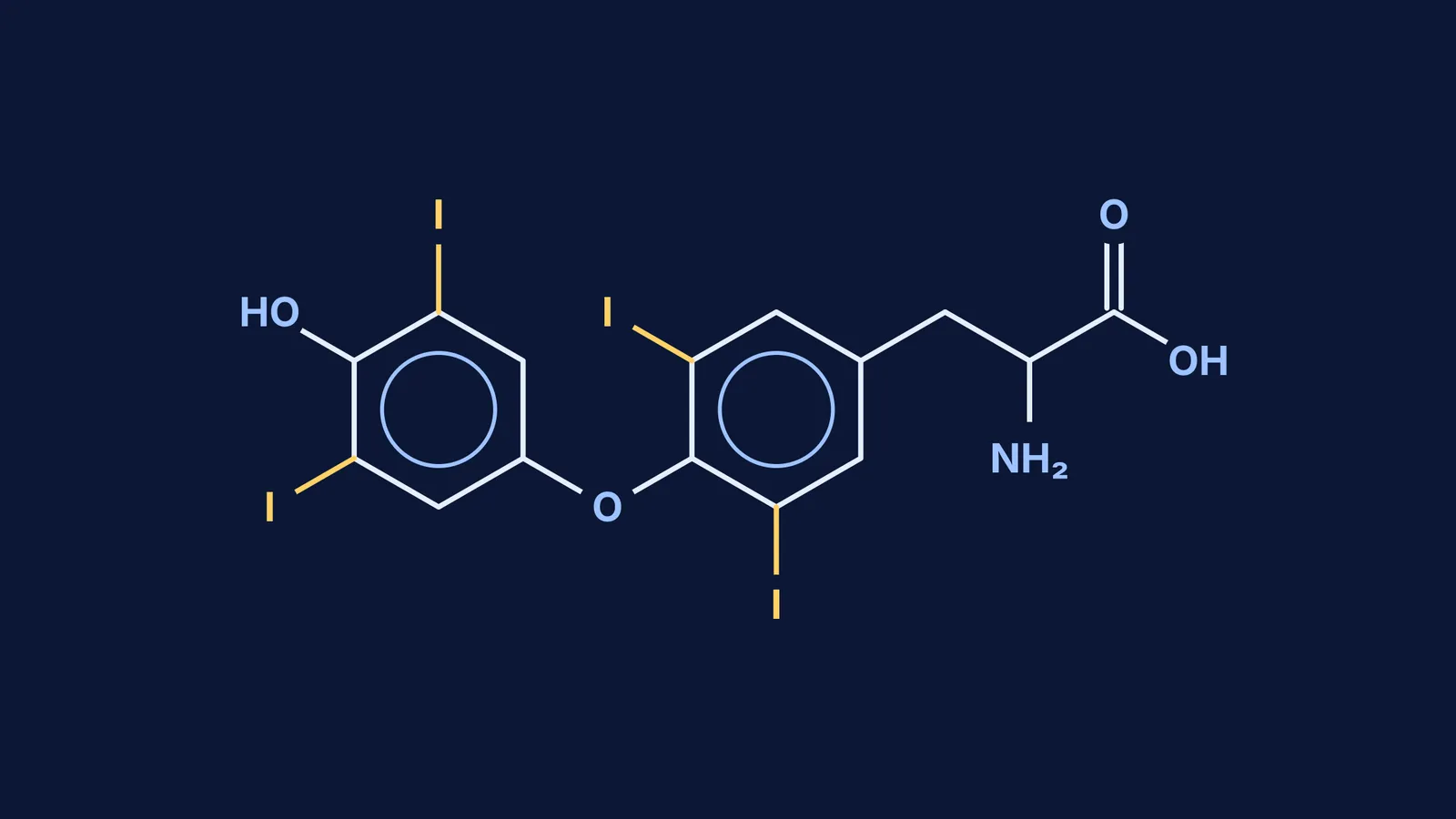
Thyroxine's formula is C15H11I4NO4, with a molar mass of 776.87 g/mol (PubChem). Iodine's atomic mass is 126.90 (PubChem periodic table).
Iodine in one mole: 4 x 126.90 = 507.6 g
Iodine percentage: 507.6 / 776.87 x 100 = 65.3 per cent
So the 60 per cent sample was close but not pure, and the 1913 fraction at 23.3 per cent was far off. Rising iodine really was a purity gauge.
Now the yield from the 1927 review. Taking these as US tons of about 907 kg, 3 tons is roughly 2,700 kg, so 33 g (33,000 mg) means about 12 milligrams of hormone per kilogram of gland, slightly less as the total was over 3 tons.
What went wrong after 1914?
Two things, according to the American Thyroid Association account. Kendall could not repeat his own crystallisation for all of 1915; the problem turned out to involve the metal lining of his large extraction vats. And his proposed structure, an indole ring with three iodine atoms, was wrong. Charles Harington in London found the correct structure, with four iodine atoms, in 1926 (Nature, 1926), and also made the hormone synthetically. Kendall later wrote that "the failure to synthesize thyroxin was a bitter disappointment."
How did Kendall get from thyroxine to cortisone?
He turned to the adrenal cortex, isolating its hormones at Mayo while Tadeus Reichstein did the same, independently, in Zurich. Philip Hench, a Mayo physician, had noticed that rheumatoid arthritis sometimes eased during jaundice or pregnancy. When Hench gave patients one of the adrenal hormones, cortisone, its anti-inflammatory effect was discovered. It relieved disease only while it was given and did not cure it (Nobel Prize biography).
The three shared the 1950 Nobel Prize in Physiology or Medicine "for their discoveries relating to the hormones of the adrenal cortex, their structure and biological effects."
What can you borrow from Kendall's method?
Pick a number you can check. Kendall followed iodine per cent (American Thyroid Association). In a long numerical, check units or a limiting case after each step.
Know the target. 65.3 per cent tells you 60 is not done. Estimate an answer's size before you calculate.
Treat accidents as data. The boiled-off crust was his best sample.
For the biology side, revise glands, hormones and their actions in chemical coordination, see how hormonal feedback loops keep levels steady, and read about V. Ramalingaswami and the Kangra valley iodised salt study.
If percentage composition still feels shaky, the Fermi Problem Library has worked problems with a step-by-step solver that explains the reasoning rather than printing an answer. The Fermi Concept Library gives each chemistry and biology concept its own lesson and its place in the map.