On this page
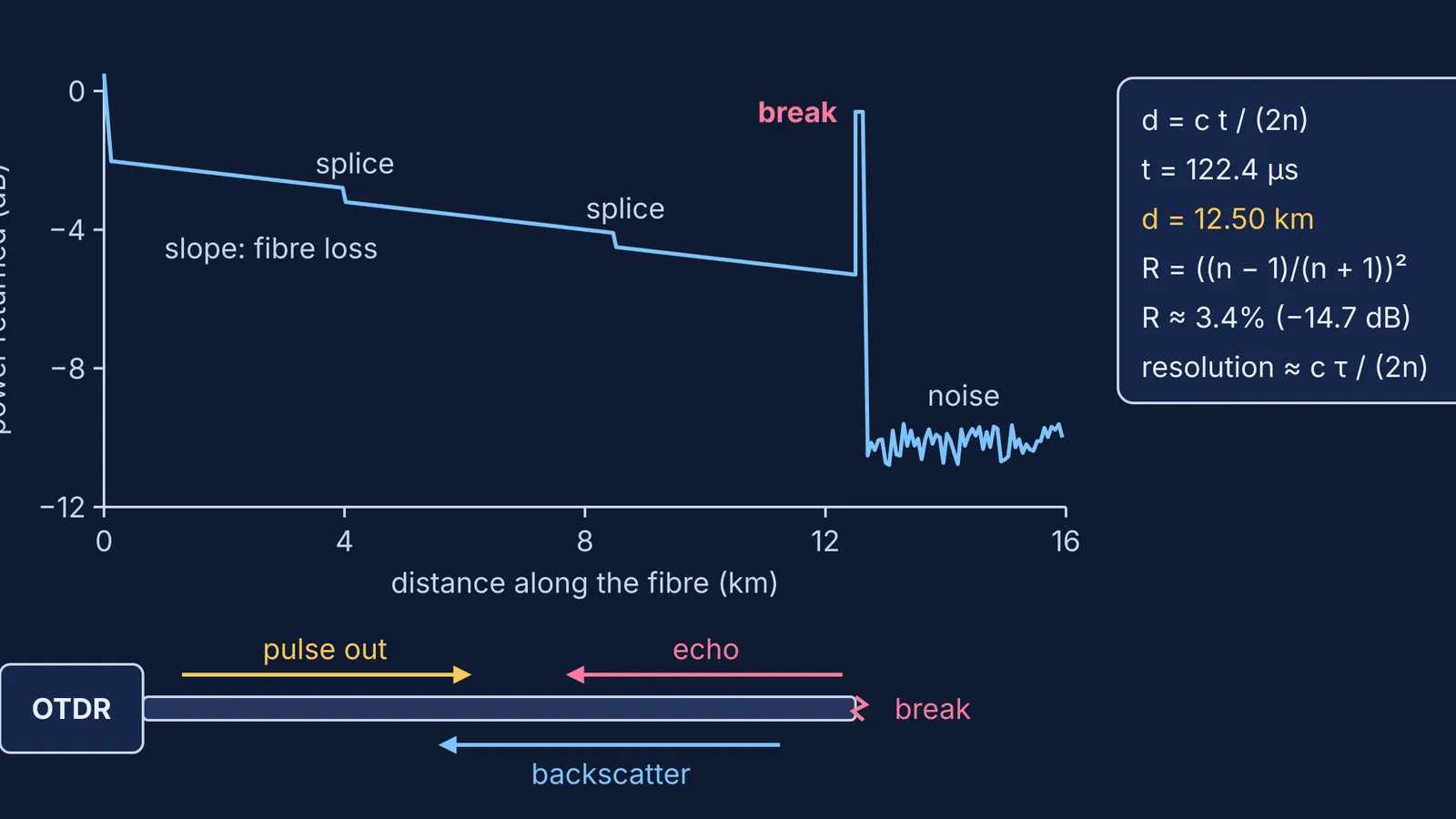
A digger cuts a buried fibre-optic cable along a rural road, and the villages beyond lose their internet. Nobody can see where it broke. A technician plugs an instrument into the cable at the exchange, sends in a short flash of light and waits for the echo. If the echo comes back 122.4 µs later, the break is 12.50 km down the fibre. The instrument is an OTDR, an optical time-domain reflectometer, and the physics behind it is the speed of light in glass and the reflection at a glass surface.
How long light takes along a fibre, and why rays on different paths spread out, is worked in the time taken by light through an optical fibre.
What does an OTDR actually measure?
An OTDR sends short pulses of laser light into one end of the fibre and records how much light comes back, and when. Two kinds of light return.
Rayleigh backscatter. Glass is not perfectly uniform. Tiny variations in density, much smaller than the wavelength, scatter a very small fraction of the light at every point along the fibre. Some travels back to the instrument, later and weaker from farther away, giving a record of the whole fibre.
Fresnel reflection. Wherever the refractive index changes suddenly, as at a connector or the glass-to-air face of a break, a larger burst of light bounces straight back. It shows as a sharp spike.
The instrument converts each arrival time into a distance and plots power against distance. That plot is called the trace. EXFO's guide to OTDR fundamentals describes both effects, and lists fibre breaks and open connectors among the events that give Fresnel spikes.
How does an echo time become a distance?
Light in the fibre travels at v = c/n, not at c. The pulse goes to the break and the echo comes back, so the light covers twice the distance. If the echo arrives after time t,
d = v t / 2 = c t / (2n)
The n here is the group index, the index that sets the speed of a pulse, not the 1.5 often used for glass in textbook problems. Corning's product sheet for its SMF-28 Ultra single-mode fibre gives an effective group index of 1.4682 at 1,550 nm.
Worked example: where is the break?
The echo from a clean break arrives 122.4 µs after the pulse. Use c = 2.998 × 10⁸ m/s and n = 1.4682.
Speed of light in the fibre: v = c/n = 2.998 × 10⁸ / 1.4682 = 2.042 × 10⁸ m/s.
Distance travelled by the light: v t = 2.042 × 10⁸ × 122.4 × 10⁻⁶ = 24,990 m.
Divide by 2 for the round trip: d = 12,500 m = 12.50 km.
Check the units: (m/s) × s = m. An echo at 50 µs gives 2.042 × 10⁸ × 50 × 10⁻⁶ / 2 = 5.10 km. Each microsecond of echo delay means about 102 m of fibre.
How much light does a clean break reflect?
For light hitting a flat surface head-on, the fraction reflected is
R = ((n₁ − n₂)/(n₁ + n₂))²
With glass on one side and air (n = 1) on the other, this becomes ((n − 1)/(n + 1))². This formula uses the ordinary refractive index of the core, about 1.45 for silica at 1,550 nm, not the group index. So R = (0.45/2.45)² = 0.034, or 3.4%. In decibels, 10 log₁₀(0.034) = −14.7 dB. This is the same reflection, about 4% from a glass surface, that the day-night car mirror uses for its dim night image.
That 3.4% is the ideal upper limit. It needs a perfectly flat face at exactly 90° to the fibre. A real break is rarely that neat. A crushed or angled break sends most of the reflected light out of the core, and the trace shows only a small spike or simply drops into noise. VIAVI's OTDR quick reference lists an open flat (UPC) connector at −14 to −20 dB, close to our figure, but a fibre break or cut at −30 to −48 dB. Angled (APC) connectors are polished at a slant for exactly this reason, so their reflections stay out of the core.
Why does the trace slope downwards?
The backscatter itself gets weaker with distance because the fibre absorbs and scatters light along its whole length. Corning's sheet lists a maximum attenuation of about 0.18 dB/km at 1,550 nm for bare fibre. Cabling and splices add a little, so take a round 0.2 dB/km. Light from the break has lost 0.2 × 12.5 = 2.5 dB on the way out and another 2.5 dB on the way back, 5.0 dB in all. The OTDR halves the round-trip loss and labels the trace in one-way dB, so the line falls by 2.5 dB over 12.5 km. A fusion splice shows as a small step down with no spike, because it changes the loss but not the refractive index.
How close can two faults be before the OTDR blurs them?
A pulse lasting τ fills a length of fibre. Light scattered from its front and back edges returns separated by τ, which corresponds to a distance of c τ/(2n). Two faults closer than this merge into one bump.
A 10 ns pulse: 2.998 × 10⁸ × 10 × 10⁻⁹ / (2 × 1.4682) = 1.0 m.
A 1 µs pulse: 102 m.
A 10 µs pulse: 1.02 km.
Short pulses see fine detail but carry little energy, so they cannot reach far. Long pulses reach far but blur nearby events. The EXFO guide calls this the trade-off between dynamic range and dead zone. Technicians start with a long pulse to find roughly where the trouble is, then use a short one to pinpoint it.
Is it safe to look at the fibre end?
No. Never look into a fibre end or a connector, even if it looks dark. Telecom lasers at 1,310 nm and 1,550 nm are infrared and invisible, so you get no warning glare, and the beam can damage the eye. The same goes for the open end at the break itself. Technicians check whether a fibre is live with a power meter, never by eye.
If you want to revise how light is trapped in the core in the first place, see the acceptance angle of an optical fibre. For more practice on refractive index and reflection, the Concept Library explains each idea from the start, and the Fermi Problem Library has a step-by-step solver that explains the reasoning.
Quick checklist
Distance to a fault: d = c t/(2n). Divide by 2 for the round trip.
Use the group index, about 1.468 for standard single-mode fibre at 1,550 nm.
A flat glass-air break reflects at most about 3.4%, or −14.7 dB. Real breaks often reflect far less.
The trace slope is fibre loss, shown one way, about 0.2 dB/km at 1,550 nm.
Pulse length τ sets the resolution, c τ/(2n): about 1 m for 10 ns, 102 m for 1 µs.
Fibre distance is longer than route distance. Never look into a fibre end.