On this page
The chapter Photosynthesis in Higher Plants falls under Unit 4, Plant Physiology, in the NEET (UG) 2026 syllabus. Every rule and exception below comes from NCERT Class 11 Biology, Chapter 11 (Reprint 2026-27), with its section number. All 12 questions are original.
Which rules in Photosynthesis in Higher Plants have NCERT exceptions?
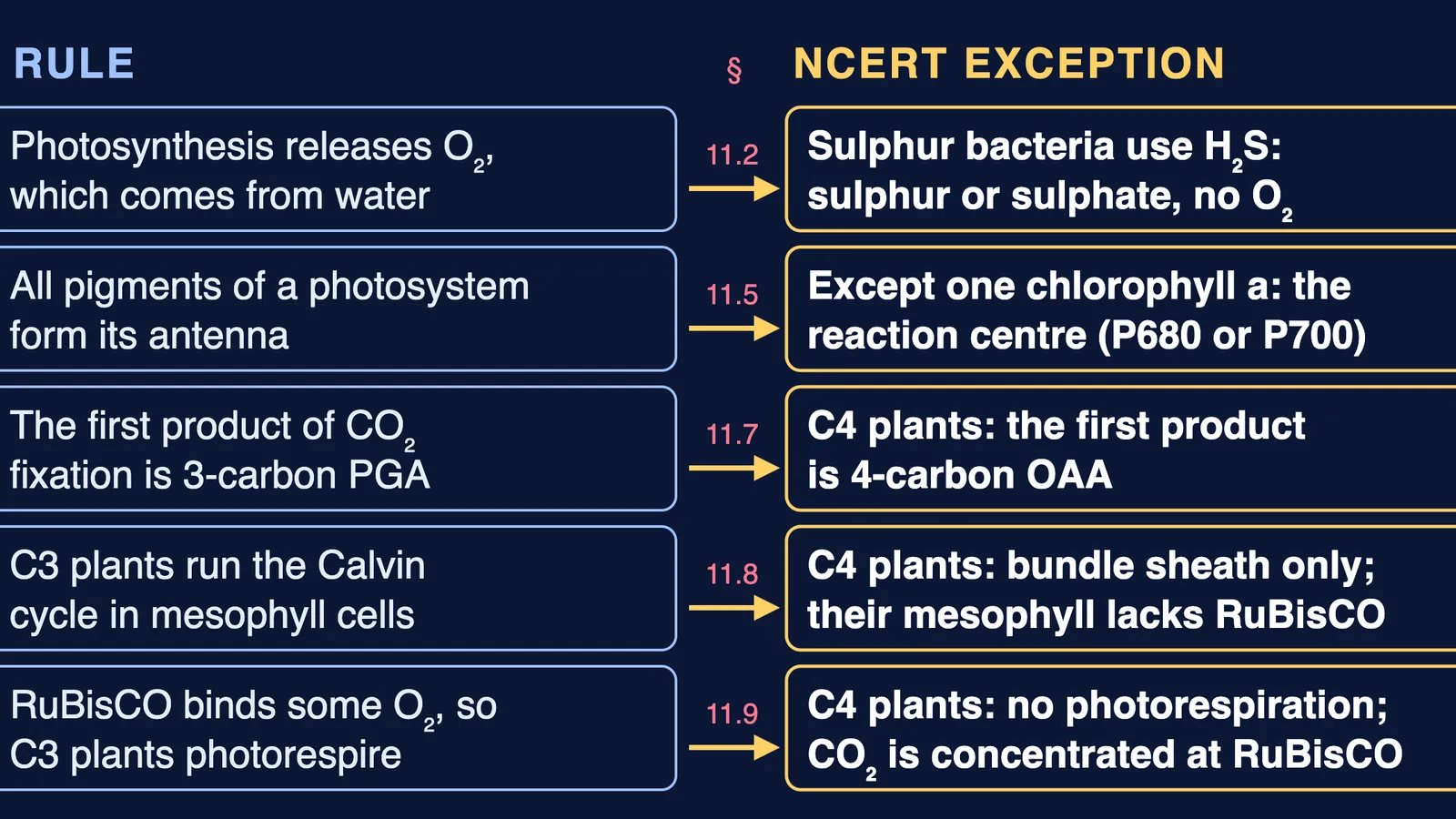
Rule: photosynthesis releases oxygen, which comes from water. Exception: purple and green sulphur bacteria take hydrogen from H2S, so the product is sulphur or sulphate, not O2 (11.2).
Rule: most photosynthesis happens in blue and red light, where chlorophyll a absorbs most. Exception: some occurs at other visible wavelengths, as accessory pigments pass absorbed energy to chlorophyll a (11.4).
Rule: a photosystem's pigments form its light-harvesting antenna. Exception: one chlorophyll a molecule, which is the reaction centre: P680 in PS II, P700 in PS I (11.5).
Rule: grana lamellae carry both photosystems and NADP reductase. Exception: stroma lamellae lack PS II and NADP reductase; they are the likely site of cyclic flow, which makes ATP but no NADPH (11.6.2).
Rule: chemiosmosis in chloroplasts works as in respiration. Exception: the one difference NCERT names: protons pile up inside the thylakoid lumen, not in an intermembrane space (11.6.3).
Rule: the first stable product of CO2 fixation is 3-carbon PGA. Exception: in C4 plants it is 4-carbon OAA (11.7).
Rule: the Calvin cycle runs in mesophyll cells, as in C3 plants. Exception: C4 mesophyll cells lack RuBisCO, so the cycle runs only in bundle sheath cells (11.8).
Rule: RuBisCO also binds O2, so C3 plants lose some fixation to photorespiration. Exception: C4 plants show none, because CO2 is concentrated at the enzyme (11.9).
Rule: light is rarely limiting in nature. Exception: plants in shade or in dense forests (11.10.1).
Rule: more CO2 raises the rate. Exception: in low light neither C3 nor C4 plants respond, and C4 plants saturate near 360 µL L⁻¹ (11.10.2).
How do you handle odd-one-out and exception questions?
First name the property the four items share. Then test each item on other properties too: location, carbon number, phase. If one item stands apart on every property you try, it is the answer. When the stem names the basis, judge on that alone. For "which is NOT an exception", find the option where the rule still holds.
Odd-one-out and NOT-an-exception questions
Q1. Odd one out by the hydrogen donor used in photosynthesis: (a) Mint (b) Tomato (c) Maize (d) Green sulphur bacteria
Answer: (d). Green plants use H2O; green sulphur bacteria use H2S (11.2).
Q2. Odd one out by the side of the thylakoid membrane it sits on or faces: (a) NADP reductase (b) Water-splitting complex (c) CF1 of ATP synthase (d) Primary electron acceptor
Answer: (b). It is on the inner (lumen) side; the other three are on the stroma side (11.6.1, 11.6.3).
Q3. (a) Light absorption (b) Water splitting (c) Oxygen release (d) Regeneration of RuBP
Answer: (d). The other three are light reactions; RuBP regeneration is a Calvin cycle stage (11.5, 11.7.2).
Q4. Inside the bundle sheath cells of a C4 leaf: (a) PEP carboxylase (b) RuBisCO (c) Calvin cycle (d) Release of CO2 from C4 acids
Answer: (a). Bundle sheath cells lack PEPcase; it works in the mesophyll (11.8).
Q5. Which of these is not an exception NCERT names? (a) Stroma lamellae lack PS II (b) C4 mesophyll cells lack RuBisCO (c) C4 plants use the Calvin cycle (d) Purple and green sulphur bacteria release no O2
Answer: (c). The Calvin pathway is common to all photosynthetic plants, so here the rule holds (11.7.2).
Q6. Rule: more of a factor speeds up photosynthesis. Which is NOT an exception? (a) Light beyond a point breaks down chlorophyll (b) CO2 above 0.05 per cent can harm over long periods (c) Extra CO2 in low light gives no gain (d) At low light, CO2 fixation rises linearly with light
Answer: (d). This follows the rule; the other three break it (11.10.1, 11.10.2).
Two-statement and single-correct questions
Key for Q7 to Q9: (A) I and II both true (B) neither true (C) I true, II false (D) I false, II true.
Q7. I: Most photosynthesis happens in blue and red light, yet some happens at other visible wavelengths. II: The action spectrum of photosynthesis overlaps the absorption spectrum of chlorophyll a exactly, one to one.
Answer: (C). Accessory pigments widen the usable wavelengths, so the overlap is not complete (11.4).
Q8. I: Unlike respiration, photosynthesis piles up protons inside the thylakoid lumen. II: The H carrier that takes electrons from the primary acceptor picks up its proton from the lumen.
Answer: (C). The H carrier removes its proton from the stroma (11.6.3).
Q9. I: Water stress opens stomata and raises CO2 supply. II: Water affects photosynthesis more through the plant than as a direct reactant.
Answer: (D). Water stress closes stomata and makes leaves wilt (11.10.4).
Q10. NCERT lists four needs for chemiosmosis. Which is not one of them? (a) A membrane (b) NADP reductase (c) A proton gradient (d) ATP synthase
Answer: (b). NCERT's four are ATP synthase, a proton gradient, a proton pump and a membrane (11.6.3).
Q11. Which crops does NCERT name for CO2-enriched greenhouses, and why does it work? (a) Maize and sorghum; they saturate early (b) Maize and sorghum; Kranz anatomy (c) Tomatoes and bell pepper; C3 plants keep responding to more CO2 (d) Tomatoes and bell pepper; they lack photorespiration
Answer: (c). Current CO2 levels limit C3 plants, which saturate only beyond 450 µL L⁻¹ (11.10.2).
Q12. When does NCERT say RuBisCO binds CO2 far more readily than O2? (a) When the CO2:O2 ratio is nearly equal (b) Only when O2 is absent (c) Only in darkness (d) Only in the mesophyll of C4 plants
Answer: (a). NCERT states this for a near-equal CO2:O2 ratio; binding is competitive (11.9).
What should you do after this set?
Cover each exception and recall it from its rule. Then practise with the statement and match-the-list set on photosynthesis and the Plant Physiology NEET practice questions, or revise with our full guide to Photosynthesis in Higher Plants.
Which exceptions keep slipping? Fermi's AI tutor works out what you already know and builds a plan for the session.