On this page
Kewda water and kewda attar come from the male flower spikes of the screw pine, Pandanus odoratissimus. In India the crop is grown mostly in Ganjam district in southern Odisha. A 2014 review in Advances in Pharmacological Sciences estimates about 30,000 to 40,000 trees there, and close to a million flower spikes a year going into kewda attar, water and oil. The molecule behind most of that scent is an ether: 2-phenylethyl methyl ether, C₆H₅CH₂CH₂OCH₃, often shortened to PEME. That makes it a good test for three NCERT ideas at once: Williamson synthesis, cleavage of ethers by HI, and the Lucas test.
What is in kewda oil?
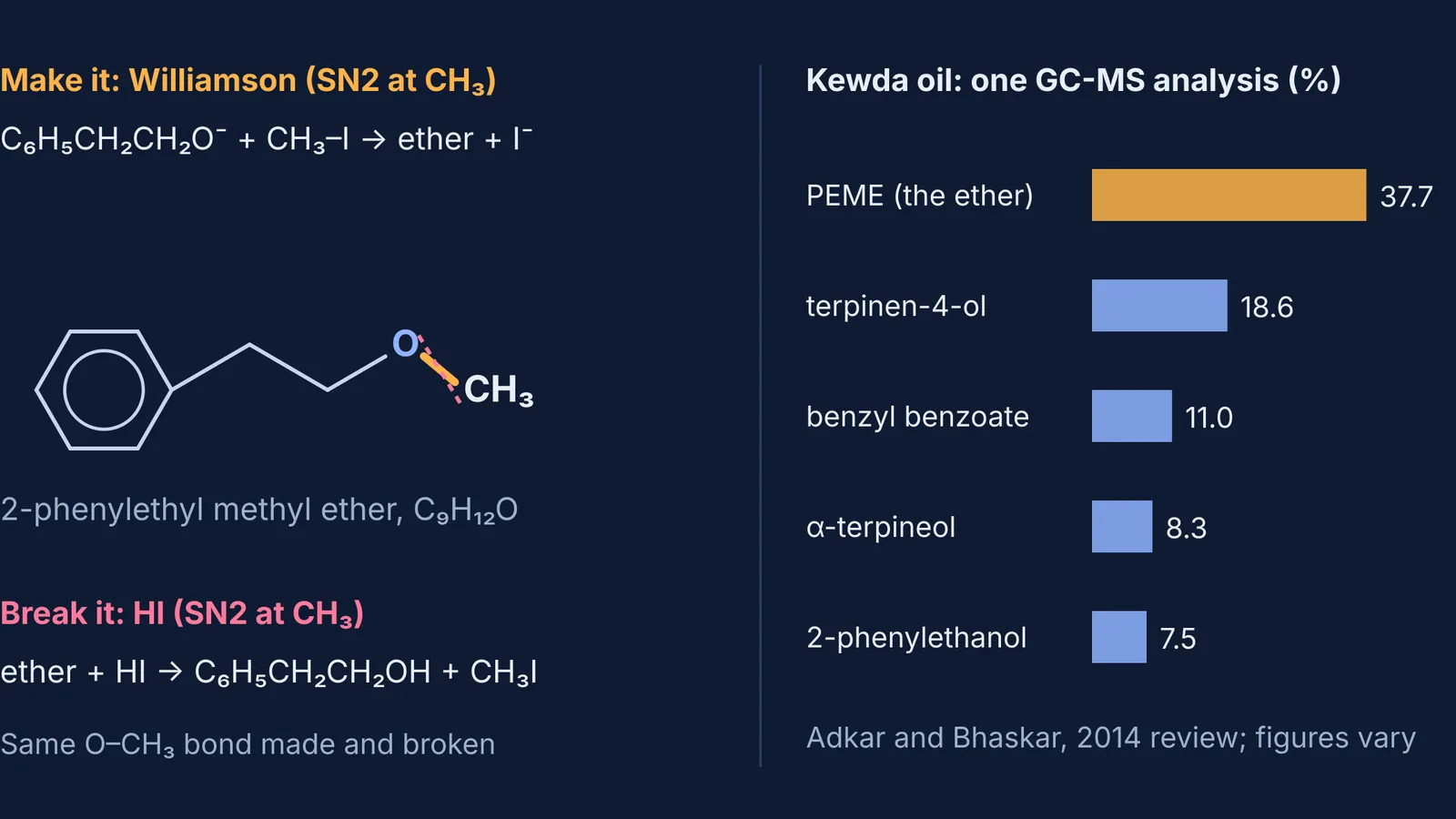
The review describes kewda oil as the product of hydrodistillation of the male (staminate) flower spikes. The flowering season is July to October, and a mature tree bears 30 to 40 spikes a year. The oil has more than sixty components. One GC-MS analysis quoted in the review gives:
2-phenylethyl methyl ether: 37.7%
terpinen-4-ol (the review spells it "terpene-4-ol"): 18.6%
benzyl benzoate: 11%
α-terpineol: 8.3%
2-phenylethanol (2-phenylethyl alcohol): 7.5%
Treat these as one analysis, not a fixed recipe. Composition depends on the flowers, the season and the distillation method, and other sources give quite different figures for the ether. The review's own list, with two more components, already adds up to slightly over 100%, so read every value as approximate.
How do you name 2-phenylethyl methyl ether?
Two groups sit on the oxygen: CH₃ and C₆H₅CH₂CH₂ (2-phenylethyl). The common name lists both groups and adds "ether": 2-phenylethyl methyl ether. For the IUPAC name, the larger group becomes the parent and the smaller one becomes an alkoxy substituent, as our post on the alkoxy-alkane rule for naming ethers explains. Here the parent is benzene carrying a 2-methoxyethyl group: (2-methoxyethyl)benzene.
Formula: C₉H₁₂O. Molar mass: 136.19 g/mol.
A quick isomer check: 2-phenylethanol, C₈H₁₀O, differs from PEME by one CH₂, but it is an alcohol, not an ether, so the two are not in the same homologous series. A real functional isomer of PEME is 3-phenylpropan-1-ol, C₆H₅CH₂CH₂CH₂OH, which is also C₉H₁₂O.
Which Williamson pair makes this ether?
Every unsymmetrical ether can be cut two ways on paper. For PEME:
Route A: sodium 2-phenylethoxide + iodomethane. C₆H₅CH₂CH₂O⁻Na⁺ + CH₃I → C₆H₅CH₂CH₂OCH₃ + NaI
Route B: sodium methoxide + 2-phenylethyl bromide. CH₃O⁻Na⁺ + C₆H₅CH₂CH₂Br → C₆H₅CH₂CH₂OCH₃ + NaBr
Both halides look harmless, because neither is secondary or tertiary. The difference is what else the alkoxide can do.
In Route A the halide is CH₃I. A methyl halide has no β-hydrogen, so elimination is impossible. The only reaction open to the alkoxide is SN2 at the least hindered carbon there is.
In Route B the halide has β-hydrogens on the carbon next to the ring. Methoxide is a strong base. Removing one of those hydrogens in an E2 step gives styrene, C₆H₅CH=CH₂, whose new C=C is conjugated with the benzene ring. That conjugation makes this elimination easier than for an ordinary primary halide, so some of your halide is lost as alkene:
CH₃O⁻ + C₆H₅CH₂CH₂Br → C₆H₅CH=CH₂ + CH₃OH + Br⁻
So choose Route A. The general method is in our guide to choosing the halide and alkoxide in Williamson synthesis. Make the alkoxide first with sodium: 2C₆H₅CH₂CH₂OH + 2Na → 2C₆H₅CH₂CH₂O⁻Na⁺ + H₂.
One honest limit: this is a textbook SN2 versus E2 argument. The PEME in kewda water is not made this way. It comes from the flowers by distillation.
What does HI do to 2-phenylethyl methyl ether?
With concentrated HI, the ether oxygen is protonated first. Then iodide attacks a carbon next to the oxygen. Neither group is aryl or tertiary, so the reaction is SN2, and iodide attacks the less hindered carbon: the methyl group.
C₆H₅CH₂CH₂OCH₃ + HI → C₆H₅CH₂CH₂OH + CH₃I
Atoms balance: C 9 = 8 + 1, H 13 = 10 + 3, O 1 = 1, I 1 = 1.
Watch one trap. The CH₂ attached to the oxygen is not benzylic; the benzylic CH₂ is the one next to the ring. So there is no stable carbocation on the oxygen side, and no reason to switch to SN1. With excess HI and heat, the 2-phenylethanol reacts further to 2-phenylethyl iodide and water. For the full three-question method, see our post on predicting the products of ether cleavage with HI.
Notice the symmetry. The methyl group arrives as CH₃I in Williamson synthesis and leaves as CH₃I in HI cleavage. The same O–CH₃ bond is made and broken, both times by SN2 at methyl.
Worked example: from the oil to the iodide
Question. Take 10.0 g of kewda oil with the composition above, and treat the GC-MS percentages as mass percentages. (a) How many moles of PEME and of terpinen-4-ol does it contain? (b) If only the PEME reacts with one equivalent of HI, what masses of CH₃I and 2-phenylethanol form?
Molar masses: PEME (C₉H₁₂O) 136.19, terpinen-4-ol (C₁₀H₁₈O) 154.25, CH₃I 141.94, 2-phenylethanol (C₈H₁₀O) 122.17 g/mol.
Mass of PEME: 10.0 × 0.377 = 3.77 g. Moles: 3.77 ÷ 136.19 = 0.0277 mol (27.7 mmol).
Mass of terpinen-4-ol: 10.0 × 0.186 = 1.86 g. Moles: 1.86 ÷ 154.25 = 0.0121 mol (12.1 mmol).
Mole ratio PEME : terpinen-4-ol = 27.7 ÷ 12.1 ≈ 2.3 : 1.
The equation is 1 : 1 : 1, so 0.0277 mol of each product forms.
CH₃I: 0.0277 × 141.94 ≈ 3.93 g. 2-phenylethanol: 0.0277 × 122.17 ≈ 3.38 g.
Per gram of pure PEME that is 1.042 g CH₃I and 0.897 g 2-phenylethanol. Check: 3.77 g PEME plus 0.0277 × 127.91 ≈ 3.54 g HI gives 7.31 g, equal to 3.93 + 3.38 g. In a real flask the terpinen-4-ol and α-terpineol would react with HI too, so this is a paper exercise.
Can the Lucas test tell the alcohols in kewda oil apart?
Partly. Terpinen-4-ol and α-terpineol are both C₁₀H₁₈O, and in both the OH sits on a carbon bonded to three other carbons, so both are tertiary alcohols. Both turn the Lucas reagent cloudy almost at once, so the test cannot separate them. 2-phenylethanol is primary, so it stays clear at room temperature. PEME is an ether with no OH, so the Lucas test does not apply to it. Our post on the Lucas test for primary, secondary and tertiary alcohols has the timings.
If you want more mixed sets of route-choice and cleavage questions for JEE Main and Advanced, Fermi Test Prep has JEE Main and Advanced preparation with an AI tutor. To check your reasoning on a single problem, the Fermi Problem Library has a step-by-step solver that explains the reasoning.
Quick checklist
PEME is C₆H₅CH₂CH₂OCH₃, C₉H₁₂O, 136.19 g/mol; IUPAC name (2-methoxyethyl)benzene.
Williamson: 2-phenylethoxide + CH₃I. The reverse pair risks E2 to styrene.
HI: SN2 at methyl gives CH₃I + 2-phenylethanol; excess HI goes on to the iodide.
Kewda oil figures vary; one analysis gives 37.7% PEME.
Terpinen-4-ol and α-terpineol are both 3° and look the same in the Lucas test.