

On this page
Ethers are organic compounds where an oxygen atom connects two alkyl or aryl groups. While common names like "dimethyl ether" are still used, the formal IUPAC system names these compounds as alkoxyalkanes.
In this substitutive nomenclature, you do not use an "ether" suffix. Instead, you treat the oxygen and the smaller carbon chain as a substituent attached to a longer parent carbon chain.
How to identify the parent alkane and alkoxy group?
The IUPAC rules for naming an ether follow a size-based priority system. The longest continuous carbon chain attached to the oxygen becomes the parent alkane, providing the root name of the molecule.
The shorter carbon chain, along with the oxygen atom, is treated as the substituent. To name it, you replace the "-yl" ending of the corresponding alkyl group with "-oxy".
For instance, a methyl group (CH₃) attached to oxygen becomes a methoxy group. An ethyl group (CH₂CH₃) becomes an ethoxy group.
If you are stuck on which chain is longer, or how functional groups are prioritized, the Fermi Concept Library holds a lesson for every concept in chemistry and its place in the map.
What are the steps for the IUPAC naming of ethers?
Naming an ether systematically requires four clear steps:
Find the parent chain. Identify the longest carbon chain attached to the oxygen. This determines the base name (e.g., ethane, propane).
Name the alkoxy substituent. Identify the shorter chain and the oxygen, and name it as an alkoxy group (e.g., methoxy).
Number the parent chain. Number the carbons of the parent chain starting from the end that gives the alkoxy group the lowest possible number (locant).
Combine the parts. Write the locant number, a hyphen, the alkoxy name, and the parent alkane name as one continuous word.
How does this work for methoxyethane and ethoxybenzene?
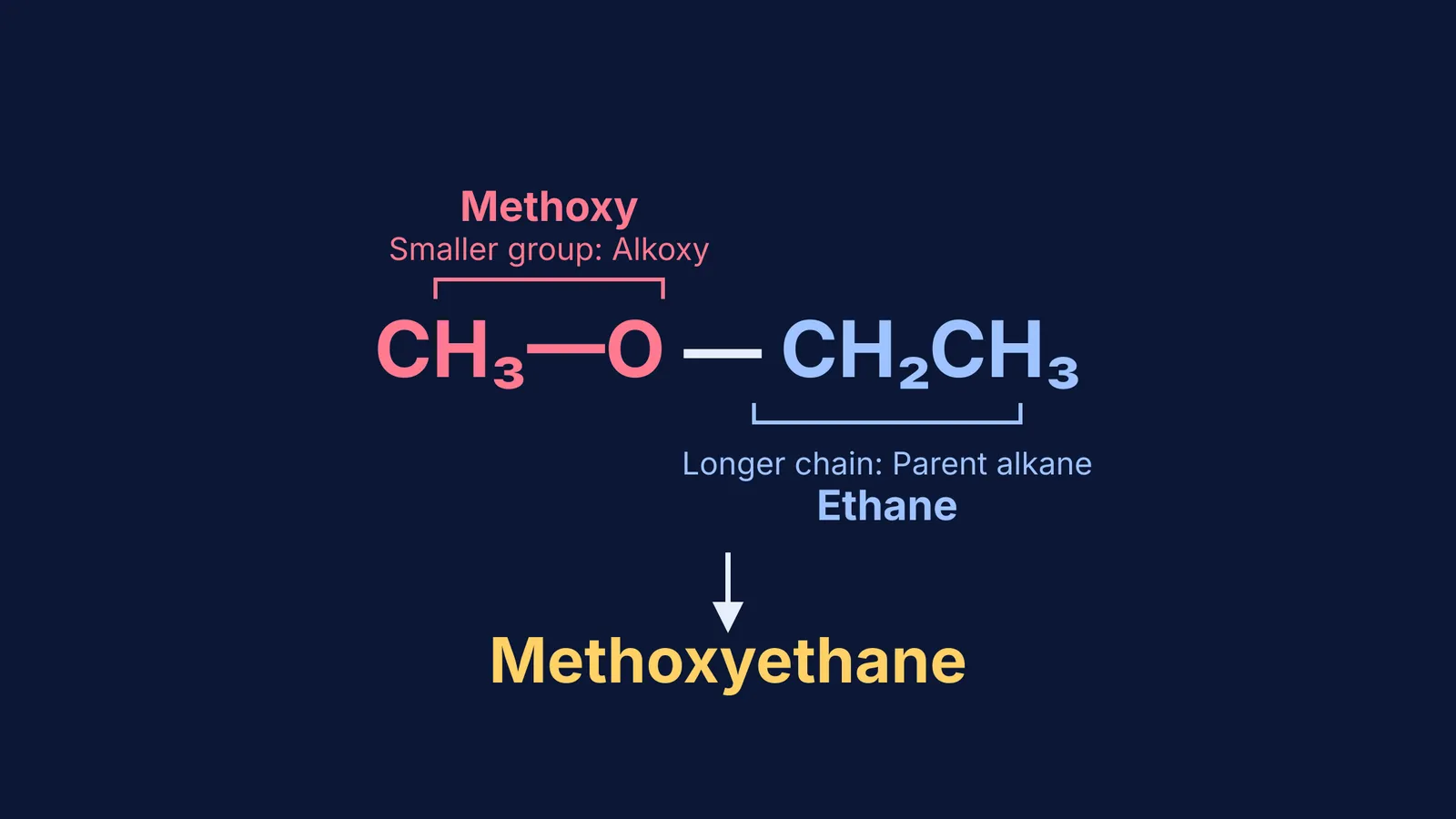
Consider the molecule CH₃—O—CH₂CH₃. The two groups attached to the oxygen are a one-carbon methyl group and a two-carbon ethyl group.
The longest chain has two carbons, making the parent alkane ethane.
The smaller group is methyl, so the substituent is methoxy.
Because the parent chain is only two carbons long, numbering is not strictly necessary (it will always be position 1), giving the IUPAC name methoxyethane.
If an ether contains a benzene ring, the rules still apply. In the molecule CH₃CH₂—O—C₆H₅, the oxygen connects an ethyl group and a phenyl ring.
The benzene ring has six carbons, making it the parent chain (benzene).
The two-carbon chain is smaller, making the substituent ethoxy.
The IUPAC name is ethoxybenzene (though its common name, phenetole, is also widely recognised).
If you want to practice more of these examples, the Fermi Problem Library has worked problems with a step-by-step solver that explains the reasoning rather than printing an answer.
What about symmetrical ethers?
When the two carbon chains on either side of the oxygen are identical, the ether is symmetrical. You still follow the alkoxyalkane rule.
For CH₃CH₂—O—CH₂CH₃, both chains are two carbons long. You pick one to be the parent (ethane) and the other to be the substituent (ethoxy). The IUPAC name is ethoxyethane.
In older or common nomenclature, symmetrical ethers are often named using the prefix "di-", such as diethyl ether, but ethoxyethane is the preferred IUPAC name.
If you are learning to name compounds for board exams or competitive tests, reviewing how basic prefixes work can help. See Naming carbon compounds in Class 10: prefixes, suffixes, examples for a foundation, or test your skills by exploring C4H10O isomers: telling the four alcohols and three ethers apart.


