

On this page
Photosynthesis in Higher Plants sits in Unit 4, Plant Physiology, of the NMC's updated NEET (UG)-2026 syllabus. The NEET (UG)-2026 information bulletin gives Biology 90 of the 180 questions, and each right answer earns +4 while each wrong one costs −1.
These 14 questions are our own, not predictions. Every answer rests on NCERT Class 11 Biology, Chapter 11 (Reprint 2026-27). To revise the chapter first, use our step-by-step guide to Photosynthesis in Higher Plants.
How do you solve Statement I and Statement II questions?
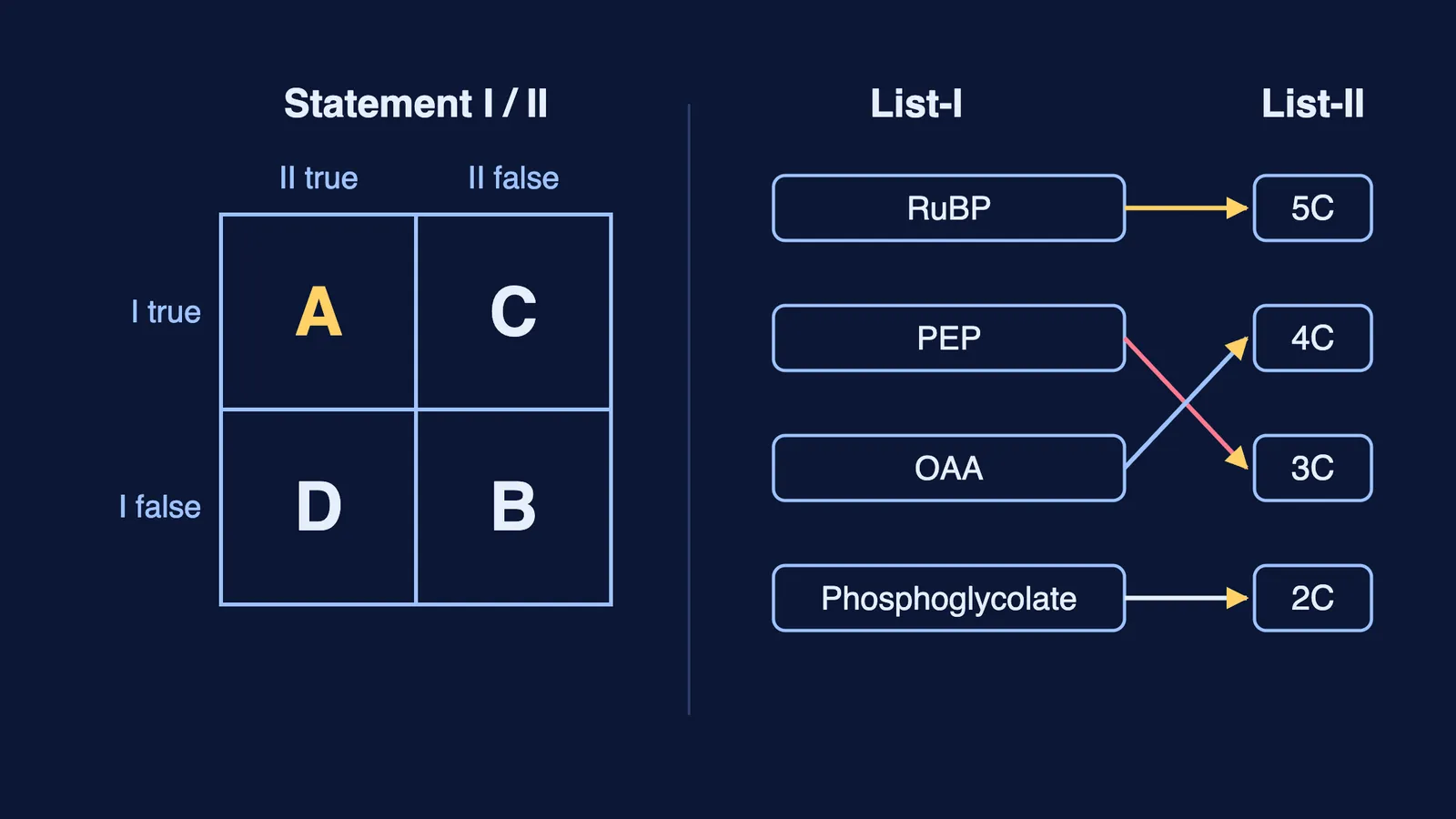
Judge each statement alone, then read the key off the grid in the diagram. Traps often swap one word.
Key for Q1 to Q6: (A) Both statements correct. (B) Both incorrect. (C) Only Statement I correct. (D) Only Statement II correct.
Q1. Statement I: Photosynthesis takes place only in the leaves of a plant. Statement II: In the chloroplast, enzymatic reactions in the stroma synthesise sugar.
Answer: (D). Other green parts photosynthesise too; sugar is made in the stroma.
Q2. Statement I: Stroma lamellae lack PS II and NADP reductase. Statement II: Electron flow there can make ATP but not NADPH.
Answer: (A). With only PS I working, electrons cycle back to PS I, so the flow yields ATP alone.
Q3. Statement I: NCERT states that the biological function of photorespiration is not yet known. Statement II: In C4 plants, CO2 released in bundle sheath cells makes RuBisCO act mainly as a carboxylase.
Answer: (A). The raised CO2 level at the enzyme minimises its oxygenase activity.
Q4. Statement I: Bundle sheath cells in Kranz anatomy have thick walls that block gas exchange and no intercellular spaces. Statement II: These cells contain very few chloroplasts.
Answer: (C). NCERT says they have a large number of chloroplasts.
Q5. Statement I: Calvin used radioactive 14C in algae and found a 3-carbon acid as the first fixation product. Statement II: Researchers first expected a 5-carbon CO2 acceptor and later found a 2-carbon one.
Answer: (C). They sought a 2-carbon acceptor for years, then found 5-carbon RuBP.
Q6. Statement I: Tropical plants have a lower temperature optimum for photosynthesis than temperate plants. Statement II: Light reactions are more sensitive to temperature than the dark reactions.
Answer: (B). Tropical plants have the higher optimum, and the enzymatic dark reactions are more temperature-sensitive.
How should you approach photosynthesis match-the-list questions?
Q7. Match the pigment with its colour on a paper chromatogram.
List-I: A. Chlorophyll a B. Chlorophyll b C. Xanthophylls D. Carotenoids List-II: (i) Yellow (ii) Yellow green (iii) Yellow to yellow-orange (iv) Bright or blue green
(A) A-iv, B-ii, C-i, D-iii (B) A-ii, B-iv, C-iii, D-i (C) A-iv, B-i, C-ii, D-iii (D) A-ii, B-iv, C-i, D-iii
Answer: (A). These are NCERT's four chromatogram bands.
Q8. Match the scientist with the finding.
List-I: A. Priestley B. Ingenhousz C. Julius von Sachs D. Engelmann List-II: (i) Glucose is made in green parts and stored as starch (ii) First action spectrum, using Cladophora and aerobic bacteria (iii) Plants restore air spoiled by candles and animals (iv) Sunlight is needed; green parts release oxygen bubbles
(A) A-iv, B-iii, C-i, D-ii (B) A-iii, B-iv, C-i, D-ii (C) A-iii, B-iv, C-ii, D-i (D) A-i, B-iv, C-iii, D-ii
Answer: (B). Priestley-(iii) removes (A) and (D); Engelmann's prism work fixes D-ii.
Q9. Match the chloroplast region with what happens there.
List-I: A. Thylakoid lumen B. Stroma lamellae C. Grana lamellae D. Stroma List-II: (i) Contain both PS I and PS II (ii) Enzymatic reactions make sugar (iii) Protons accumulate (iv) Likely site of cyclic flow
(A) A-iii, B-i, C-iv, D-ii (B) A-ii, B-iv, C-i, D-iii (C) A-iii, B-iv, C-i, D-ii (D) A-iv, B-iii, C-ii, D-i
Answer: (C). Protons from water splitting gather in the lumen.
Q10. Match the enzyme with its feature.
List-I: A. RuBisCO B. PEPcase C. NADP reductase D. ATP synthase List-II: (i) Sits on the stroma side of the membrane (ii) Its CF0 part forms a proton channel (iii) Active site binds both CO2 and O2 (iv) Fixes CO2 in C4 mesophyll cells
(A) A-iii, B-iv, C-i, D-ii (B) A-iv, B-iii, C-i, D-ii (C) A-iii, B-iv, C-ii, D-i (D) A-i, B-iv, C-iii, D-ii
Answer: (A). RuBisCO's dual binding gives it its name; PEPcase fixes CO2 in C4 mesophyll cells.
Q11. Match the factor with its point in NCERT Chapter 11.
List-I: A. Light B. CO2 C. Temperature D. Water List-II: (i) Effect is mostly indirect, through stomata and wilting (ii) Linear link with fixation rate at low intensity (iii) Dark reactions, being enzymatic, respond most (iv) Major limiting factor, at 0.03 to 0.04 per cent in air
(A) A-iv, B-ii, C-iii, D-i (B) A-ii, B-iv, C-i, D-iii (C) A-ii, B-iii, C-iv, D-i (D) A-ii, B-iv, C-iii, D-i
Answer: (D). NCERT calls CO2 the major limiting factor; water acts through the plant.
How do you handle single-correct questions in this chapter?
In "which are correct" items, mark each statement true or false first, then pick the option holding exactly that set.
Q12. A chloroplast fixes 42 CO2 molecules through the Calvin cycle. How much ATP and NADPH does it use?
(A) 84 ATP, 84 NADPH (B) 126 ATP, 84 NADPH (C) 84 ATP, 126 NADPH (D) 126 ATP, 126 NADPH
Answer: (B). Per CO2, the Calvin cycle uses 3 ATP and 2 NADPH, so 42 × 3 = 126 and 42 × 2 = 84 (enough for 7 glucose).
Q13. Which statements about C4 plants are correct? (i) They are adapted to dry tropical regions. (ii) They tolerate higher temperatures. (iii) They show high rates of photorespiration. (iv) They respond to high light intensities.
(A) (i), (ii) and (iv) only (B) (i) and (iii) only (C) (ii) and (iii) only (D) All four
Answer: (A). NCERT says C4 plants lack photorespiration.
Q14. Which is NOT one of NCERT's internal (plant) factors affecting photosynthesis?
(A) Orientation of leaves (B) Internal CO2 concentration (C) Amount of chlorophyll (D) Temperature
Answer: (D). NCERT lists temperature as an external factor.
What should you do after this set?
Note the format of every miss. For more mixed practice, try the Plant Physiology NEET practice questions. For cause-and-effect reasoning, work through our photosynthesis assertion-reason questions.
Unsure which photosynthesis topic needs work first? Fermi's AI tutor works out what you already know and builds a plan for the session.


