On this page
Photosynthesis in Higher Plants is Chapter 11 of NCERT Class 11 Biology and opens Unit IV, Plant Physiology. It follows our Cell Cycle and Cell Division Class 11 guide. This guide is for the CBSE school exam, not NEET.
How many marks is Photosynthesis in Higher Plants in Class 11?
The CBSE Class XI Biology curriculum for 2026-27 gives Unit IV, Plant Physiology, 12 marks out of 70 in the theory paper. The 12 are shared with Respiration in Plants and Plant Growth and Development; CBSE prints no figure for this chapter alone.
The curriculum lists every part of the chapter, with pigments at an elementary level. NCERT's list of rationalised content for Class XI cut two whole Plant Physiology chapters, Transport in Plants and Mineral Nutrition, but lists no cuts in photosynthesis.
What does the chapter cover, step by step?
Work from the current NCERT chapter (Reprint 2026-27). Our piece on the experiments from Priestley to Engelmann covers the history. Then, in order:
Site: thylakoid membranes trap light and make ATP and NADPH; the stroma makes sugar.
Pigments: chlorophyll a is the chief pigment; the accessory pigments pass energy to it and protect it from photo-oxidation.
Photosystems: PS I has reaction centre P700, PS II has P680, numbered by discovery, not working order.
Z scheme: electrons pass from PS II through cytochromes to PS I, then reduce NADP+ to NADPH + H+. Water splitting at PS II replaces them (2H2O gives 4H+, O2 and 4e−); see why the equation has 12 water molecules.
Photophosphorylation: in non-cyclic flow PS II and PS I work together to give ATP as well as NADPH; in cyclic flow only PS I is active, so only ATP forms.
Chemiosmosis: protons collect in the lumen and return to the stroma through CF0 of ATP synthase; CF1 makes ATP.
How do you count ATP and NADPH in the Calvin cycle?
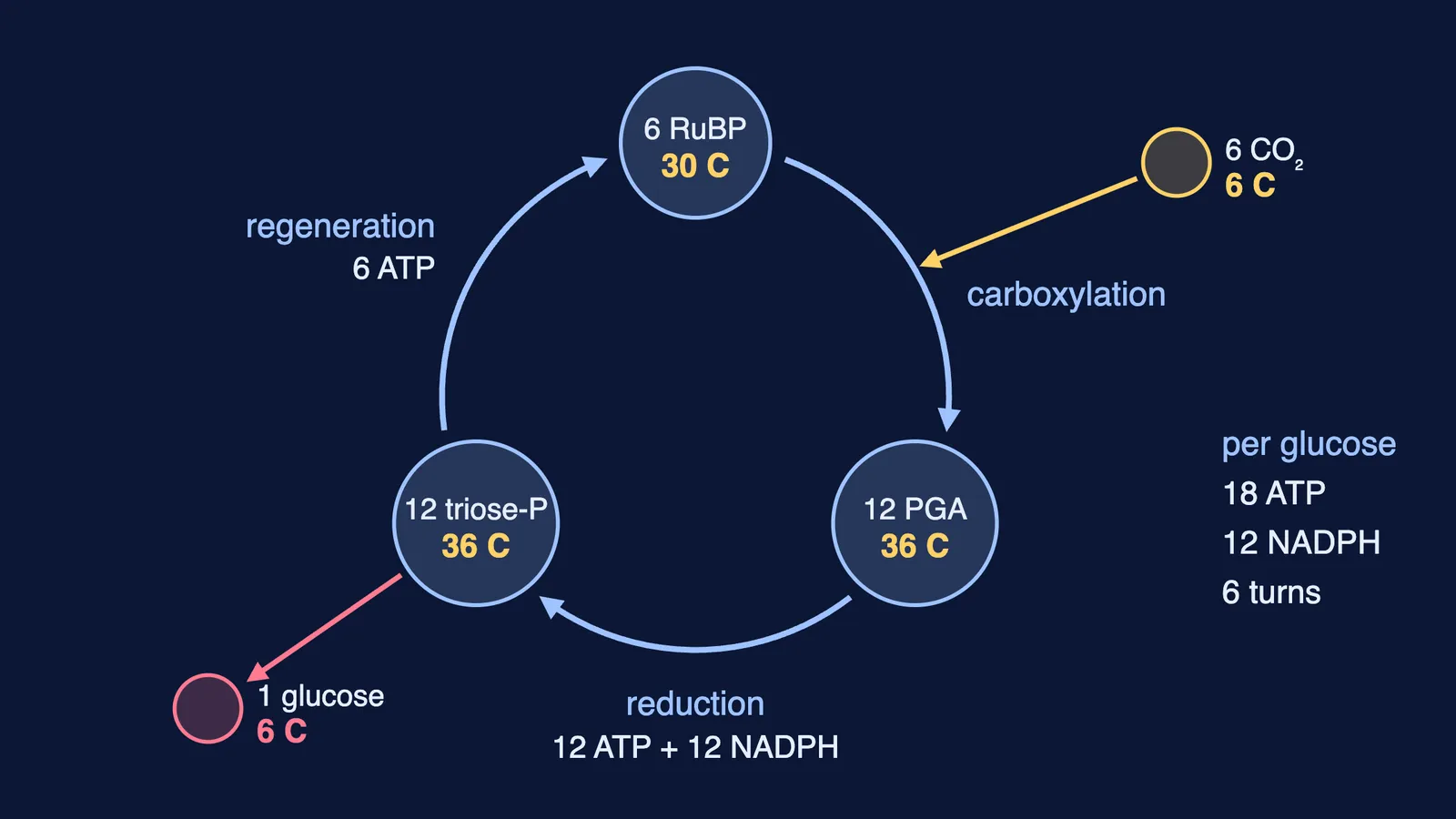
The NCERT chapter splits the cycle into carboxylation, reduction and regeneration. RuBisCO joins CO2 to 5-carbon RuBP, giving two 3-carbon PGA. Each CO2 fixed costs 3 ATP and 2 NADPH, and one glucose takes 6 turns: 18 ATP and 12 NADPH in all. The diagram above tracks the carbon: 30 C in six RuBP plus 6 C from CO2 gives 36 C in twelve PGA.
Worked example 1 (our numbers). A leaf fixes 30 CO2 molecules. Turns = 30. Glucose = 30 ÷ 6 = 5. ATP = 30 × 3 = 90. NADPH = 30 × 2 = 60.
Worked example 2. A chloroplast has 54 ATP and 40 NADPH. ATP allows 54 ÷ 18 = 3 glucose; NADPH allows 40 ÷ 12 = 3.33. ATP runs out first: 3 glucose, with 4 NADPH left. NCERT suggests cyclic photophosphorylation probably makes up this ATP gap.
C3 vs C4 plants and photorespiration: what is the difference?
In C3 plants the first product is 3-carbon PGA. In C4 plants such as maize and sorghum it is 4-carbon OAA, made in mesophyll cells when PEPcase fixes CO2 onto PEP. The C4 acid moves to the Kranz bundle sheath cells and releases CO2 for the Calvin cycle there.
RuBisCO also binds O2. In C3 plants this gives one PGA and one 2-carbon phosphoglycolate, uses ATP, releases CO2 and makes no sugar: photorespiration, per the NCERT text. C4 plants raise CO2 at RuBisCO, so they lack photorespiration, which NCERT links to their higher productivity.
Which factors affect photosynthesis?
Blackman's 1905 law of limiting factors says the factor nearest its minimal value sets the rate. From the NCERT chapter:
Light: the rate rises linearly at low intensity, and light saturation occurs at 10 per cent of full sunlight.
CO2: air holds 0.03 to 0.04 per cent; raising it up to 0.05 per cent can increase fixation. C4 plants saturate at about 360 µL L−1, but C3 plants saturate only beyond 450 µL L−1, so greenhouse tomatoes and bell pepper get extra CO2.
Temperature: the enzymatic dark reactions are more sensitive; C4 plants have a higher optimum.
Water: stress closes stomata and wilts leaves, an indirect effect.
Which questions should you practise?
Marks in brackets are our suggestion; the curriculum prints a paper design only for Class XII.
Why is PS II named second though it acts first? Give its reaction-centre wavelength. (2 marks)
A chloroplast fixes 24 CO2 molecules. Find the turns of the Calvin cycle, the glucose formed, and the ATP and NADPH used. (3 marks)
Assertion: the biosynthetic phase carries on briefly after the light is switched off, then stops. Reason: it needs ATP and NADPH from the light reaction. (1 mark)
List three events that build the proton gradient across the thylakoid membrane. (3 marks)
Trace a carbon atom from air to sugar in a maize leaf, naming cells and enzymes. (5 marks)
Why does a greenhouse grower gain more by adding CO2 for a C3 crop than a C4 crop? (2 marks)
Not sure where to start? Fermi's AI tutor works out what you already know, builds a plan for the session, and teaches through it.