On this page
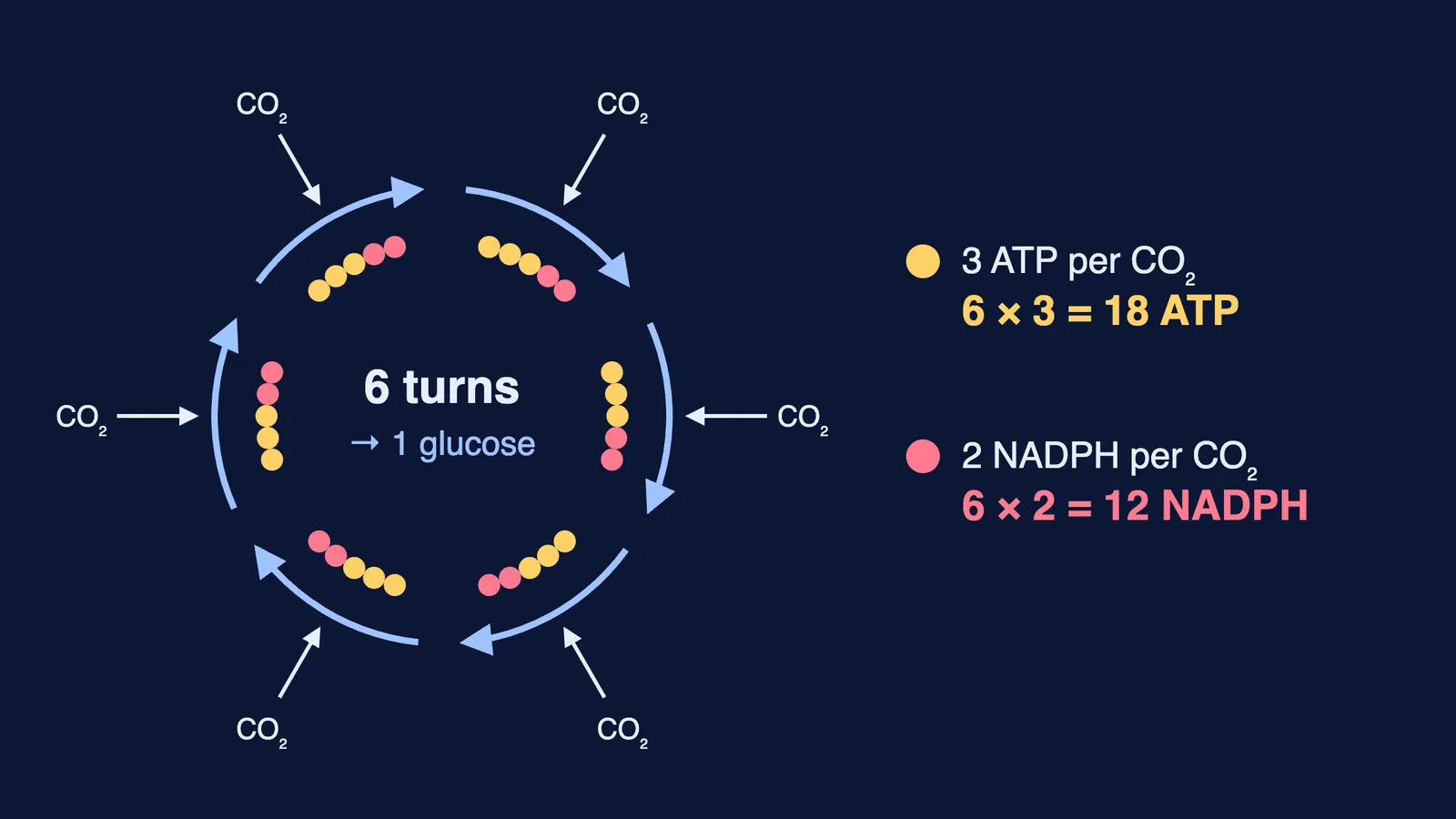
Every statement below follows the NCERT Class 11 Biology chapter Photosynthesis in Higher Plants (Reprint 2026-27), which is Chapter 11 of the CBSE 2026-27 Class XI Biology curriculum. The items are original practice. The diagram above shows the arithmetic behind Q4.
How do you answer assertion-reason questions on photosynthesis?
Judge A alone, then R alone. Only if both are true, read "A because R" and ask whether R is the cause NCERT gives. Most traps pair a true fact with the wrong effect. Our three-check method for assertion-reason questions explains more.
Assertion-reason keys:
(A) Both A and R are true and R is the correct explanation of A.
(B) Both A and R are true but R is NOT the correct explanation of A.
(C) A is true but R is false.
(D) A is false but R is true.
Statement I / Statement II keys:
(A) Both statements are correct.
(B) Both statements are incorrect.
(C) Statement I is correct, Statement II is incorrect.
(D) Statement I is incorrect, Statement II is correct.
Photosynthesis assertion-reason questions with answers
Numbers in Q4 to Q6 come from NCERT Chapter 11.
Q1 (easy). Assertion (A): When the light is switched off, the biosynthetic phase of photosynthesis carries on for a short while and then stops. Reason (R): The biosynthetic phase does not use light directly but depends on the ATP and NADPH made in the light reactions.
Answer: (A). Both are true. The reactions run until the stock of ATP and NADPH is used up, which is why they stop soon after.
Trap: reading "dark reaction" as "happens in the dark".
Q2 (easy). Assertion (A): Photosystem I gets its name because it is the first photosystem to act in the light reaction. Reason (R): The reaction centre of PS I is a chlorophyll a molecule with an absorption peak at 700 nm.
Answer: (D). A is false: the photosystems are named in order of discovery, and PS II acts first. R is true.
Trap: reading the numbers as the working order.
Q3 (medium). Assertion (A): Photorespiration does not occur in C4 plants. Reason (R): The bundle sheath cells of C4 plants are rich in PEP carboxylase.
Answer: (C). A is true. R is false: bundle sheath cells are rich in RuBisCO but lack PEPcase, which works in the mesophyll. A holds because CO2 released in the bundle sheath raises its concentration at RuBisCO.
Trap: putting PEPcase in the bundle sheath.
Q4 (medium). Assertion (A): Making one glucose molecule through the Calvin cycle uses 18 ATP and 12 NADPH. Reason (R): The CO2 acceptor of the Calvin cycle, RuBP, is a 5-carbon ketose sugar.
Answer: (B). Both are true. A follows from each CO2 fixed needing 3 ATP and 2 NADPH, over six turns per glucose (6 × 3 = 18, 6 × 2 = 12).
Trap: choosing (A) because both are about the Calvin cycle.
Q5 (hard). Assertion (A): At high light intensity, raising CO2 above about 360 µL L⁻¹ can still increase the rate of photosynthesis in a C3 plant but not in a C4 plant. Reason (R): C4 plants show CO2 saturation at about 360 µL L⁻¹, while C3 plants saturate only beyond 450 µL L⁻¹.
Answer: (A). Both are true, and the saturation points directly explain A.
Trap: ignoring "high light"; at low light neither group responds to extra CO2.
Q6 (hard). Assertion (A): Except for plants in shade or dense forests, light is rarely a limiting factor for photosynthesis in nature. Reason (R): Increasing incident light beyond a point breaks down chlorophyll and lowers photosynthesis.
Answer: (B). Both are true. The reason for A is that light saturation occurs at about 10 per cent of full sunlight.
Trap: linking any true light fact to A.
Statement I and Statement II questions on photosynthesis
Q7 (easy). Statement I: Accessory pigments let the plant use a wider range of wavelengths and also protect chlorophyll a from photo-oxidation. Statement II: The reaction centre of each photosystem is made of hundreds of pigment molecules bound to proteins.
Answer: (C). I is true. II is false: hundreds of pigments form the antenna; the reaction centre is a single chlorophyll a molecule.
Trap: mixing up the antenna and the reaction centre.
Q8 (medium). Statement I: Working on green plants, Cornelius van Niel showed that the O2 released in photosynthesis comes from CO2. Statement II: When purple and green sulphur bacteria use H2S as the hydrogen donor, the oxidation product is sulphur or sulphate, not O2.
Answer: (D). I is false twice: van Niel studied purple and green bacteria and inferred that the O2 comes from water. II is true.
Trap: remembering the name, not the organism.
Q9 (medium). Statement I: Water is split on the inner side of the thylakoid membrane, so the protons released accumulate in the lumen. Statement II: The CF0 part of ATP synthase is embedded in the thylakoid membrane and forms the channel through which protons diffuse back to the stroma.
Answer: (A). Both match NCERT: protons build up in the lumen, and their flow through CF0 makes CF1 synthesise ATP.
Trap: placing the proton build-up in the stroma.
Q10 (hard). Statement I: In photorespiration, RuBP combines with O2 to form two molecules of PGA, and some ATP is made. Statement II: The binding of CO2 and O2 to RuBisCO is non-competitive, so their relative concentration does not decide which one binds.
Answer: (B). I is false: RuBP plus O2 gives one phosphoglycerate and one 2-carbon phosphoglycolate, and the pathway uses ATP rather than making it. II is false: the binding is competitive.
Trap: check each statement separately.
How should you use this set?
Cover the answers and do all ten, writing a one-line reason for each key.
For each miss, rewrite the trap in your own words.
From memory, place PEPcase, RuBisCO, OAA and the Calvin cycle in mesophyll and bundle sheath columns.
If the Z scheme still feels like a list of words, the Fermi Concept Library covers every concept in physics, chemistry, biology, mathematics and computing, each with its own lesson and its place in the map.
For the whole chapter, read our Photosynthesis in Higher Plants Class 11 guide, and for longer practice, our photosynthesis case study questions for Class 11.