On this page
What do photosynthesis case-study questions test?
A case-study question asks graded questions on a short real-world passage. Photosynthesis in Higher Plants is Chapter 11 of NCERT Class 11 Biology (Reprint 2026-27), and the CBSE Class XI Biology curriculum for 2026-27 lists pigments, the photochemical and biosynthetic phases, chemiosmosis, photorespiration, C3 and C4 pathways and factors affecting photosynthesis. Class 11 exams are set by your school, so treat these as practice in the case-based style, not a prediction of any paper.
Our cases and numbers are original; every fact follows NCERT. For the chapter plan, read our Photosynthesis in Higher Plants Class 11 guide; for one-line reasoning drills, try the assertion-reason set on photosynthesis and respiration; for the general method, see how to handle case-based questions.
Case 1: Which colours of light make Hydrilla bubble?
Ananya, a Class 11 student in Pune, grinds spinach leaves and runs a paper chromatogram. She sees four bands: blue green, yellow green, yellow and yellow-orange. Next she places a sprig of Hydrilla in a beaker of water under three LED lamps of equal brightness, one at a time, and counts oxygen bubbles for 5 minutes each. Blue light (about 450 nm) gives 31 bubbles, green light (about 530 nm) gives 7 and red light (about 660 nm) gives 35. Then she tries a deep-red lamp emitting only near 710 nm. The sprig is lit, but no bubbles appear.
(i) The blue green band on her chromatogram is: (a) chlorophyll b (b) chlorophyll a (c) xanthophylls (d) carotenoids
(ii) Which pigment is the chief pigment of photosynthesis, and which two colours of light does it use most?
(iii) Green light gave 7 bubbles. Express this as a percentage of the red-light count, and explain why the count is not zero.
(iv) Why did the 710 nm lamp give no bubbles even though the sprig was lit?
Answers.
(i) (b). Chlorophyll b is yellow green, xanthophylls yellow, carotenoids yellow to yellow-orange.
(ii) Chlorophyll a. Its absorption peaks, and the highest rates of photosynthesis, fall in the blue and red regions.
(iii) 7 ÷ 35 × 100 = 20%. Accessory pigments (chlorophyll b, xanthophylls, carotenoids) absorb a wider range of wavelengths and pass the energy to chlorophyll a, so some photosynthesis happens at other wavelengths.
(iv) Light beyond 680 nm excites only PS I (P700), so electrons flow cyclically and only ATP is made. PS II (P680) is not excited, so no water is split and no oxygen is released.
Case 2: Where do the protons go inside a thylakoid?
A plant biology lab in Hyderabad isolates thylakoids from spinach chloroplasts and keeps them in a buffer. When the lamp is switched on, a pH-sensitive dye shows the lumen falling to pH 5 while the outside buffer, standing in for the stroma, stays near pH 8. The team estimates that, in one burst of light, the water-splitting complex in a patch of membrane splits 10 water molecules. In a second trial, a student adds a chemical that makes the thylakoid membrane leaky to H⁺ ions. ATP production stops.
(i) In the light, protons accumulate in: (a) the stroma (b) the lumen (c) the cytoplasm (d) the intermembrane space
(ii) For 10 water molecules split, how many O₂ molecules, H⁺ ions and electrons are released?
(iii) How many times more H⁺ ions per litre does the lumen hold than the stroma?
(iv) Using the parts of ATP synthase, explain why the leaky membrane stopped ATP production.
Answers.
(i) (b). The intermembrane space is the mitochondrial site, in respiration.
(ii) 2H₂O → 4H⁺ + O₂ + 4e⁻, so 10 H₂O give 5 O₂, 20 H⁺ and 20 electrons.
(iii) pH falls by 8 − 5 = 3 units, and each unit is a factor of 10, so 10³ = 1,000 times more H⁺.
(iv) ATP is made when protons flow back to the stroma through the CF₀ channel; the energy changes the shape of CF₁, which makes ATP. A leaky membrane lets protons escape without passing CF₀, so the gradient collapses and CF₁ makes no ATP.
Case 3: Should a greenhouse add CO₂ for tomato and maize?
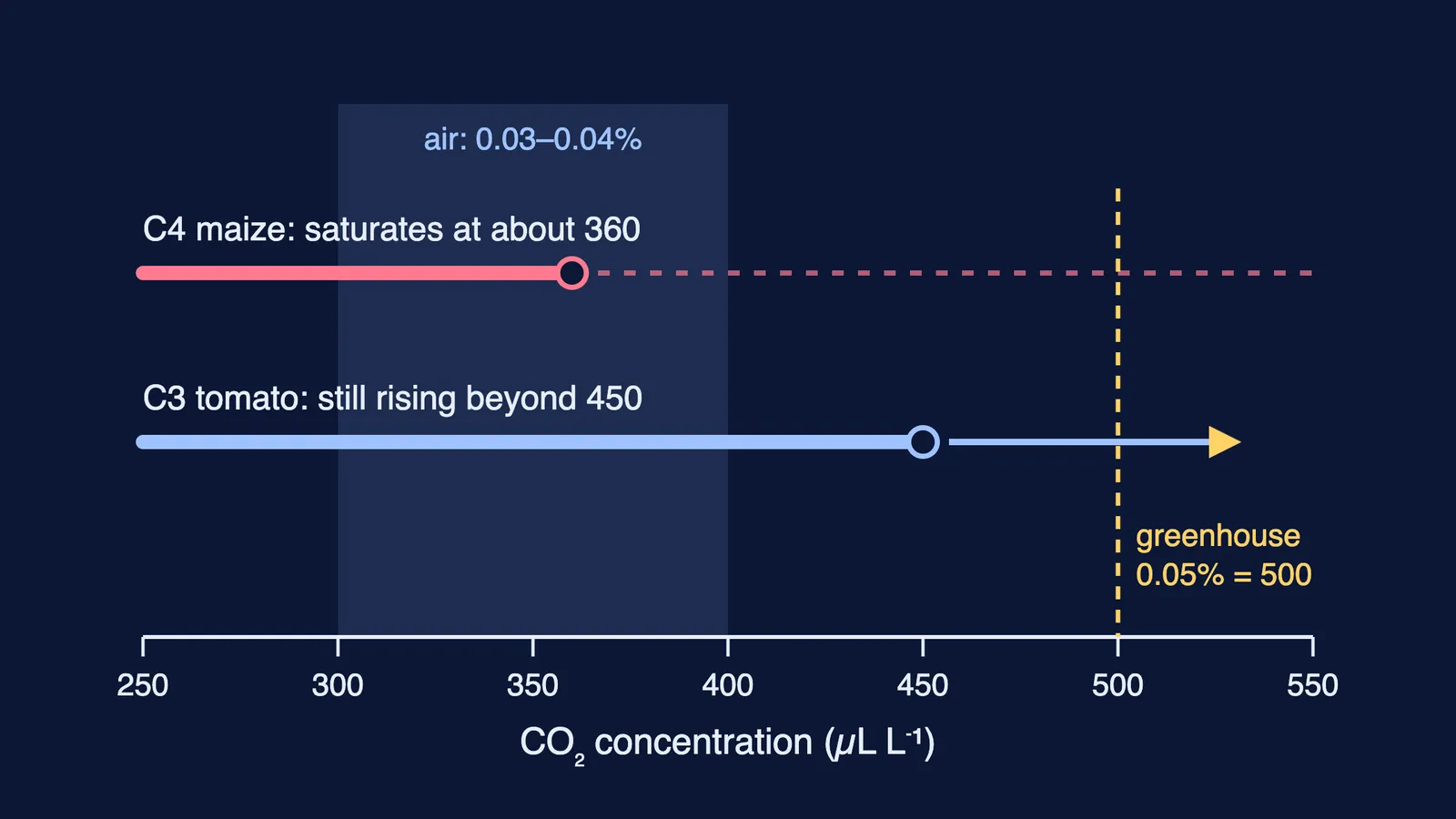
A farm near Nashik grows tomatoes in a greenhouse and maize in an open field. The greenhouse sensor reads 0.04% CO₂ on a bright morning. The manager plans to raise it to 0.05% and asks whether piping CO₂ over the maize would help too. During a cloudy week, the enriched greenhouse shows no gain in tomato growth. In May, on a hot, dry afternoon at about 40 °C, the tomato leaves partly close their stomata, while the maize keeps growing well.
(i) In maize leaves, the Calvin cycle runs in: (a) mesophyll cells only (b) bundle sheath cells only (c) both (d) neither
(ii) Convert 0.04% and 0.05% CO₂ to µL L⁻¹. Which crop gains from enrichment to 0.05%?
(iii) Why did extra CO₂ give no gain in the cloudy week?
(iv) Explain why tomato suffers more than maize on the hot, dry afternoon.
Answers.
(i) (b). Maize mesophyll cells fix CO₂ with PEPcase and lack RuBisCO.
(ii) 0.04% = 400 µL L⁻¹ and 0.05% = 500 µL L⁻¹. Maize, a C4 plant, saturates at about 360 µL L⁻¹, so it is already saturated. Tomato, a C3 plant, saturates only beyond 450 µL L⁻¹, so it gains.
(iii) By Blackman's law of limiting factors, the rate is set by the factor nearest its minimum. In low light, light limits the rate, and neither C3 nor C4 plants respond to high CO₂.
(iv) Water stress closes stomata and cuts CO₂ supply. In tomato, RuBisCO then binds more O₂, so photorespiration wastes fixed carbon, and C3 plants have a lower temperature optimum. Maize concentrates CO₂ in its Kranz bundle sheath cells, so it shows no photorespiration and tolerates higher temperatures.
How to attack case-study questions on photosynthesis
Underline every number and match it to an NCERT anchor: 680 and 700 nm, 360 and 450 µL L⁻¹, 0.03 to 0.04% CO₂.
Decide which photosystem works before you predict oxygen, ATP or NADPH.
For proton questions, state the side first: protons build up in the lumen and return through CF₀.
For C3 versus C4, name the cell type and enzyme.
When a factor changes and nothing happens, look for another limiting factor.
If the Z scheme still feels like a list of names, the Fermi Concept Library gives every concept in biology its own lesson and its place in the map.