

On this page
In 2022, the National Testing Agency (NTA) reintroduced Assertion-Reason questions to the NEET exam, causing a major pattern shift that caught candidates off guard. The CBSE Class 12 Biology sample paper for 2024–25 contains exactly 4 Assertion-Reason questions in Section A.
These questions give you two statements. You must decide if they are true, and if the second statement (the Reason) is the underlying biological cause of the first (the Assertion).
What are assertion reason photosynthesis and respiration traps?
The most common trap is Option B: both statements are factually true, but the Reason is not the correct explanation of the Assertion.
This happens frequently when comparing photosynthesis and respiration because they are closely linked metabolic processes. It is easy to assume that because two true facts relate to the same cycle, one must cause the other.
Consider this classic example:
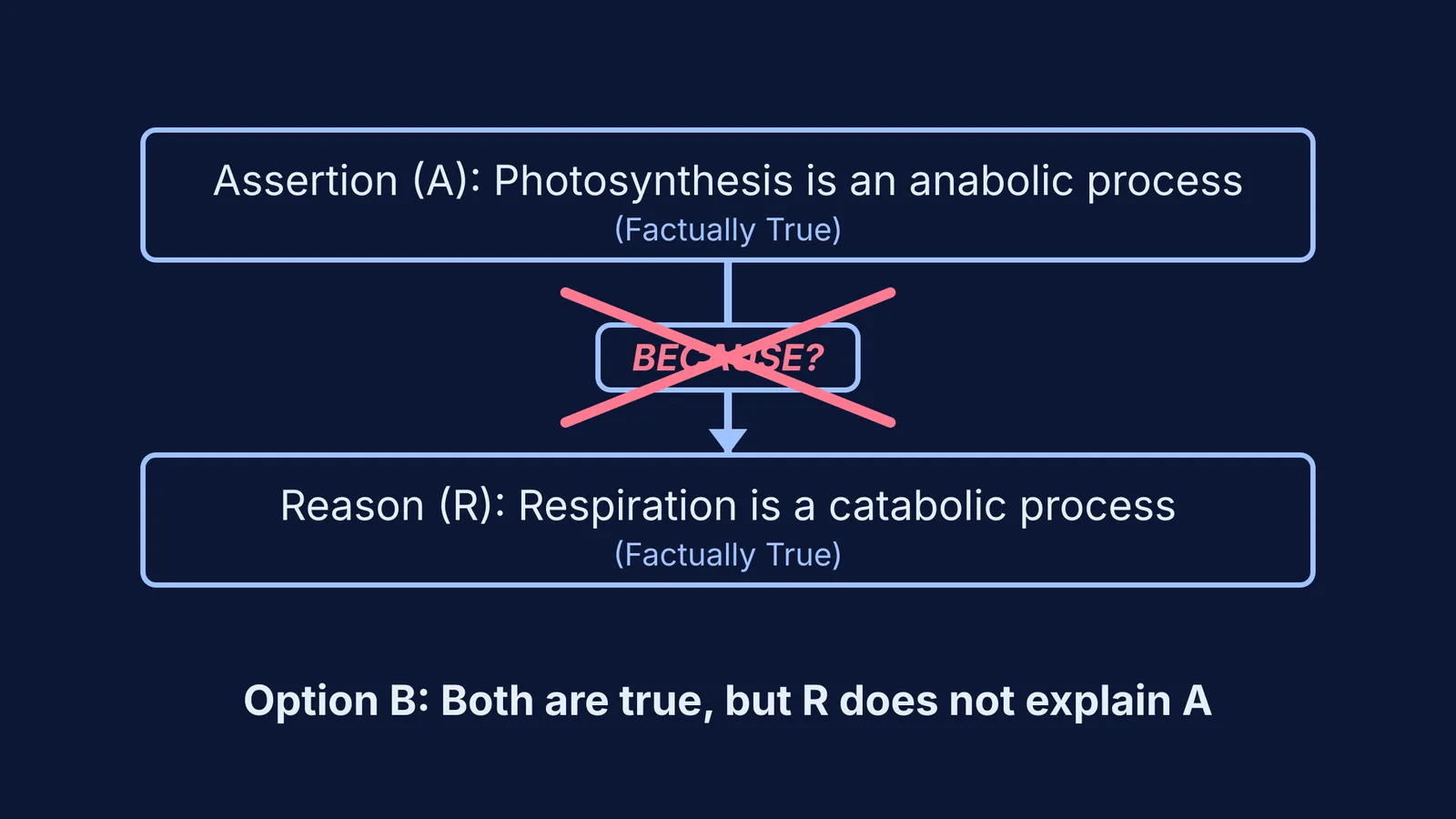
Assertion (A): Photosynthesis is an anabolic process. Reason (R): Respiration is a catabolic process.
Both statements are undeniably true. Photosynthesis builds glucose molecules from simple inorganic substances, which defines anabolism. Respiration breaks down glucose to release energy, which defines catabolism.
However, the fact that respiration breaks things down is not the *cause* of photosynthesis building things up. They are independent definitions. The correct answer is Option B.
If you are unsure of the fundamental definitions of these cycles, Fermi's AI tutor can work out what you already know and build a plan for the session to review plant metabolism.
How do you know if the reason is the correct explanation?
The most reliable framework for solving these is the "Because Test". It forces you to evaluate the logical link rather than just fact-checking.
Test the Assertion: Is it factually correct? If it is false, the answer is immediately Option D.
Test the Reason: Is it factually correct? If it is false, the answer is Option C.
Insert the word "because": If both are true, read them as a single sentence joined by the word "because".
Evaluate the logic: Does the combined sentence make biological sense? If yes, it is Option A. If no, it is Option B.
Applying the test to the previous example gives: "Photosynthesis is an anabolic process *because* respiration is a catabolic process." This sentence makes no sense. The correct explanation would be: "Photosynthesis is an anabolic process *because* it synthesises complex organic molecules from simple inorganic ones."
What is the chloroplast and mitochondria trap?
Another frequent Option B trap involves the cellular locations of these processes.
Assertion (A): In a plant cell, the products of the chloroplast are the reactants for the mitochondria. Reason (R): Mitochondria are the powerhouse of the cell where ATP is generated.
Both statements are true. The chloroplast produces glucose and oxygen, which the mitochondria then use. The mitochondria are indeed the powerhouse of the cell.
But applying the Because Test reveals the trap: "The products of the chloroplast are the reactants for the mitochondria *because* mitochondria are the powerhouse of the cell."
The fact that mitochondria make ATP does not explain why they specifically require the outputs of the chloroplast. The true reason is the chemical linkage of the carbon cycle: respiration fundamentally relies on the oxidation of the carbohydrates produced by photosynthesis.
How does the ATP yield create a trap?
Another classic trap area is the energy yield and the role of ATP.
Assertion (A): Aerobic respiration yields significantly more ATP per glucose molecule than anaerobic respiration. Reason (R): Glycolysis is the first step of both aerobic and anaerobic respiration.
Both of these statements are biologically correct. Aerobic respiration produces a high yield of ATP, while anaerobic respiration produces a much lower yield. Glycolysis does indeed serve as the common initial pathway for both processes, breaking glucose down into pyruvate in the cytoplasm.
However, the Because Test fails again: "Aerobic respiration yields much more ATP *because* glycolysis is the first step of both."
The fact that they share a starting pathway is not the reason for the massive difference in energy yield. The true explanation for the higher ATP yield is that aerobic respiration involves the complete oxidation of glucose via the Krebs cycle and the electron transport chain, which requires oxygen as the final electron acceptor. Therefore, this is another Option B answer.
If you find these logical links difficult to spot, the Fermi Concept Library maps out every concept in physics, chemistry, biology, mathematics and computing, each with its own lesson and its place in the map.


