On this page
A small piston compressor in a garage fills its tank quickly at first, then more and more slowly as the tank pressure climbs. Part of the reason is obvious: the motor has to push harder. But there is a second, less obvious reason. The piston cannot push all the air out of the cylinder. The small pocket of squeezed air left behind expands again on every return stroke and takes up room that fresh air should fill. The higher the delivery pressure, the more room it takes.
The work needed to compress air, and why two stages with cooling between them save energy, is worked in why air compressors use two stages. This post is about something that post leaves out: how much air the compressor actually delivers.
What is the clearance volume in a compressor?
At the top of its stroke, the piston must not hit the cylinder head or the valves. So a small gap is left, called the clearance volume, V_c. The piston sweeps a volume V_s on each stroke. Their ratio is the clearance ratio
c = V_c / V_s
Engine cylinders have the same kind of gap; the Otto cycle post uses it to define the compression ratio. In a compressor the gap is kept as small as practical. We use c = 5% as an illustrative value.
Why does the trapped air reduce delivery?
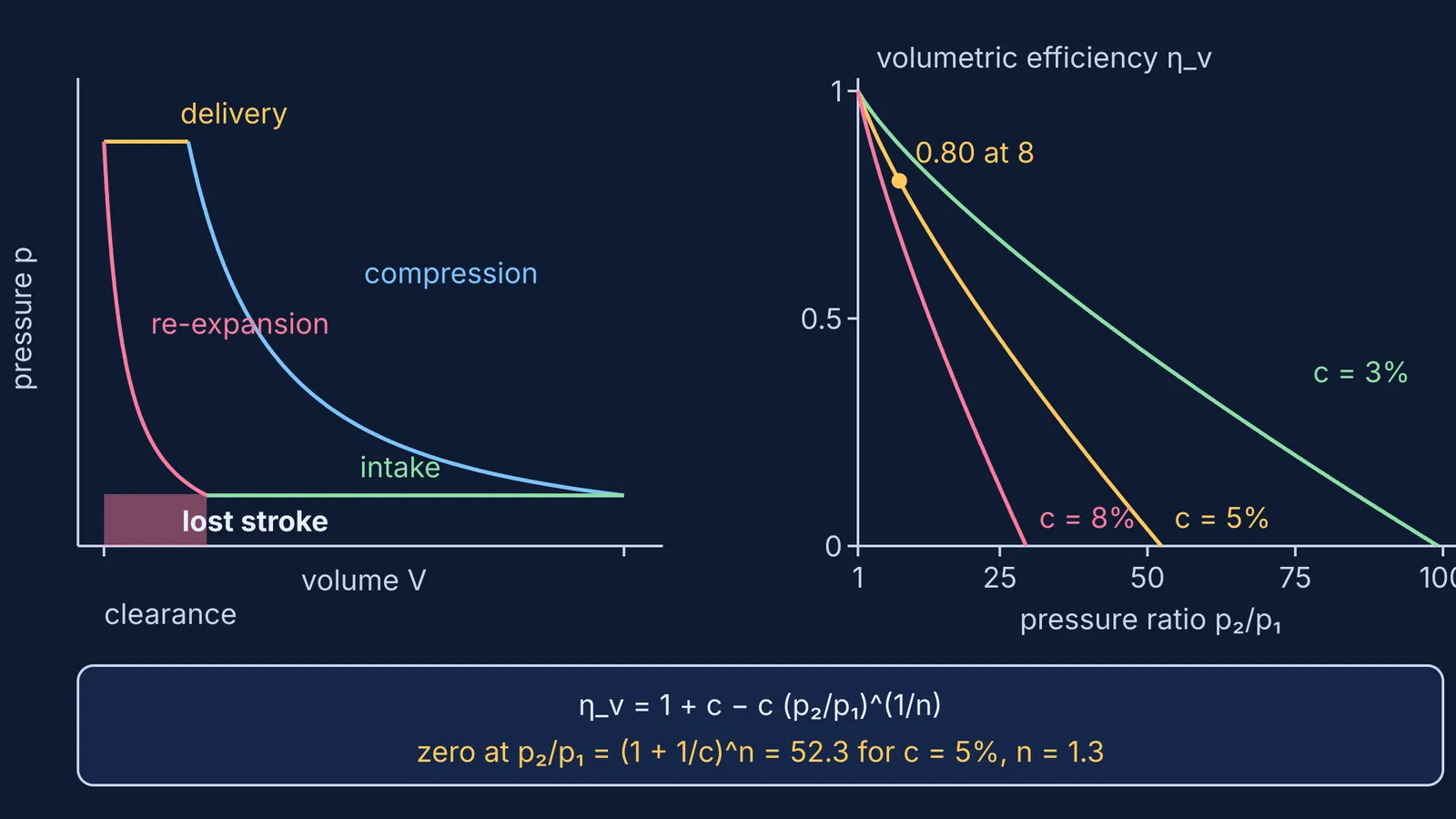
Follow one cycle on a p–V diagram, with intake pressure p₁ and delivery pressure p₂.
Compression. The cylinder holds V_s + V_c of air at p₁. The piston squeezes it until it reaches p₂.
Delivery. The delivery valve opens and the piston pushes air into the tank at constant p₂, until only V_c is left.
Re-expansion. The piston moves back. The intake valve cannot open while the cylinder pressure is above p₁, so first the trapped air in V_c expands from p₂ down to p₁.
Intake. Only after that does fresh air flow in, for the rest of the stroke.
The part of the stroke used for re-expansion draws in no air at all. That is the lost stroke shaded in the diagram above.
How do you calculate volumetric efficiency?
Treat the re-expansion as polytropic, pVⁿ = constant. The trapped air starts at V_c and p₂ and ends at p₁, so its volume becomes
V₄ = V_c (p₂/p₁)^(1/n)
Fresh air enters from V₄ to V_c + V_s, so the volume drawn in is V_c + V_s − V₄. Dividing by V_s gives the clearance volumetric efficiency
η_v = 1 + c − c (p₂/p₁)^(1/n)
This is the result derived in IIT Kharagpur's NPTEL lecture on reciprocating compressors (equation 18.22). If the polytropic process itself is new to you, polytropic processes for JEE covers pVⁿ = constant and its work.
For air, n lies between 1 (isothermal) and 1.4 (adiabatic). Real re-expansion is fast but the cylinder walls exchange some heat, so we take n = 1.3 as an illustrative value.
Worked example: a workshop compressor
A compressor has c = 0.05, n = 1.3, a swept volume of 200 cm³ and makes 1,000 strokes a minute. It draws air at 1 bar. Find the air delivered at a pressure ratio of 8, that is 8 bar absolute (about 7 bar on the gauge).
1/n = 1/1.3 = 0.769.
8^0.769 = 4.95.
η_v = 1 + 0.05 − 0.05 × 4.95 = 1.05 − 0.248 = 0.80.
Swept volume per minute: 200 cm³ × 1,000 = 200 L.
Free air delivered: 0.80 × 200 L = 160 L per minute.
"Free air" means volume measured at intake conditions, 1 bar and room temperature, not at tank pressure. At 8 bar absolute those 160 L of free air squeeze into about 20 L once cooled to room temperature.
The same machine at other pressure ratios:
Ratio 4: η_v = 0.90.
Ratio 8: η_v = 0.80.
Ratio 12: η_v = 0.71.
Ratio 20: η_v = 0.55.
At what pressure ratio does a compressor deliver nothing?
As p₂/p₁ rises, the trapped air re-expands further. At some ratio it fills the whole cylinder by the end of the return stroke, and no fresh air enters at all. Set η_v = 0:
c (p₂/p₁)^(1/n) = 1 + c, so p₂/p₁ = (1 + 1/c)ⁿ
For c = 0.05 and n = 1.3: (1 + 20)^1.3 = 21^1.3 = 52.3. The NPTEL lecture calls this the limiting pressure ratio (equation 18.23). With c = 3% it is 99; with c = 8% it is only 29.5. The compressor still runs and the air still heats up, but none is delivered.
Why does splitting the compression into two stages help delivery too?
Suppose the overall ratio of 8 is split into two stages of √8 = 2.83 each. For the first stage, η_v = 1 + 0.05 − 0.05 × 2.83^0.769 = 0.94, compared with 0.80 for a single stage. The low-pressure cylinder now draws in 94% of its swept volume, so more air enters the machine for the same cylinder size. This is a second reason, besides the intercooling saving, why high-pressure compressors use two or more stages.
Does the formula give the real delivery?
No, it gives an upper limit. The formula counts only the clearance effect. Real compressors deliver less because of pressure drop across the valves, heating of the incoming air by the hot cylinder, and leaks past the piston rings and valves.
A safety note. Compressed-air equipment is for trained staff only. The tank pressure is set by the maker's safety valve, not by the user. Never adjust or block that valve, and never point an air line at anyone.
To practise problems like this one, the Fermi Problem Library has a step-by-step solver that explains the reasoning. If you are preparing for JEE, Fermi Test Prep offers personalised preparation for JEE Main & Advanced with an AI tutor, live classes, adaptive mocks, mentorship and a study plan that updates based on mastery.
Quick checklist
Clearance ratio c = V_c/V_s. The trapped air re-expands before any intake.
η_v = 1 + c − c (p₂/p₁)^(1/n). It equals 1 when p₂ = p₁.
With c = 5%, n = 1.3, a ratio of 8 gives η_v = 0.80: 160 L of free air a minute from 200 L swept.
Delivery stops at p₂/p₁ = (1 + 1/c)ⁿ, which is 52.3 here.
Two stages raise each stage's η_v; at √8 each it is 0.94.
Free air is measured at intake conditions, and real delivery is lower than η_v predicts.